
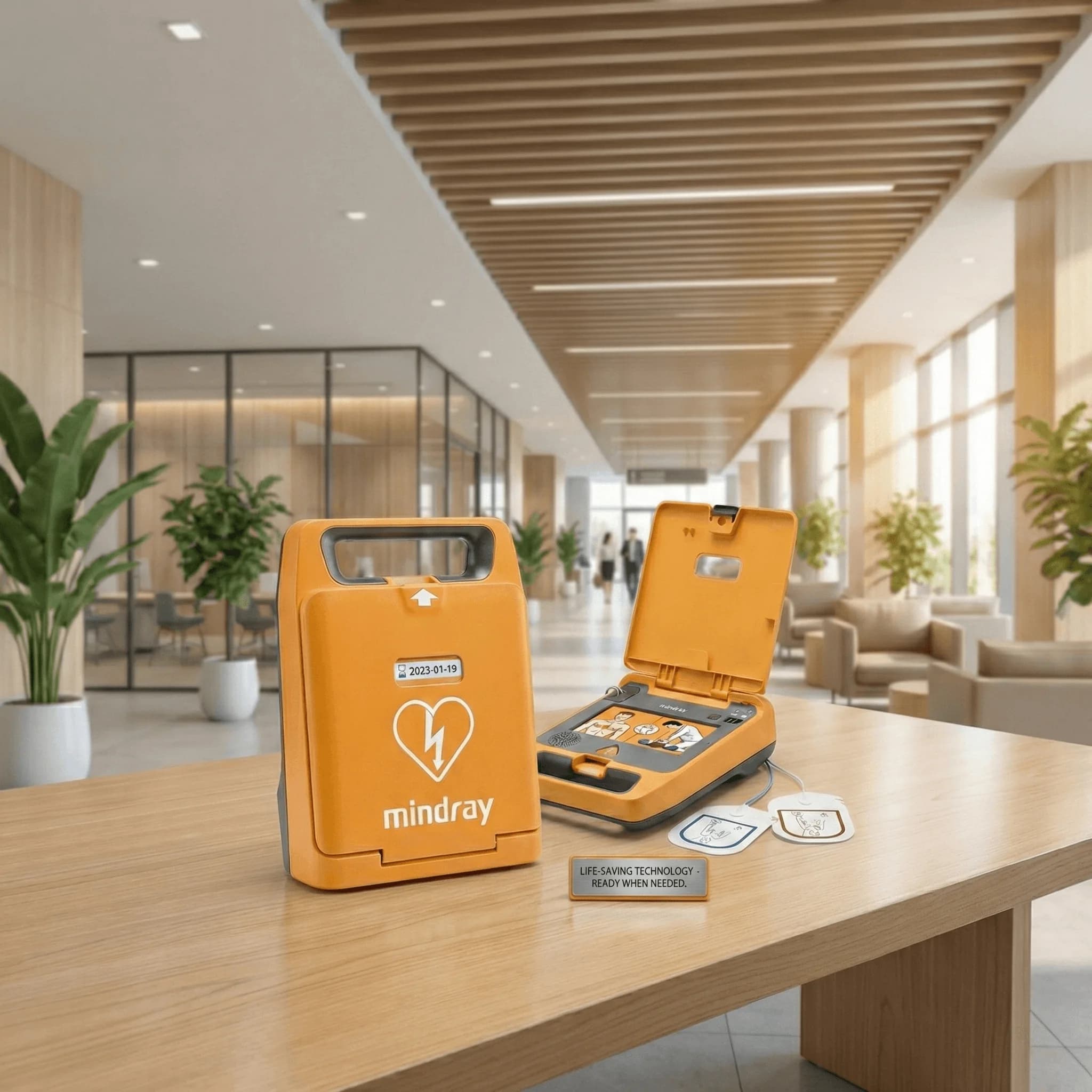
Defibrillator for medical practices and health centres: equipping properly
Medical or allied-health practice, dental surgery, multi-professional practice or health centre: choose a defibrillator that fits your organisation, your patients and the skills on site, with the consumables and maintenance that keep it ready.
- Automatic or semi-automatic, to suit your team
- Location and protocol defined
- Checks and consumables logged
Why a defibrillator in a medical practice?
A practice or healthcare centre sees patients with a known cardiovascular risk, others under exertion in physiotherapy or sports medicine, others who are elderly. Cardiac arrest can also happen in the waiting room, when the patient is alone and clinicians are in consultation.
Having health professionals on site is not enough: without a device immediately available, their skills cannot be applied. And the person who finds the patient is not always a clinician: secretary, receptionist, companion.
Our approach stays measured: a reliable device, in the right place, built into your emergency protocol and kept available.
Is a defibrillator mandatory in a medical practice in France?
The answer depends on the legal status of the structure, not on the profession. Since decree no. 2025-1167 of 5 December 2025, the category 5 list covers health establishments and health centres, but neither private practices nor multi-professional practices.
| Your situation | Defibrillator required? |
|---|---|
| Health centre (article L. 6323-1 of the Public Health Code) | Yes, if it is open for more than three months and receives at least the number of people set by order; unconditionally if it is in categories 1 to 4. |
| Health establishment: clinic, hospital (article L. 6111-1 of the same code) | Yes, under the same conditions. |
| Private practice: doctor, dentist, physiotherapist, nurse | No AED obligation, unless the practice is inside an ERP that is itself subject to the rule. |
| Multi-professional practice (article L. 6323-3) | Not listed in article R. 157-1 of the Building and Housing Code: no obligation, but a shared device is strongly recommended. |
| Care homes and facilities for elderly or disabled people | Yes, under the same duration and threshold conditions. |
Even without an obligation, a defibrillator available immediately is what lets a care team use its skills when a cardiac arrest happens on its premises. Any device installed must be maintained by its owner, like any medical device.
Read our article: defibrillators in medical practices and the rulesWhich defibrillator for a practice or a health centre?
No device is “medically superior” by default: the right choice depends on who will use it and how you are organised. Points to examine:
Fully automatic or semi-automatic
A fully automatic AED delivers the shock on its own after analysis; a semi-automatic one asks the user to trigger it. Semi-automatic leaves the decision to the operator, fully automatic removes hesitation for a less experienced rescuer. Choose according to who may step in.
Paediatric patients
If you see children, check that the chosen model offers paediatric pads or a paediatric mode. At quote stage we tell you what is available for each device, without assuming compatibility.
Availability you can check
Self-test, readable status indicator, consumables in date: the person in charge of checks must be able to verify the device at a glance.
A consistent fleet
In a multi-professional health centre or a multi-site group, a single model simplifies training, pad stock and tracking of expiry dates.
Where to place the AED in a medical practice?
Where it will be seen and reached immediately: waiting room or reception, close to the consulting rooms, accessible without code or key throughout opening hours, including when the secretary is away. In an upstairs practice without a lift, the device stays on the practice floor.
In a health centre or building housing several practitioners, a device in a shared area can cover several practices if access is guaranteed at all opening times. A written agreement sets out who pays, who checks and who registers the device.
- Visible from the entrance and waiting room
- Location written into the emergency protocol
- One designated person for checks
- Signage compliant with the French order of 29 October 2019
Equipment, follow-up and consumables
Purchase or rental, we supply the device, maintain it and track pads and battery, and train all staff, including non-clinical staff, to raise the alarm and use the AED.
Purchase
€1,090 excl. VAT
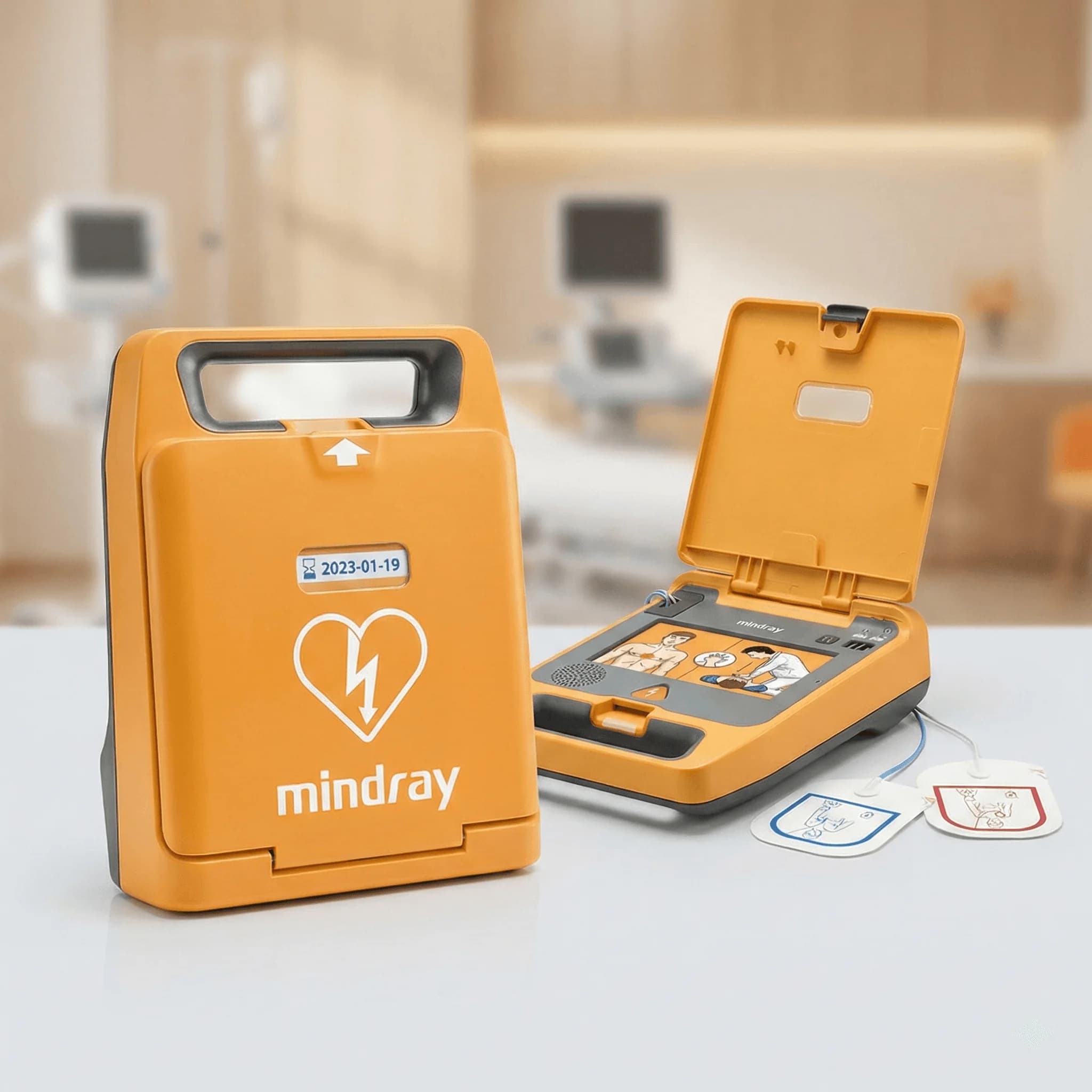
Mindray C1A AED pack: automatic defibrillator, wall cabinet, signage, first-aid kit and maintenance label.
See defibrillatorsMaintenance
From €79 excl. VAT/year
Annual contract: device check, follow-up of pads and battery, intervention report.
See maintenanceConsumables
€69 · €179 excl. VAT
Mindray MR62 pads to replace every 3 years and after each use, battery every 5 years.
See padsTraining
€490 excl. VAT per group
€369 excl. VAT with the purchase of the defibrillator
On-site session of 30 min to 2 hours for 1 to 12 people: raising the alarm, CPR and using the AED.
See trainingRental
From €48 excl. VAT/month
Device, maintenance and consumables included, with a minimum 6-month commitment.
Discover rentalHow much does a defibrillator for a medical practice cost?
For a practice, most of the long-term cost lies in consumables and maintenance. Here is the five-year budget, buying or with all-inclusive rental.
Purchase, over 5 years
- Pack DAE Mindray C1a
- €1,090
- Installation and commissioning by a technician
- €99
- Replacement pads (at 3 years)
- €69
- Replacement battery (at 5 years)
- €179
- Annual maintenance × 5 years, travel included
- From €590
- Total purchase cost over 5 years
- From €2,027 excl. VAT
Rental, over 5 years
- Annual subscription × 5 years
- €2,750 excl. VAT
- or monthly subscription × 60 months
- €2,880 excl. VAT
- Maintenance and consumables
- Security deposit
- €600
Prices excl. VAT. Equipment follows our online catalogue; maintenance is shown as a “from” price, the exact rate depends on the number of devices.
Equipment and consumables
The Mindray C1A pack, the device alone to complete existing equipment, and the consumables to plan for over time.


Depending on your facility
Single practice
A device in the waiting room, visible from the entrance, a one-page protocol posted at reception and a regular indicator check recorded in a logbook.
Multi-professional health centre
A shared device in a common area, an agreement between practitioners on funding and maintenance, and one person in charge of checks and GéoDAE registration.
Dental or physiotherapy clinic
Several chairs or treatment rooms, patients under exertion or stress: the device sits at the centre of circulation, and the whole team, assistants included, knows where it is.
Laboratory and sampling centre
Busy mornings, reception staff on the front line: a short awareness session for the reception team shortens the time between collapse and first defibrillation.
The applicable French rules
The equipment obligation stems from article R. 157-1 of the Building and Housing Code. All ERP in categories 1 to 4 are covered; in category 5, since decree no. 2025-1167 of 5 December 2025, the list covers in particular health establishments (article L. 6111-1 of the Public Health Code) and health centres (article L. 6323-1), open for more than three months and above an attendance threshold set by order. Private practices and multi-professional practices are not listed.
A defibrillator is a medical device subject to the maintenance obligation of the order of 3 March 2003: its owner organises it, through the manufacturer, a provider or in-house (article R. 5212-25 of the Public Health Code). In an ERP, the device is signposted according to the order of 29 October 2019 and registered in GéoDAE.
These are general pointers; your structure’s situation is confirmed in its safety file and with your professional body.
Frequently asked questions
Is a defibrillator mandatory in a private medical practice?
No. Private practices are not health establishments and are not in the list of article R. 157-1 of the French Building and Housing Code. The obligation only applies if the practice is located inside an ERP that is itself subject to it. Equipping remains a choice consistent with care work.
Does a dental practice need a defibrillator?
A private dental practice is not covered. A dental health centre is, if it is open for more than three months and receives at least the number of people set by order. Either way, the device goes at the centre of the circulation areas, known to assistants and practitioners alike.
What is the difference between a health centre and a medical practice for this rule?
A health centre (article L. 6323-1 of the Public Health Code) is a structure in its own right, listed by the regulations; a private practice is not. A multi-professional practice (article L. 6323-3) is not listed either.
Automatic or semi-automatic AED for a practice or health centre?
A semi-automatic device lets the operator trigger the shock, which suits a trained team; a fully automatic one delivers it after analysis, removing any hesitation for a less experienced rescuer such as a secretary or a companion. Choose according to who may use the device, not only the practitioner.
Should paediatric pads be planned for?
If you see children, the question must be asked. Paediatric solutions differ from one model to another: we tell you at quote stage what exists for the chosen device.
How often should the AED be checked?
The device runs self-tests, but someone must regularly check the status indicator and log the check. Add the consumable expiry dates, per the manufacturer, and the yearly maintenance visit organised under our contract.
What must be replaced after use?
The pads, always: they are single-use. The device must then be checked before going back into service, and the battery condition verified. With rental, replacing the device after use is included.
Should practice staff, including reception, be trained?
No training is required to use an AED, but the person who finds the patient is often the secretary or a companion. An on-site session of 30 minutes to 2 hours for 1 to 12 people lets the whole team call for help, perform CPR and apply the device without hesitation.
Which defibrillator for a physiotherapy or nursing practice?
The same criteria apply: who will step in, which patients are seen, where the device will be visible. For patients exercising, as in physiotherapy, the device must be within immediate reach of the exercise room. The Mindray C1A pack suits most practices.
Where should the AED be placed in the structure?
In the waiting room or at reception, visible from the entrance, reachable without code throughout opening hours, and written into the emergency protocol. In a shared structure, in a common area, with a written agreement on follow-up.
Further reading
Defibrillators by sector
Equipment to define?
Describe your facility, your patients and your team: within 24 hours we propose a suitable device, location and follow-up, to buy or to rent.