
Regulatory guide
Mandatory defibrillators in French workplaces and public buildings: what the law says
Which premises are covered, by when, what signage is required, how GéoDAE registration works, what maintenance is owed and what happens if you skip it. Official sources throughout.
Written by Cyrille GAGNAIRE, France Défibrillateur. Updated 27 July 2026.
The legal framework in two texts
The requirement to install an automated external defibrillator (AED) rests on French law no. 2018-527 of 28 June 2018, known as the "cardiac defibrillator act", completed by decree no. 2018-1186 of 19 December 2018. Together they created articles L. 123-5 and R. 123-57 to R. 123-60 of the French construction and housing code, which require public-access buildings to install a visible and accessible AED.
Why this law? Around 50,000 people suffer sudden cardiac arrest in France every year. Without defibrillation, every minute that passes cuts the chance of survival by roughly 10%: having an AED close at hand changes the outcome entirely.
Several public-access premises on the same site may share a single device (article R. 123-58). A shopping centre, for instance, can cover several shops with one AED, provided it stays reachable by everyone within a time frame compatible with an emergency.
Who is covered, and since when?
The category of a public-access building depends on how many people it can hold. The requirement came into force in stages between 2020 and 2022, and every deadline has now passed.
| Building category | Capacity | AED required since |
|---|---|---|
| Category 1 | More than 1,500 people | 1 January 2020 |
| Category 2 | 701 to 1,500 people | 1 January 2020 |
| Category 3 | 301 to 700 people | 1 January 2020 |
| Category 4 | 300 people or fewer (excluding category 5) | 1 January 2021 |
| Category 5 | Small premises below the thresholds, depending on activity | 1 January 2022 (listed premises) |
For category 5 (small premises), only certain activities are covered by article R. 123-57: care facilities for elderly or disabled people, healthcare establishments, railway stations, mountain hotels and restaurants, mountain refuges, enclosed and covered sports facilities and multi-purpose sports halls.
What about companies that do not receive the public? The French labour code does not explicitly require an AED, but the employer remains bound by a general duty of safety (article L. 4121-1) and must match first-aid equipment to the risks of the activity (article R. 4224-14). Isolated sites, physical work, dense staffing, an older workforce: all are factors that, in the mandatory risk assessment document, argue strongly for voluntary provision.
Installation, signage and GéoDAE registration
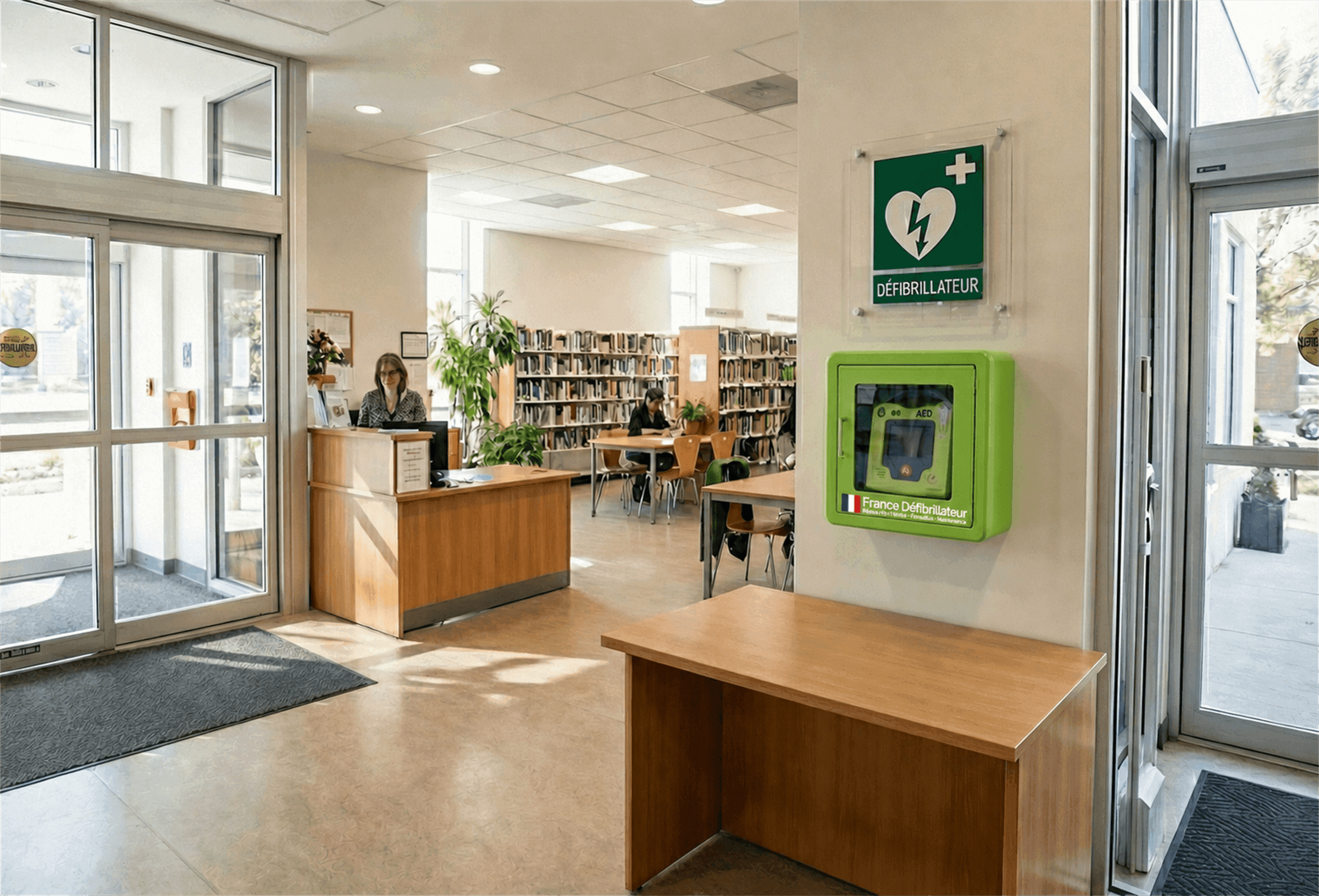
The AED must be installed somewhere visible and easily reachable, and signposted with the standard pictograms defined by the order of 29 November 2018: a notice showing the device is present, plus directional signs along the route. Good practice is a device reachable within five minutes round trip from any point on the site, ideally accessible outdoors around the clock in a suitable cabinet, heated where needed.
Each device must then be registered in the national GéoDAE database (decree no. 2019-703 of 4 July 2019), which lets emergency medical services and public first-aid apps locate available AEDs. An unregistered device is invisible to the emergency services. France Défibrillateur handles GéoDAE registration with every installation, along with the regulatory signage.
Maintenance is an obligation too
A defibrillator is a medical device. The operator must therefore keep it maintained under the conditions set by article R. 5212-25 of the French public health code and by the manufacturer: replacing pads (typical service life of 2 to 5 years) and the battery (3 to 5 years) before they expire, checking the self-test indicator regularly, and returning the device to service after every use.
An AED that is installed but out of service exposes the operator more than having none at all. That is exactly what preventive maintenance contracts are for: they document the checks and anticipate consumable expiry dates.
What are the penalties for not complying?
The texts set no specific administrative fine. The risk lies elsewhere: if a cardiac arrest occurs on the premises, the absence of a required AED, or its poor upkeep, can ground a civil or even criminal liability claim against the operator. Safety commissions can also record the non-compliance during their periodic visits, with the administrative consequences that follow.
Frequently asked questions
Is a defibrillator mandatory in every company?
No. The legal requirement targets public-access buildings in categories 1 to 4, and some category 5 premises depending on their activity. A company that does not receive the public has no explicit obligation to install an AED, but its general duty of safety towards employees (article L. 4121-1 of the labour code) and its risk assessment can make a strong case for one, particularly on isolated or busy sites.
What were the deadlines?
Decree no. 2018-1186 phased the requirement in: 1 January 2020 for categories 1 to 3, 1 January 2021 for category 4, and 1 January 2022 for the category 5 premises concerned. All these dates have passed, so any covered establishment should be equipped today.
Which category 5 premises are covered?
Care facilities for elderly and disabled people, healthcare establishments, railway stations, mountain hotels and restaurants, mountain refuges, and enclosed covered sports facilities as well as multi-purpose sports halls.
Does the defibrillator have to be registered?
Yes. Every AED in service must be registered in the national GéoDAE database (decree no. 2019-703), which lets emergency services and public apps locate devices. France Défibrillateur completes this registration with every installation.
What does an unequipped establishment risk?
The decree sets no specific fine. However, in the event of an incident, the operator can face civil and criminal liability on the grounds of missing or poorly maintained equipment, and safety commissions can record the non-compliance during their visits.
Who is responsible for maintenance?
The operator. An AED is a medical device: article R. 5212-25 of the public health code requires the operator to keep it maintained, replacing pads and batteries before expiry and carrying out regular checks, in line with the manufacturer instructions.
Official sources
- Law no. 2018-527 of 28 June 2018 on cardiac defibrillators (Légifrance)
- Decree no. 2018-1186 of 19 December 2018 on AEDs (Légifrance)
- Order of 29 November 2018 on AED signage (Official Journal of 13 December 2018)
- GéoDAE, the national defibrillator database (French Ministry of Health)
Need to bring your site into compliance?
We establish what applies to you, supply the equipment (purchase or rental from €50 excl. VAT per month), install it with regulatory signage, register the device on GéoDAE and maintain it over time. Reply within 24 hours.