Defibrillators in clinics and healthcare facilities: obligations and organisation
Written by Cyrille GAGNAIRE, France Défibrillateur. Published on 5 October 2026.
In a clinic, you might assume a cardiac arrest is always handled within seconds. The reality is more nuanced: a visitor can collapse in the lobby, an employee in a service corridor, a patient in a waiting room. A healthcare facility remains an ERP (établissement recevant du public, a public-access building) with equipment, maintenance and signage obligations that clinical staff do not replace.
A care facility is still a public-access building
Clinics, health centres and care facilities welcome the public: patients, relatives, suppliers, trainees. As such, they fall under the ERP regime (établissements recevant du public, public-access buildings) and the obligation to install an AED (automated external defibrillator, DAE in French) set by loi 2018-527 and décret 2018-1186 (the French law and decree on AEDs).
The timeline depends on the category: categories 1 to 3 equipped since 1 January 2020, category 4 since 2021, and some category 5 ERPs since 2022. A large clinic usually belongs to the first categories, a small health centre to the last.
An emergency trolley in a ward does not remove this obligation. The operator's AED must be reachable by the public and by staff, not only on one floor or in one unit.
Why caregivers alone are not enough
Around 50,000 cardiac arrests occur every year in France, and each minute without defibrillation reduces the chances of survival by about 10%. In a large building, travel time matters as much as skill.
A ward defibrillator stored in a locked trolley on the third floor is useless to someone who collapses on the ground floor, in the car park or in the cafeteria. Areas without permanent medical presence are exactly where a freely accessible AED makes the difference.
Administrative, technical, cleaning and catering staff make up a large share of the workforce. These teams meet visitors all day without always knowing how to react. A visible device and trained staff fill that gap.
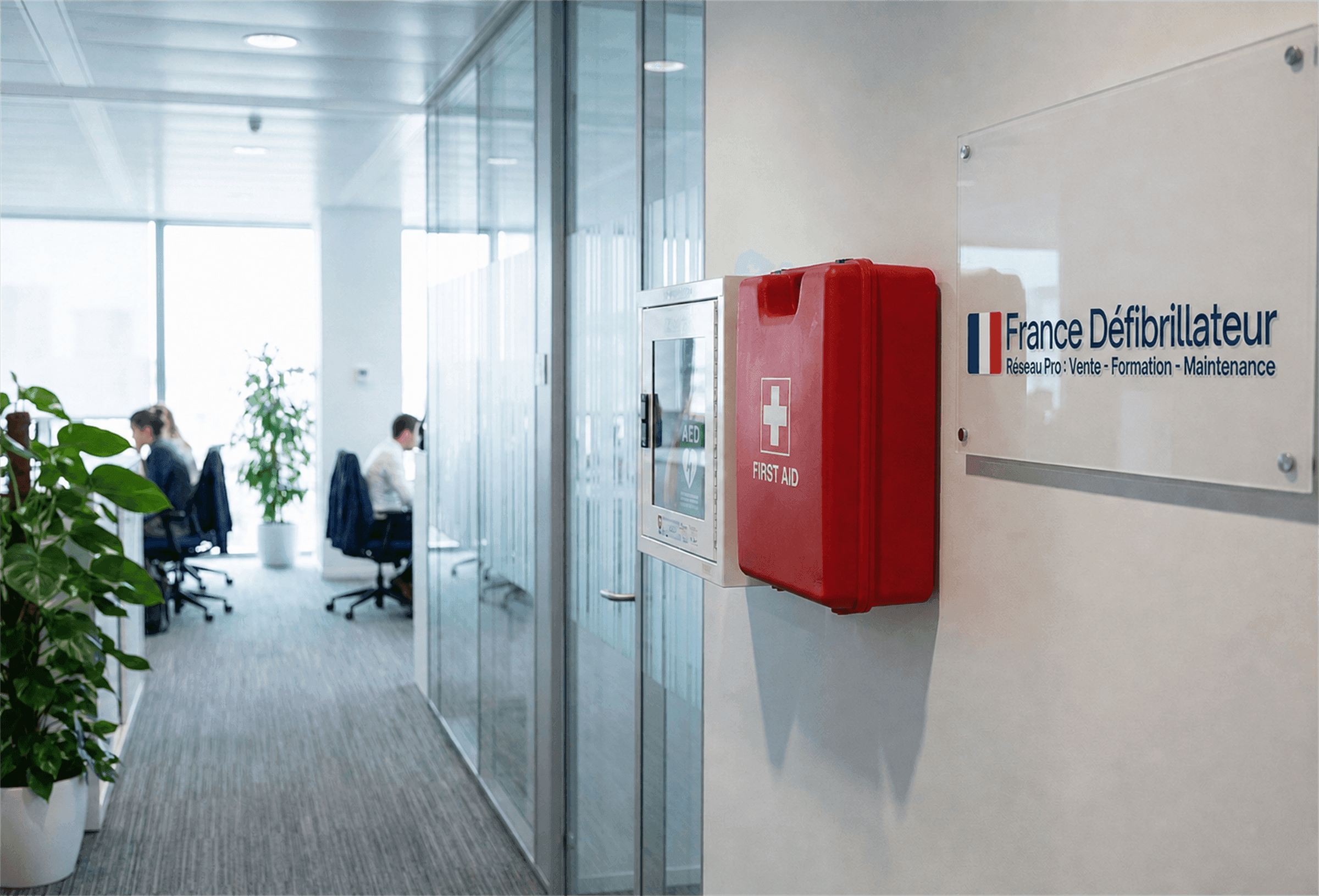
Where to place devices in a care building
Placement is decided by a real walk-through: how long does it take to fetch the device and come back to the patient from the farthest points? The larger or more compartmentalised the site, the less a single AED is enough.
The following areas should be considered first.
| Area | Point of attention |
|---|---|
| Reception hall | All public passes through, device visible from the entrance |
| Waiting rooms and consultations | Fragile patients, sometimes elderly companions |
| Car park and outdoor access | Outdoor-rated cabinet if the device is installed there |
| Catering and staff areas | Teams with little exposure to emergency procedures |
| Upper floors and remote wings | One device per zone if the route is too long |
Maintenance and traceability are the operator's responsibility
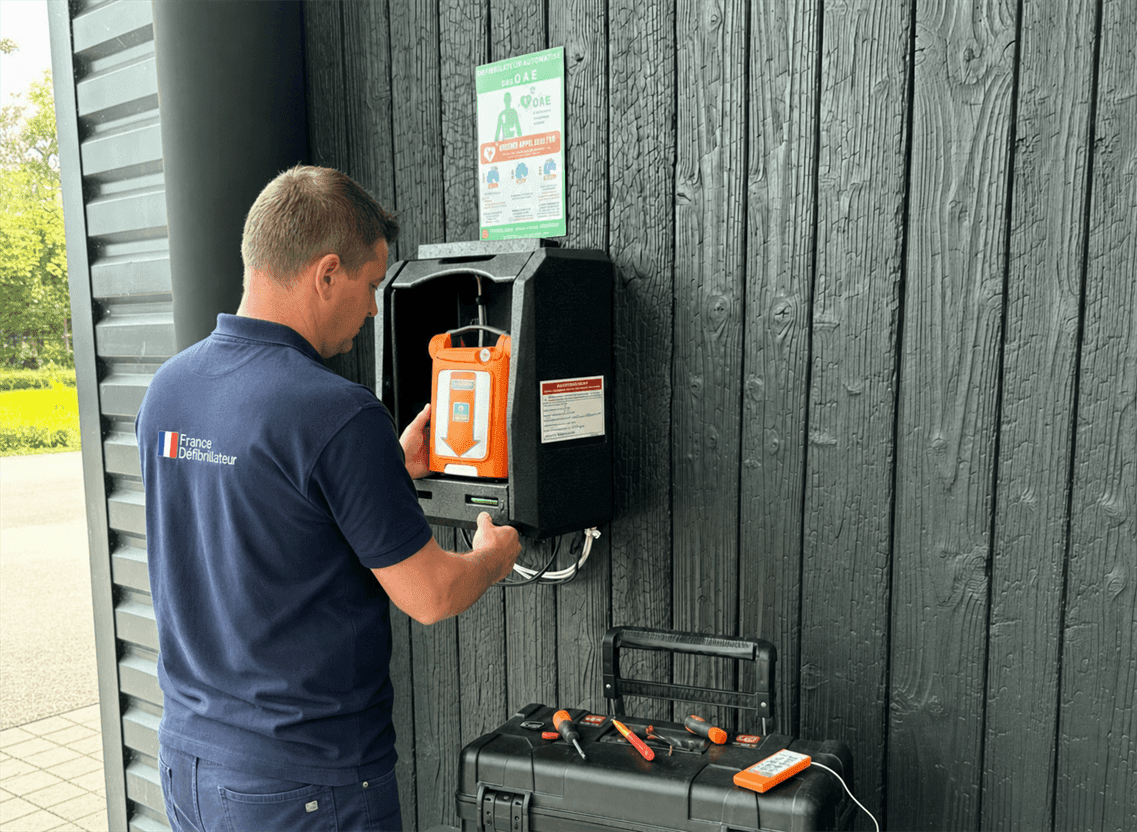
Maintenance of the defibrillator falls to the operator, in accordance with article R. 5212-25 du Code de la santé publique (the French Public Health Code). In a healthcare facility used to medical device traceability, this principle is familiar: it applies here too to AEDs accessible to the public.
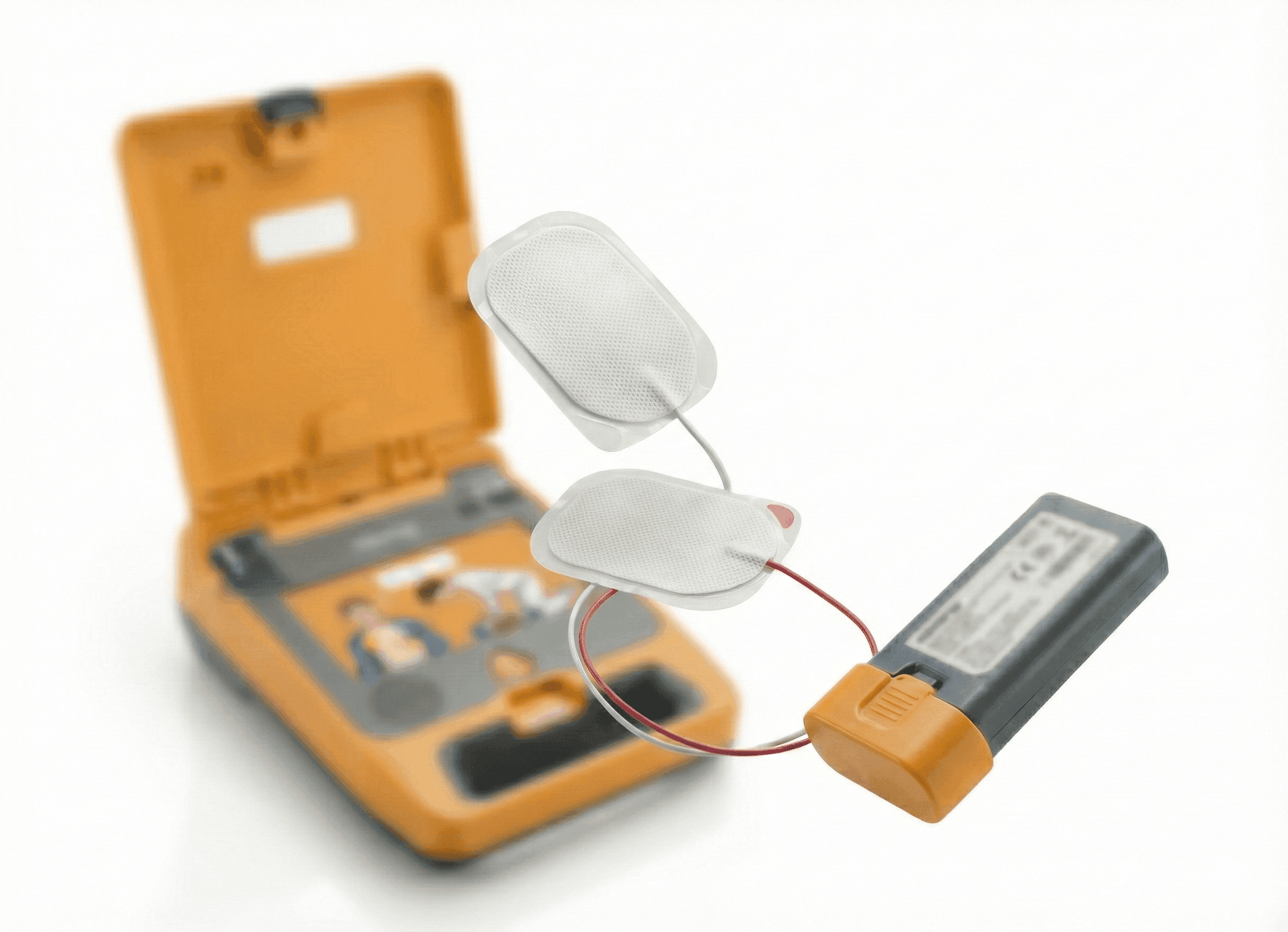
Consumables have a limited life: pads 2 to 5 years, batteries 3 to 5 years, the device itself 8 to 10 years and more. You therefore need to track expiry dates, read the self-test indicators and record each check in a register.
A rental with maintenance included, offered from €50 excl. VAT per month, spares the technical department this follow-up. The 5-year warranty covers a purchase, and delivery takes 2 to 5 working days.
Signage, registration and public information
The AED must be signposted according to the arrêté du 29 novembre 2018 (the French ministerial order on AED signage): a standard pictogram at the device location and directional signs from the main entrances. In a building with complex circulation, clear directions are worth more than a single sign.
Registering the device in GéoDAE is also mandatory. It lets emergency services locate it during a call. Remember to update it if the device moves during a refurbishment.
Access instructions must be known to reception and the security team: a device locked in a restricted room loses most of its value.
Training every team
Caregivers have their own training, but other professions in the facility do not always receive any. A short awareness session on the chain of survival, chest compressions and AED use suits reception, security and cleaning staff as well as administrative teams.
Regular simulation exercises help check that everyone knows where the device is and who calls the emergency services. It is often during these that a locked cabinet or a sign hidden behind a partition is discovered.
A quote is provided within 24 hours to size the number of devices and training sessions according to the facility's surface area and footfall.
Frequently asked questions
Does an emergency trolley replace a publicly accessible AED?
No. The emergency trolley is reserved for the care teams of a unit and is often locked. The ERP obligation targets a device quickly reachable by the public and staff, signposted and registered in GéoDAE. The two systems complement each other without replacing one another.
How many defibrillators does a clinic need?
The regulation sets the equipment obligation, not a number of devices per surface area. In practice, you measure travel time from the farthest areas. A large building with several floors or wings generally calls for several well-distributed AEDs.
Who handles AED maintenance in a healthcare facility?
Maintenance is the operator's responsibility, under article R. 5212-25 du Code de la santé publique. It covers monitoring pads, battery and self-tests, and keeping a register. A rental contract with maintenance can delegate its organisation.
Must the device be registered in GéoDAE?
Yes, registration in GéoDAE is mandatory. It lets emergency services spot devices near an incident. It must be corrected if the device is moved, replaced or removed during a refurbishment of the facility.
Planning an AED project?
Purchase, rental from 50 EUR excl. VAT per month, installation with GéoDAE registration, servicing and training: our team replies within 24 hours.