Defibrillators in care homes: equipping and training before the AFGSU deadline
Written by Cyrille GAGNAIRE, France Défibrillateur. Published on 28 July 2026.
A care home houses elderly residents around the clock, many of them with existing heart conditions, in buildings where the emergency services need several minutes to reach a bedroom. The joint DGOS-DGCS circular of 30 January 2026 now places emergency first-aid training at the heart of the obligations placed on the social and medical care sector. For a home manager, this is a chance to deal in one go with two subjects that have long been treated separately: training the staff and having a device that can genuinely be used.
What the DGOS-DGCS circular of 30 January 2026 changes
Until 2026, AFGSU (the French certificate in emergency first-aid procedures) mainly concerned hospital healthcare professionals: doctors, nurses and healthcare assistants. The joint DGOS-DGCS 2026/12 circular of 30 January 2026 extends the level 1 or level 2 AFGSU requirement to all care home and social care staff in direct contact with residents.
The text provides for a phased application over the 2026-2028 period, with penalties from January 2029. Three years of grace may sound comfortable, but it is not. The first step is a named audit: list every member of staff, their role, the date of their last emergency first-aid training if they have had any, and the level that will be required of them.
The volumes involved are substantial. An estimated 600,000 care home staff are concerned across France, of whom roughly 420,000 fall under AFGSU 1 and 180,000 under AFGSU 2. The sector does not currently have enough accredited AFGSU trainers to absorb that demand. Slots in 2027 and 2028 will therefore be fought over: booking your sessions as soon as you draw up the 2027 skills development plan will spare you a fully booked calendar.
Who to train, and at what level
The circular draws a clear distinction between obligations according to the role performed, and adds a category of staff for whom training is recommended rather than compulsory. Map this grid onto your organisation chart, department by department, including short contracts and regular temporary staff.
Administrative staff in contact with residents and kitchen staff working in communal areas fall into the recommended category. In a home where reception is often the first witness to someone collapsing in the entrance hall, training them remains the most sensible decision, even without a regulatory requirement.
| Level | Roles concerned | Status |
|---|---|---|
| AFGSU 1 | Healthcare assistants, hospital service staff, activity coordinators | Compulsory |
| AFGSU 2 | Nurses, coordinating physicians, senior nursing staff | Compulsory |
| AFGSU 1 | Administrative staff in contact with residents, kitchen staff working around residents | Recommended |
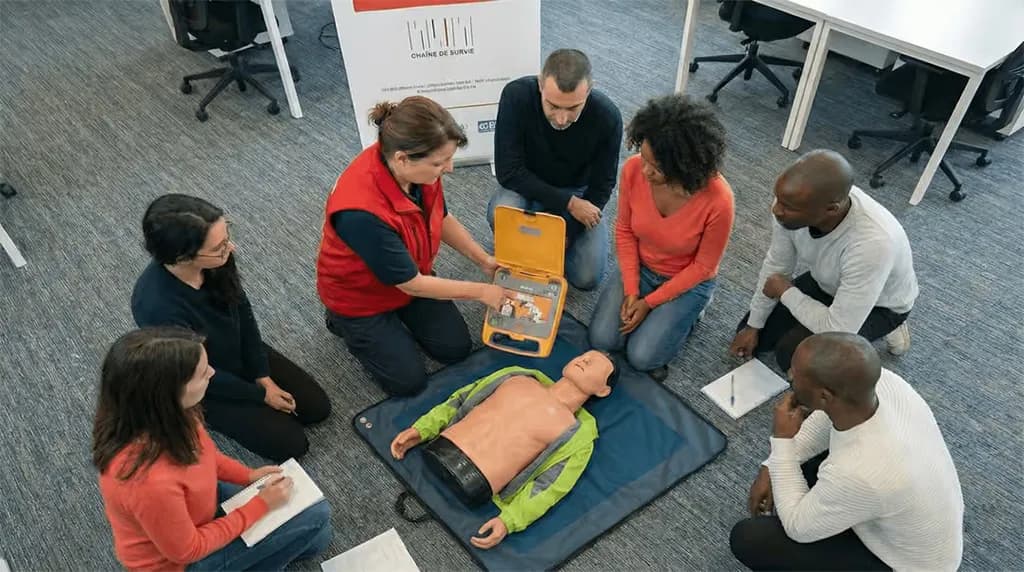
Training without equipment achieves nothing
Around 50,000 cardiac arrests occur every year in France. Every minute that passes without defibrillation cuts the chances of survival by roughly 10 per cent. A trained team forced to wait for the emergency services to arrive with a defibrillator loses precisely the time their training taught them not to lose.
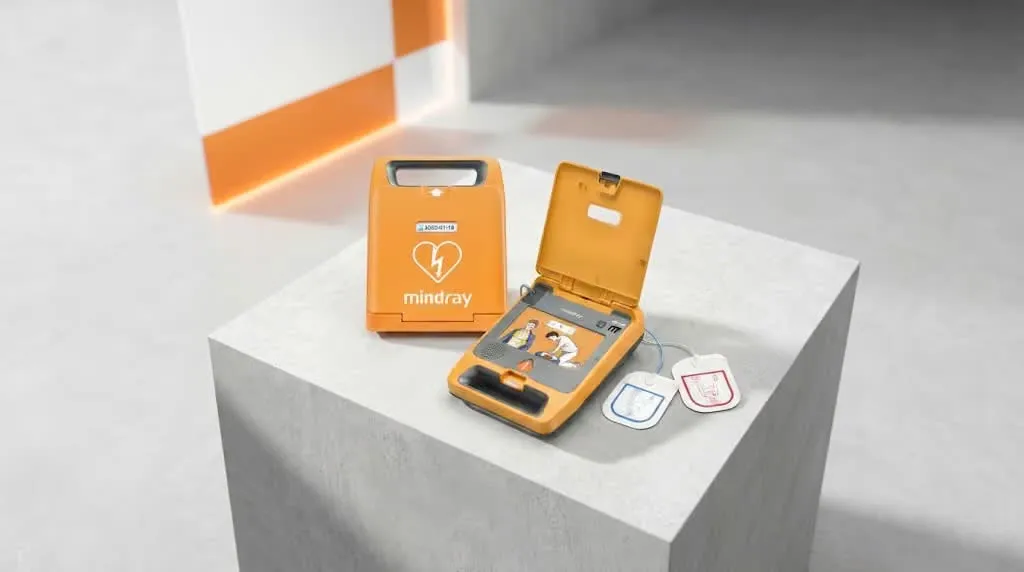
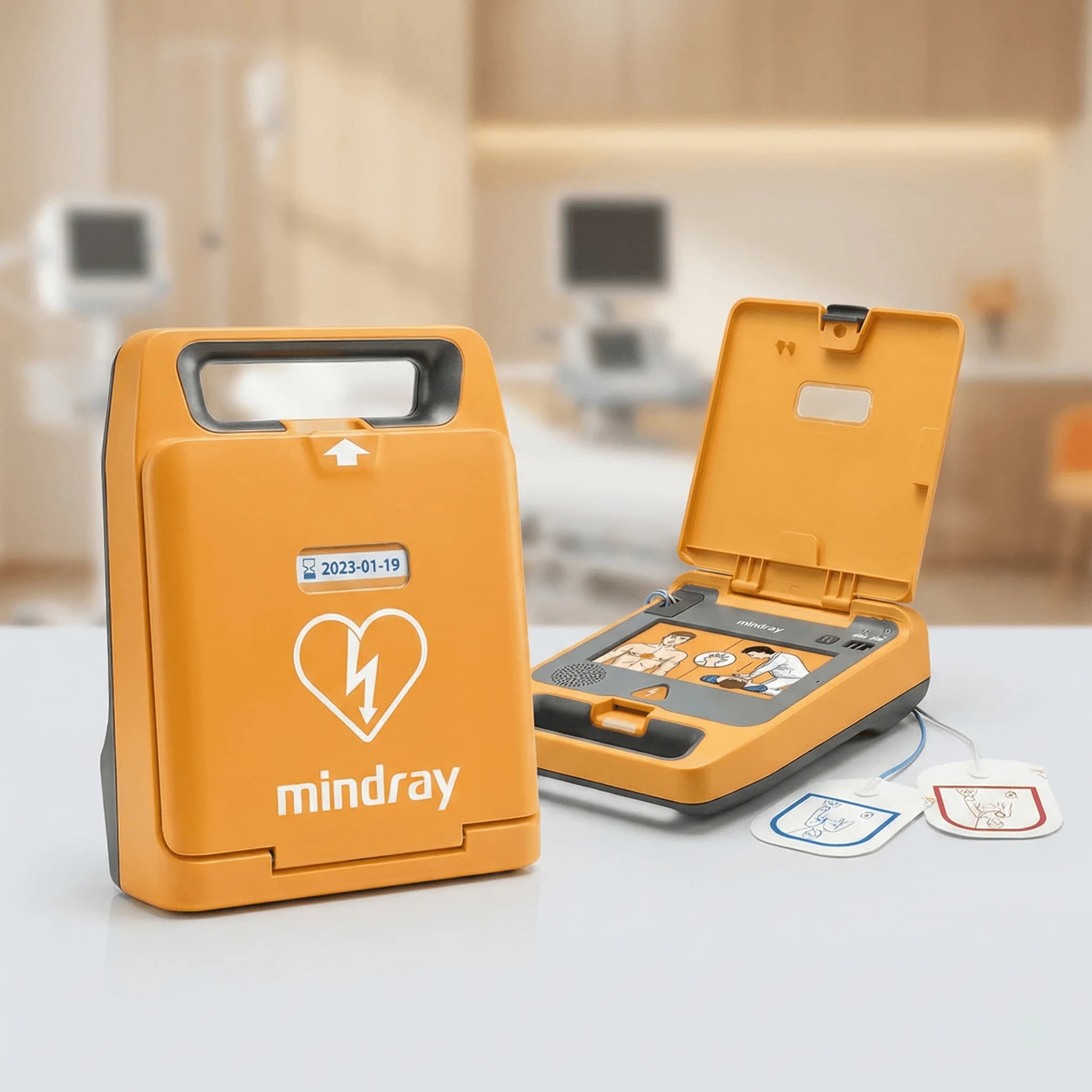
The situation in a care home is distinctive: the resident population accumulates cardiovascular risk factors, and the building operates 24 hours a day with reduced staffing overnight. An automated external defibrillator, known in France as a DAE (AED), guides the user with voice prompts and only delivers a shock if the heart rhythm it analyses calls for one, which makes it usable by an AFGSU 1 trained assistant just as much as by a nurse. If you are still unsure which type of device to choose, our article on the differences between DAE, DEA and DSA units covers that point in detail.
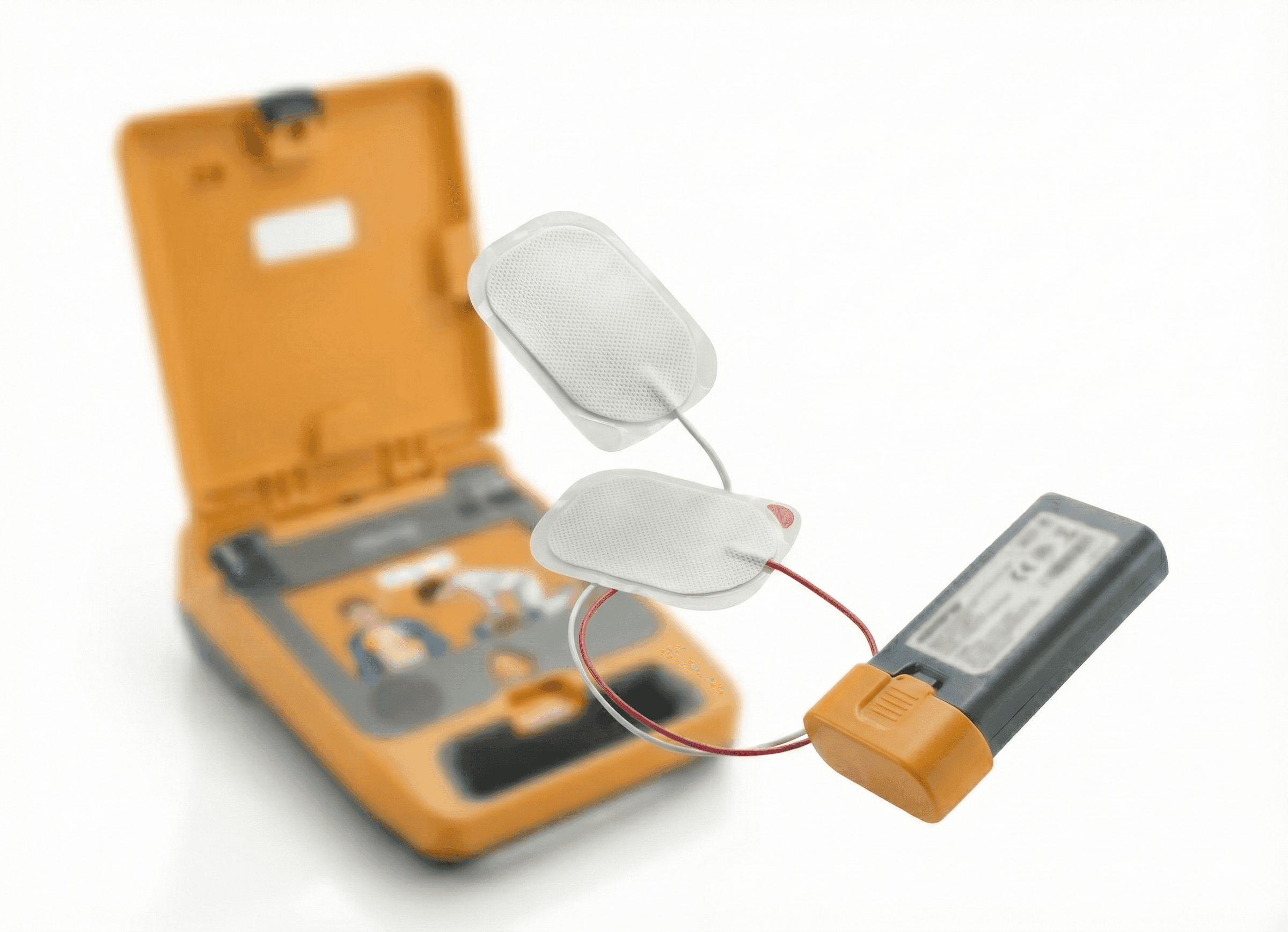
In practical terms, every scheduled training session should be an opportunity to handle the actual device installed in the home, with its training pads, rather than a generic model discovered on the day.
Is a care home covered by the ERP requirement?
A care home or sheltered housing scheme is a public-access building, known in France as an ERP (etablissement recevant du public), and as such falls under the defibrillator installation timetable that applies to ERP premises. Categories 1 to 3 were due to be equipped from 1 January 2020, category 4 from 2021, and certain category 5 premises from 2022.
The action required is straightforward: go back to the latest safety commission report, identify your building's exact category, and check that the corresponding equipment is properly installed, signposted and registered. The category depends on the number of people accommodated, residents and staff included, which can change after a building extension or an increase in authorised capacity. Our general regulatory guide to the defibrillator requirement sets out the framework common to all ERP premises.
Where to install the device in a care setting
Siting determines effectiveness far more than the model chosen. The useful criterion is the round-trip time from the furthest point a resident is likely to occupy: a bedroom at the end of a wing, the activities room, the therapeutic garden, the dining room. Time it once, under night-time conditions.
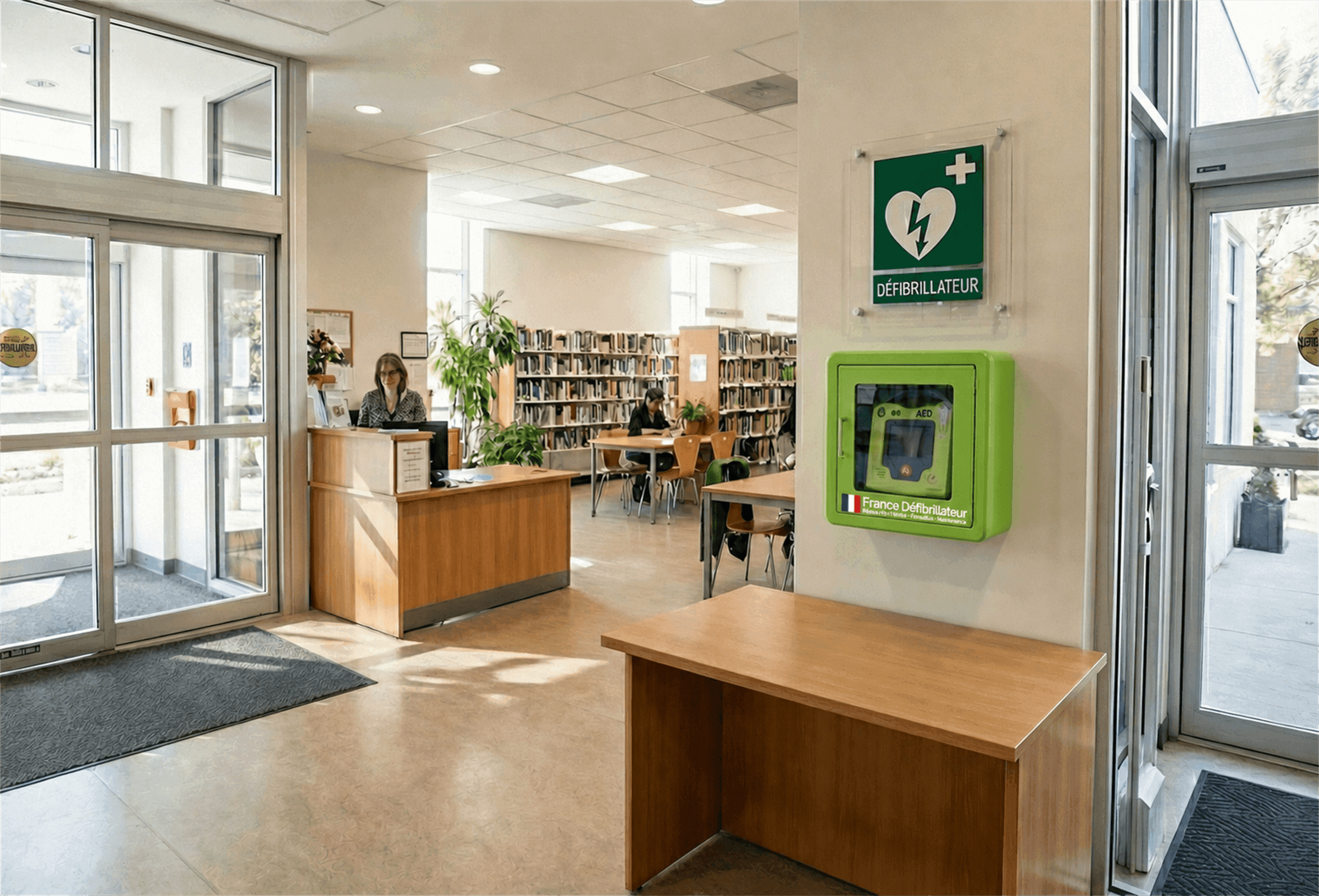
In most homes, the entrance hall is the natural anchor point: everyone knows where it is, it is accessible to visitors and it sits close to the main circulation route. In a building with several floors or several wings, a single unit on the ground floor forces night teams into a long journey. A second cabinet near the floor nursing station solves the problem. In secure units, the device must remain accessible to staff without depending on a code known only to management.
Complete the installation with standard signage along corridors, information in the welcome pack and a reference point in the protocol for calling the emergency number 15. Registering the device on the national defibrillator database is what makes it visible to the emergency services.
Safety records and fleet monitoring
An unmaintained defibrillator is a useless defibrillator, and inspectors check the records to confirm it. Attach device monitoring to the home's safety register rather than to a separate folder that leaves with whoever was looking after it. Appoint a lead and a deputy, and set a short visual inspection interval, monthly at the very least.
Component lifespans are well known and make it possible to anticipate replacements without unpleasant budget surprises. Our article on the lifespan of a defibrillator sets out each deadline.
An up-to-date monitoring sheet also lets you answer a request from the safety commission or the regional health agency within minutes during a compliance visit.
| Item to monitor | Frequency or lifespan | Record to keep |
|---|---|---|
| Visual check of the status indicator | Monthly | Monitoring sheet in the safety register |
| Adult electrode pads | Replacement every 2 to 5 years | Invoice and expiry date |
| Battery | Replacement every 3 to 5 years | Service report |
| Complete unit | 8 to 10 years or more depending on the model | Commissioning date |
| Staff training | According to the 2026-2028 AFGSU timetable | Named certificates |
Building the 2026-2028 budget
Two budget lines run alongside each other: training the teams and buying the equipment. The second can be spread out. Renting a defibrillator starts at 50 euros excl. VAT per month, maintenance included, which turns a capital investment into an operating cost and removes the need to set money aside for replacing consumables. Purchase still makes sense when the home has investment capacity and a properly structured technical department. Our articles on renting versus buying, on the real price of a defibrillator and on the funding available compare the two approaches.
On timescales, a quotation is issued within 24 hours and delivery takes 2 to 5 working days, with a 5 year warranty on the devices. A home that makes its decision in September can therefore be equipped and have trained its first group before the end of the financial year. Line up the installation date with the first scheduled AFGSU session: staff discover the device during their training, and you enter both deadlines in the same monitoring calendar.
Frequently asked questions
From when do AFGSU shortfalls become punishable in care homes?
The joint DGOS-DGCS 2026/12 circular of 30 January 2026 provides for a phased application across 2026-2028, with penalties from January 2029. That leaves time to spread sessions over three budget years, provided you book early: the number of accredited AFGSU trainers in the care sector is currently too small to absorb the expected demand.
How many defibrillators does a care home need?
No figure is set according to the number of beds. The practical criterion is access time from the furthest point occupied by a resident. A compact single-storey building often works fine with one unit in the hall. As soon as there are several floors or several wings, a second cabinet near a nursing station avoids long journeys at night.
Can staff trained to AFGSU 1 use the defibrillator?
Yes. An automated external defibrillator analyses the heart rhythm, guides the user with voice prompts and only delivers a shock if the analysis justifies it. The circular places healthcare assistants, hospital service staff and activity coordinators under compulsory AFGSU 1 precisely because these are the people first on the scene beside the resident.
Do sheltered housing schemes and social care services need equipping too?
The circular covers all care home and social care staff in direct contact with residents as far as training is concerned. For equipment, the applicable rule is the one for public-access buildings: categories 1 to 3 since 1 January 2020, category 4 since 2021, certain category 5 premises since 2022. Check your category in the safety commission report.
How should device maintenance be recorded for a compliance visit?
Attach the monitoring sheet to the home's safety register and appoint a lead with a deputy. Log the monthly visual check of the status indicator, the expiry dates of the electrode pads, that of the battery and the commissioning date. Under a rental agreement, maintenance is included and the provider's visits feed directly into that audit trail.
Planning an AED project?
Purchase, rental from 50 EUR excl. VAT per month, installation with GéoDAE registration, servicing and training: our team replies within 24 hours.