Grants and funding options for a defibrillator
Written by Cyrille GAGNAIRE, France Défibrillateur. Published on 28 July 2026.
Around 50,000 sudden cardiac arrests occur in France every year, and every minute without defibrillation cuts the chances of survival by roughly 10 per cent. Installing a DAE (AED) is therefore a public health investment as much as a legal duty for many ERP (French public-access buildings). That still leaves the question of funding. Councils, associations and businesses do not knock on the same doors: this guide sets out the options worth exploring according to your status, presents rental as an alternative that requires no capital outlay, and explains how to put together a convincing application.
What does a defibrillator really cost?
Before looking for funding, you need to cost the requirement. In the France Défibrillateur catalogue, AEDs range from 350 to 2,395 euros incl. VAT, with a median price of about 1,090 euros. That purchase budget is only part of the total cost, however: a defibrillator relies on consumables that have to be renewed periodically.
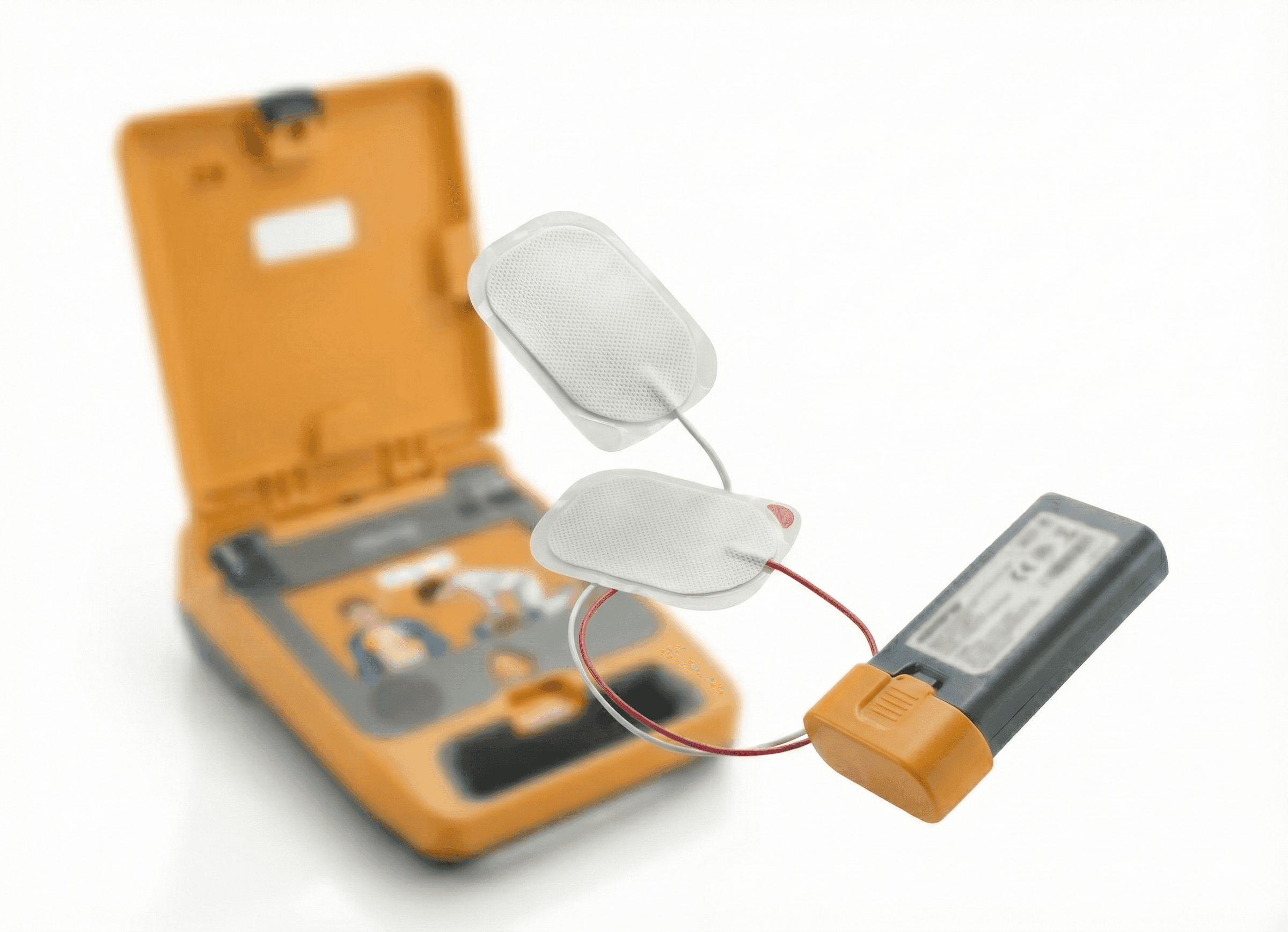
Electrode pads cost between 14 and 239 euros (median around 99 euros) and are replaced every 2 to 5 years depending on the model. Batteries range from 10 to 499 euros (median around 259 euros) for a service life of 3 to 5 years. A well maintained AED, by contrast, will run for 8 to 10 years or more. To be credible, your funding application should cover both aspects: the initial investment and the running costs.
| Item | Observed range (incl. VAT) | Median price | Indicative service life |
|---|---|---|---|
| AED (purchase) | 350 to 2,395 euros | about 1,090 euros | 8 to 10 years or more if well maintained |
| Electrode pads | 14 to 239 euros | about 99 euros | 2 to 5 years depending on the model |
| Batteries | 10 to 499 euros | about 259 euros | 3 to 5 years |
Councils: DETR, DSIL and inter-municipal levers
For a local council, the first avenue to explore is central government funding for local investment: the DETR (equipment grant for rural areas) and the DSIL (local investment support grant). Depending on the priorities set locally, buying defibrillators can fall within the categories of eligible operations. Criteria, funding rates and submission deadlines vary from one département to another, so check with your prefecture or sub-prefecture before building your project, and do not assume any particular amount.
The second lever is the inter-municipal level. Some communities of municipalities or urban communities pay matching contributions to their member councils for facilities of general interest, or run group AED installation programmes directly across their area. Finally, if your authority operates a participatory budget, a defibrillator project put forward by residents is often well received: it is a visible, uncontroversial piece of equipment that is directly linked to everyone's safety.
Associations: local sponsorship and support from public authorities
An association, whether a sports club or not, rarely has a budget line for equipment of this kind. Its strength lies elsewhere: in its local roots. Sponsorship from businesses in the area (shopkeepers, tradespeople, small and medium firms) is a realistic route, all the more so because a defibrillator is a unifying project that a sponsor can easily promote. A simple form of recognition, such as a mention of the sponsor on the accompanying signage or on the club's materials, is often enough to secure agreement.
Public authorities are worth approaching too: the council or inter-municipal body that provides a sports hall or a meeting room has every interest in seeing the site equipped, and can include the AED in its own capital spending. Participatory budgets, where they exist, are also open to projects run by associations. Make clear from the outset who will own the device and who will take on maintenance.
Businesses and ERP: share rather than multiply
There is no general grant scheme for businesses: the AED counts as an investment by the establishment, in the same way as any other safety equipment. It is worth recalling the legal framework: loi 2018-527 (the 2018 act on defibrillators) and décret 2018-1186 (the implementing decree) have required category 1 to 3 ERP to be equipped since 1 January 2020, category 4 since 1 January 2021 and certain category 5 ERP since 1 January 2022.
The rules do, however, open up a genuine source of savings: several ERP located on the same site may share a single defibrillator, provided it remains accessible in conditions that allow a rapid response. A shopping arcade, a business park or a building housing several establishments can therefore share the equipment and its upkeep costs, setting out in writing how they are divided between operators. In every case maintenance remains the operator's responsibility, as set out in article R. 5212-25 du Code de la santé publique (the French public health code).
Rental: equipping yourself without capital outlay
If no funding comes through, or if you would rather not tie up cash, rental turns the investment into a straightforward running cost. At France Défibrillateur, rental starts from 50 euros excl. VAT per month, with maintenance and consumables included: electrode pads and batteries are replaced at no extra charge when they expire, and the device is replaced after every use.
This arrangement spreads the cost, removes unpleasant surprises linked to consumables and guarantees a permanently operational device, which makes it easier to meet the maintenance obligation. For a council, rental is charged to the operating budget and avoids drawing on capital funds; for an association, it makes the project payable from membership fees or a modest annual sponsorship.
Putting together a convincing funding application
A good application comes down to a handful of documents. First, a precise and recent quotation: France Défibrillateur issues one within 24 hours, itemising the device, installation with signage compliant with the arrêté du 29 novembre 2018 (the November 2018 order on defibrillator signage), registration on the national GéoDAE database and preventive maintenance. Add a siting plan that justifies the chosen location: accessibility, visibility and proximity to busy areas.
Next comes the case itself. Draw on the public health figures (around 50,000 sudden cardiac arrests a year, roughly 10 per cent of survival chances lost for every minute without defibrillation) and, where relevant, on your regulatory obligation as an ERP. Set out the technical choice, fully automatic (DEA) or semi-automatic (DSA), bearing in mind that both analyse the heart rhythm and deliver a shock only when it is needed. Finally, show that the project will last: a 5 year warranty on the AEDs, a maintenance plan and training for users.
Frequently asked questions
Is there a national grant specifically for defibrillators?
No, there is no single national scheme reserved for AEDs. Funding comes through general-purpose mechanisms: DETR and DSIL for councils (check the criteria with your prefecture), inter-municipal matching funds, participatory budgets or local sponsorship. Each area sets its own priorities, which is why it is essential to make local enquiries before submitting an application.
Can a council help an association buy equipment?
Yes, and it is a natural avenue. An authority that provides premises to an association can include the defibrillator in its own capital spending, or back the project through its participatory budget. The key point is to agree in advance who owns the device and who covers maintenance, a duty that falls to the operator.
Can several establishments share the same defibrillator?
Yes. The rules allow several ERP located on the same site to share an AED, provided it remains accessible for a rapid response. This is a source of savings for shopping arcades, business parks and shared buildings. Set out in writing how upkeep costs are divided between operators, and register the device on the GéoDAE database.
Is rental a genuine alternative to a grant?
Yes, particularly when no funding comes through. From 50 euros excl. VAT per month, rental covers maintenance, consumables and replacement of the device after use. It removes the initial outlay (350 to 2,395 euros incl. VAT to buy) and turns the cost into a predictable running charge that is easier to fit into a tight budget.
What documents should be attached to a grant application?
A detailed and recent quotation (issued within 24 hours by France Défibrillateur), a siting plan justifying the location, a public health case, a reminder of the regulatory obligation if your ERP is covered, and a section on durability: 5 year warranty, maintenance plan, GéoDAE registration, compliant signage and user training.
Planning an AED project?
Purchase, rental from 50 EUR excl. VAT per month, installation with GéoDAE registration, servicing and training: our team replies within 24 hours.