Defibrillator in a Holiday Centre or Summer Camp
Written by Cyrille GAGNAIRE, France Défibrillateur. Published on 1 October 2026.
A holiday centre or summer camp brings together children, activity leaders, management and families, in fixed premises but also on forest outings, at the beach or on hikes. A cardiac arrest is rare there, and most often affects an adult. The question of equipment still arises, with one particularity: the defibrillator must be able to follow the group when it leaves the building.
The premises are establishments open to the public
A holiday centre set up in a school, a municipal hall, a gym or a dedicated building receives the public and falls under the French ERP classification (établissements recevant du public, buildings open to the public), with a category based on the total number of people admitted, children and staff combined. ERPs of categories 1 to 3 have had to be equipped with a defibrillator since 1 January 2020, category 4 since 2021, and some category 5 ERPs since 2022, under loi 2018-527 (law 2018-527) and décret 2018-1186 (decree 2018-1186).
Many organisations occupy premises they do not own. In that case, check whether the owner or host establishment already has a device, where it is and who maintains it. A defibrillator already in the building may be enough for on-site activities, provided the team knows it exists and can reach it during all opening hours, including Wednesdays and school holidays.
A young audience, but mostly adult victims
About 50,000 cardiac arrests occur in France every year, and each minute without defibrillation reduces the chances of survival by about 10%. In a holiday centre, the most likely victim is a leader, a parent, a cook, a driver or a visiting contractor, more rarely a child. The defibrillator therefore protects everyone present, not only the children.
This does not remove the need to be ready for a child. A collapse during intense effort, a violent blow to the chest or a near-drowning are among the situations the team must be able to recognise, without waiting for someone to hesitate over an unresponsive body.
Paediatric pads and suitable equipment
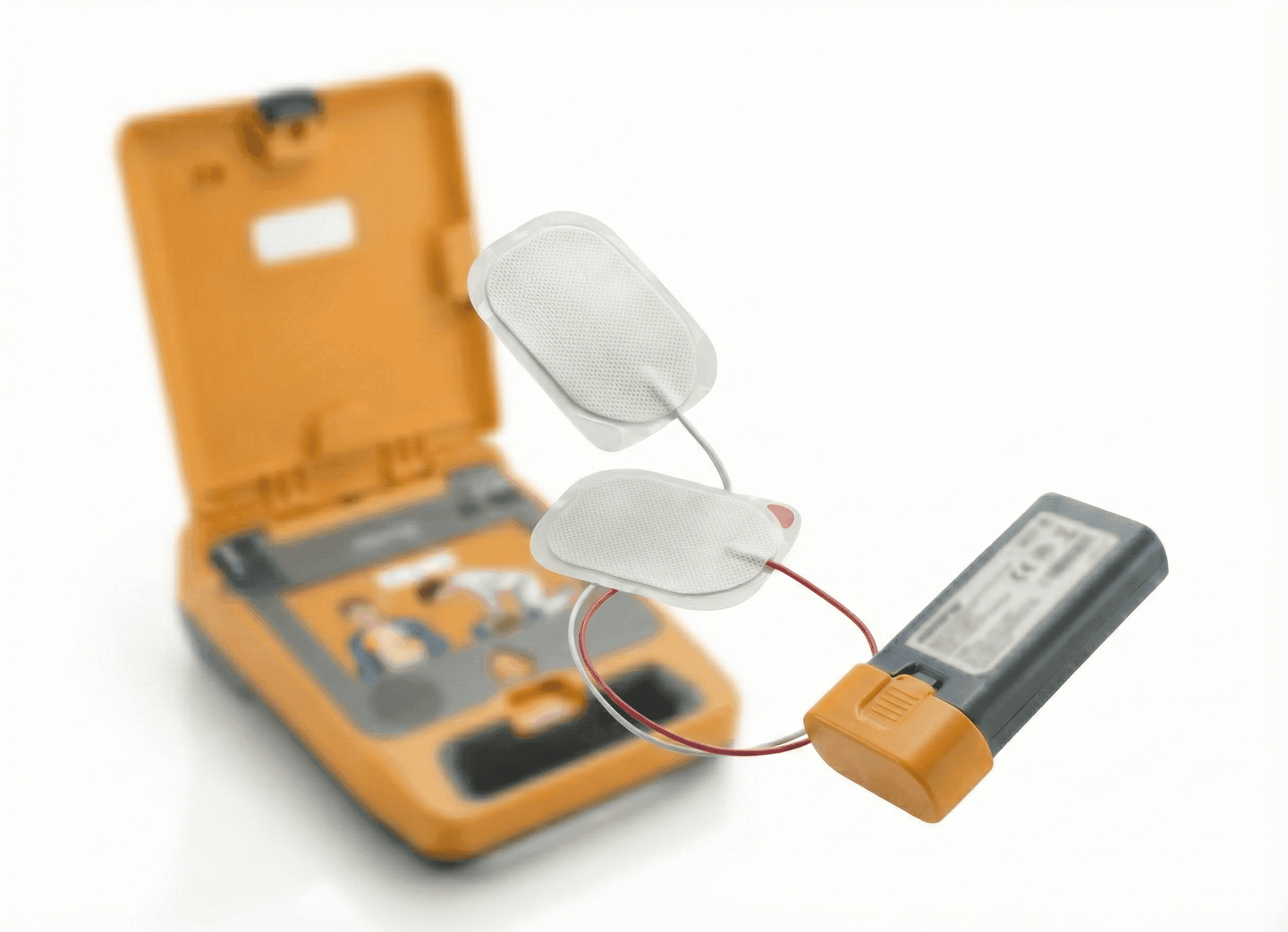
For a child under eight or under 25 kilograms, the shock energy must be reduced. Manufacturers offer either paediatric pads or a key or mode that attenuates the energy delivered. A holiday centre that welcomes both young and older children should therefore choose a compatible device and keep the paediatric pair with it, with its expiry date tracked like that of the adult pads.
If no paediatric pads are available, adult pads are still better than no defibrillation. This fallback should not become the rule in a place dedicated to children.
Outings, trips and the portable defibrillator
This is the trickiest point. A forest outing, a day at the beach or a stay in a gîte puts the group far from the fixed defibrillator, sometimes without reliable phone coverage. The organiser can take a device in a suitable carry bag, with its pads and a first aid kit, and keep it in the vehicle or the lodging for the whole stay.
A portable device requires the same precautions as a fixed one: self-test checked before departure, pads within their expiry date, protection from heat and cold according to the manufacturer's instructions. Before each departure, one team member is designated to take it and knows where it is in the vehicle.
| Situation | Habit to plan for |
|---|---|
| Activity on the premises | Know where the device is and how to reach it outside usual hours |
| Outing on foot or by coach | Take the device, its pads and the carry bag |
| Stay in lodging | Keep the device visible and accessible, check the self-test on arrival |
| Area without phone coverage | Decide in advance who raises the alarm and by what means |
Training the activity team before each season
Activity teams change a lot from one period to the next, with young people hired for the summer or the holidays. A device, however well installed, is useless if nobody knows how to use it. Life-saving training open to all leaders, not only management, makes it possible to react without depending on a single qualified person.
A short simulation exercise at the start of the season, covering the call to emergency services, starting chest compressions and placing the pads, is enough to anchor the right reflexes. Repeating this training every year remains the best way to keep a team ready despite staff turnover.
Maintenance and the operator's obligations
Maintenance of the defibrillator is the operator's responsibility, under article R. 5212-25 du Code de la santé publique (French Public Health Code). Pads are replaced every 2 to 5 years, the battery every 3 to 5 years, and the device lasts 8 to 10 years or more. A device stored all winter in a closed room must be checked before activities resume.
For a fixed device, registration in GéoDAE remains mandatory and signage follows the arrêté du 29 novembre 2018 (order of 29 November 2018). Rental, from €50 excl. VAT per month with maintenance included, can suit seasonal or voluntary organisations that prefer not to manage consumables themselves.
Frequently asked questions
Does a holiday centre have to have a defibrillator?
It depends on the ERP classification of the premises and their category. Categories 1 to 4 are concerned, as well as some category 5 ERPs. The manager must check the exact classification and make sure an accessible device exists in the building, either their own or the host establishment's.
Are paediatric pads needed for a children's venue?
For a child under eight or under 25 kilograms, the energy must be reduced using paediatric pads or an attenuation key, so they are strongly recommended. Failing that, adult pads are still preferable to no shock at all.
Can a defibrillator be taken on outings or trips?
Yes, in a suitable carry bag with its pads. Check the self-test before leaving, respect the temperature conditions given by the manufacturer and designate who carries it. On site, the device stays visible and accessible to the whole team.
Which activity leaders should be trained?
Ideally every team member, including seasonal staff, not only management. Life-saving training, completed by an exercise at the start of the season, lets anyone react quickly, whichever leader is present when the emergency happens.
Planning an AED project?
Purchase, rental from 50 EUR excl. VAT per month, installation with GéoDAE registration, servicing and training: our team replies within 24 hours.