Defibrillators in museums and heritage sites: obligations
Written by Cyrille GAGNAIRE, France Défibrillateur. Published on 29 September 2026.
A museum welcomes visitors of all ages, often on their feet for hours, in large and sometimes listed buildings. A cardiac arrest can happen there as anywhere else, and emergency services need time to cross galleries, stairs and ticket halls. Here is what the manager of a heritage venue needs to know: obligations by category, choosing the location, constraints specific to old buildings, maintenance and staff training.
What the regulations require of a venue open to the public
A museum, château, monument or exhibition centre receiving the public is an ERP (établissement recevant du public, a building open to the public). The obligation to install a DAE (défibrillateur automatisé externe, in English an AED, automated external defibrillator) depends on its category, which is set by capacity: ERP of categories 1 to 3 have had to be equipped since 1 January 2020, category 4 since 2021, and some category 5 ERP since 2022. This obligation comes from loi 2018-527 (the French law of 2018) and décret 2018-1186 (the implementing decree).
A heritage site often comprises several buildings: a town house and its annex, a château and its outbuildings. Each one may fall under its own category. The simplest approach is to ask the safety commission or the town hall for the exact classification of each building before sizing the equipment.
Why speed matters even more in a large building
Around 50,000 cardiac arrests occur in France every year, and each minute without defibrillation reduces the chance of survival by about 10%. In a museum, time is lost less on the road than inside the building: someone must spot the incident, alert a staff member, fetch the device and bring it back.
Visitors to a cultural venue are often elderly people, school groups or tourists who do not know the premises. Reception and surveillance staff, present in every gallery, therefore become the first link in the chain of survival. The device must be within reach of a staff member, not in a locked office.
Choosing the location within a visitor route
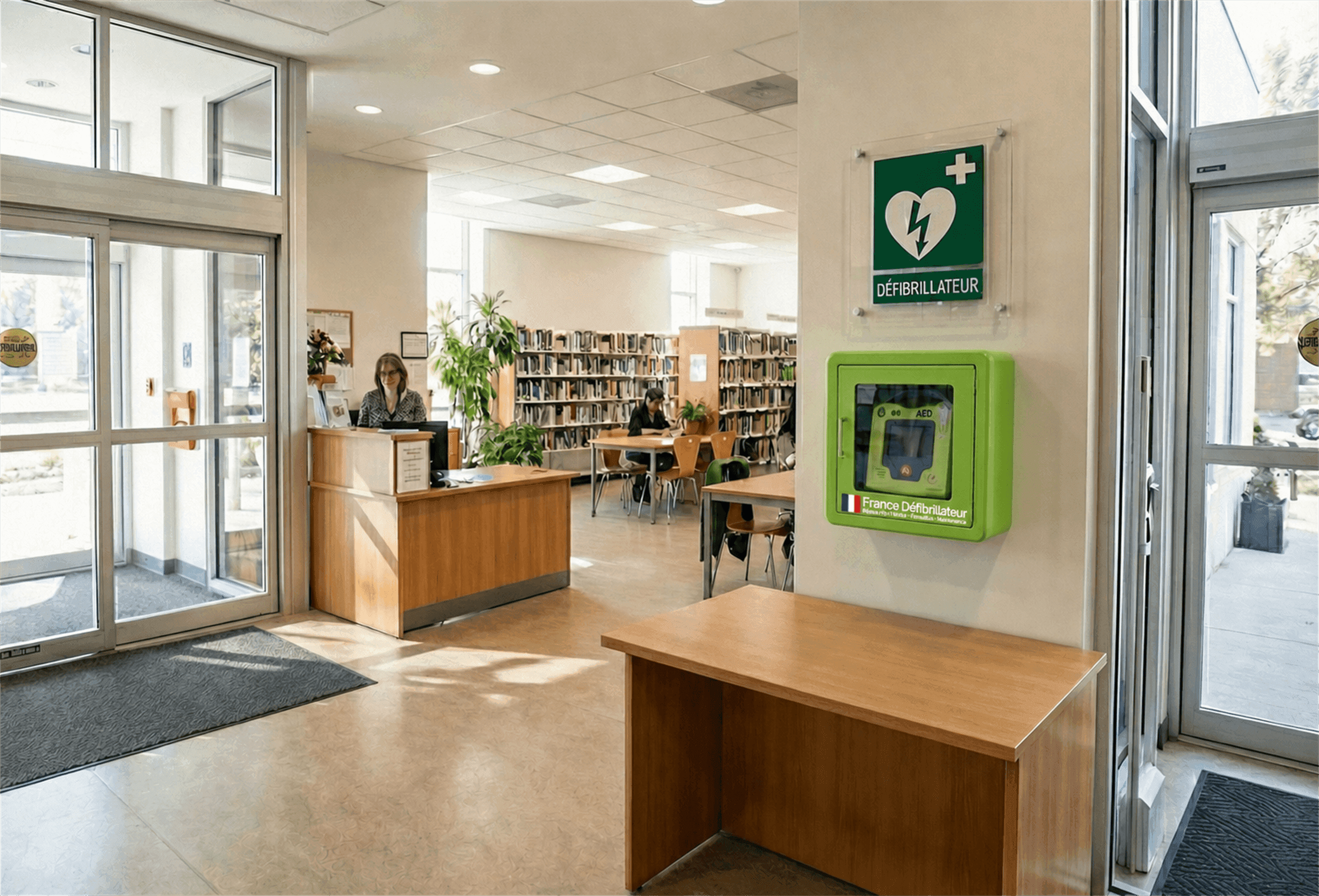
The defibrillator must be accessible during all opening hours, without a key or a complicated code, and visible from a busy area. The reception desk or entrance hall is often the best choice, since a staff member is always present there. For a large site, a second device halfway along the route may be justified.
A simple test is to time a round trip on foot between the most distant galleries and the device. If the journey seems long, the equipment should be moved closer or another one added. The number of devices is therefore decided by the real layout of the premises, not by a uniform rule.
Working with an old or protected building
In an old building, fixing a cabinet to the wall can be a problem: cut-stone walls, decorations, woodwork, protected perimeters. Before any drilling, the manager contacts the building owner and the heritage services to agree on an acceptable solution.
Several options exist: a cabinet placed on existing reception furniture, a free-standing support, or installation in a technical room near the hall. The choice between an indoor and an outdoor cabinet depends on exposure to weather and temperature. A DAE placed in an unheated room or in a courtyard must stay within the operating range specified by the manufacturer.
The manager also checks that the chosen equipment carries the CE marking and that the manufacturer states the storage conditions. This information appears in the instructions for each device.
Signage, registration and maintenance
Signage follows the arrêté du 29 novembre 2018 (the French order of 29 November 2018): the standard pictogram must guide people from the entrance to the device, with consistent arrows along the circulation routes. In a carefully designed setting, one chooses discreet but compliant supports. A sign nobody can see is useless on the day someone looks for the device.
Registration in GéoDAE is mandatory. It allows emergency services to locate the device and tell people who call 15, the French emergency medical number, where it is, provided the access hours entered match the museum's opening hours.
Maintenance is the operator's responsibility (article R. 5212-25 du Code de la santé publique, the French Public Health Code). Electrodes are replaced every 2 to 5 years, batteries every 3 to 5 years, and the device itself after 8 to 10 years or more. Regular checks of the self-test indicator, recorded in a register, avoid unpleasant surprises. Museums that close seasonally plan a check before reopening.
| Item | Indicative lifespan | Operator's action |
|---|---|---|
| Electrodes | 2 to 5 years | Replace before the expiry date |
| Battery | 3 to 5 years | Replace according to the manufacturer's instructions |
| Device | 8 to 10 years or more | Plan for its replacement |
Training reception and surveillance teams
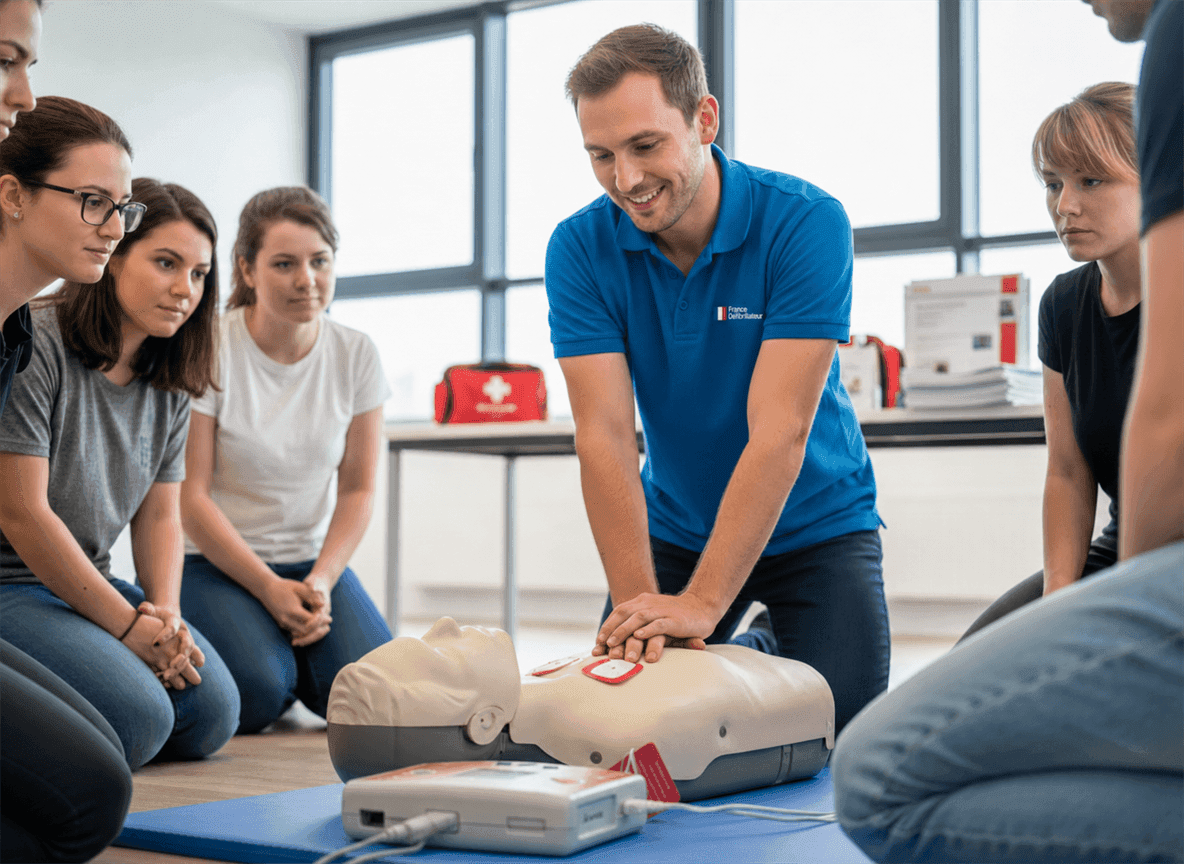
An automated defibrillator guides the user by voice, but its effectiveness depends on teams who do not hesitate. Awareness training in life-saving actions for reception, surveillance and visitor-engagement staff makes it possible to recognise a cardiac arrest, raise the alarm, perform chest compressions and use the device.
Museum staff are often numerous and changing: temporary workers, seasonal staff, security contractors. It is useful to plan a session at the start of each season and to check that at least one trained staff member is present at every opening hour. A short field exercise, device in hand, helps people remember the route.
Buying or renting for a cultural site
Managers of heritage venues often have tight budgets and long decision cycles. Renting, from €50 excl. VAT per month with maintenance included, spreads the cost and hands the monitoring of consumables to a provider. Buying suits organisations that prefer to control their own equipment, with a 5-year warranty.
France Défibrillateur delivers in 2 to 5 working days and provides a quote within 24 hours, which leaves time to prepare the location and the training before installation.
Frequently asked questions
Does a museum have to have a defibrillator?
A museum is an ERP. It must be equipped if its category requires it: since 2020 for categories 1 to 3, since 2021 for category 4, and since 2022 for some category 5 ERP. The exact classification can be checked with the safety commission or the town hall.
Where should the defibrillator go in a château or monument?
Ideally at reception or in the hall, near a permanently present staff member, visible and accessible without a key during opening hours. On a large site, time the walk from the most distant areas to decide whether a second device is needed.
Can a cabinet be fixed in a protected building?
It depends on the building and its status. Discuss it with the owner and the heritage services before any drilling. Solutions without fixings, such as a free-standing support or reception furniture, often exist.
Does the device have to be registered in GéoDAE?
Yes, registration is mandatory. It lets emergency services know where the device is. The access hours entered must match the museum's opening hours, including seasonal closures.
Who is responsible for maintaining the defibrillator?
Maintenance falls to the operator, under article R. 5212-25 du Code de la santé publique. It includes monitoring the self-test, replacing electrodes and battery, and keeping a register. A rental contract includes this maintenance.
Planning an AED project?
Purchase, rental from 50 EUR excl. VAT per month, installation with GéoDAE registration, servicing and training: our team replies within 24 hours.