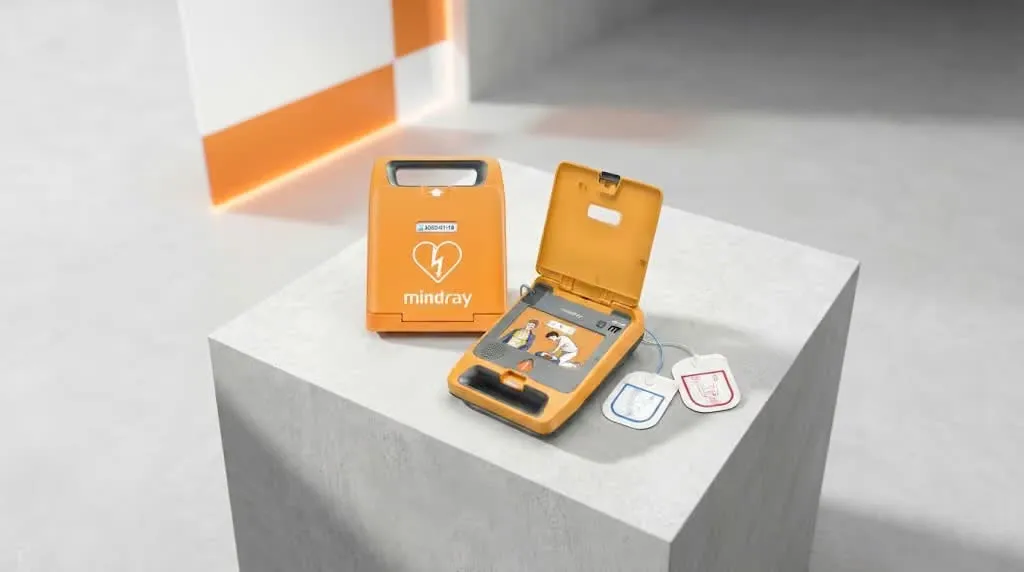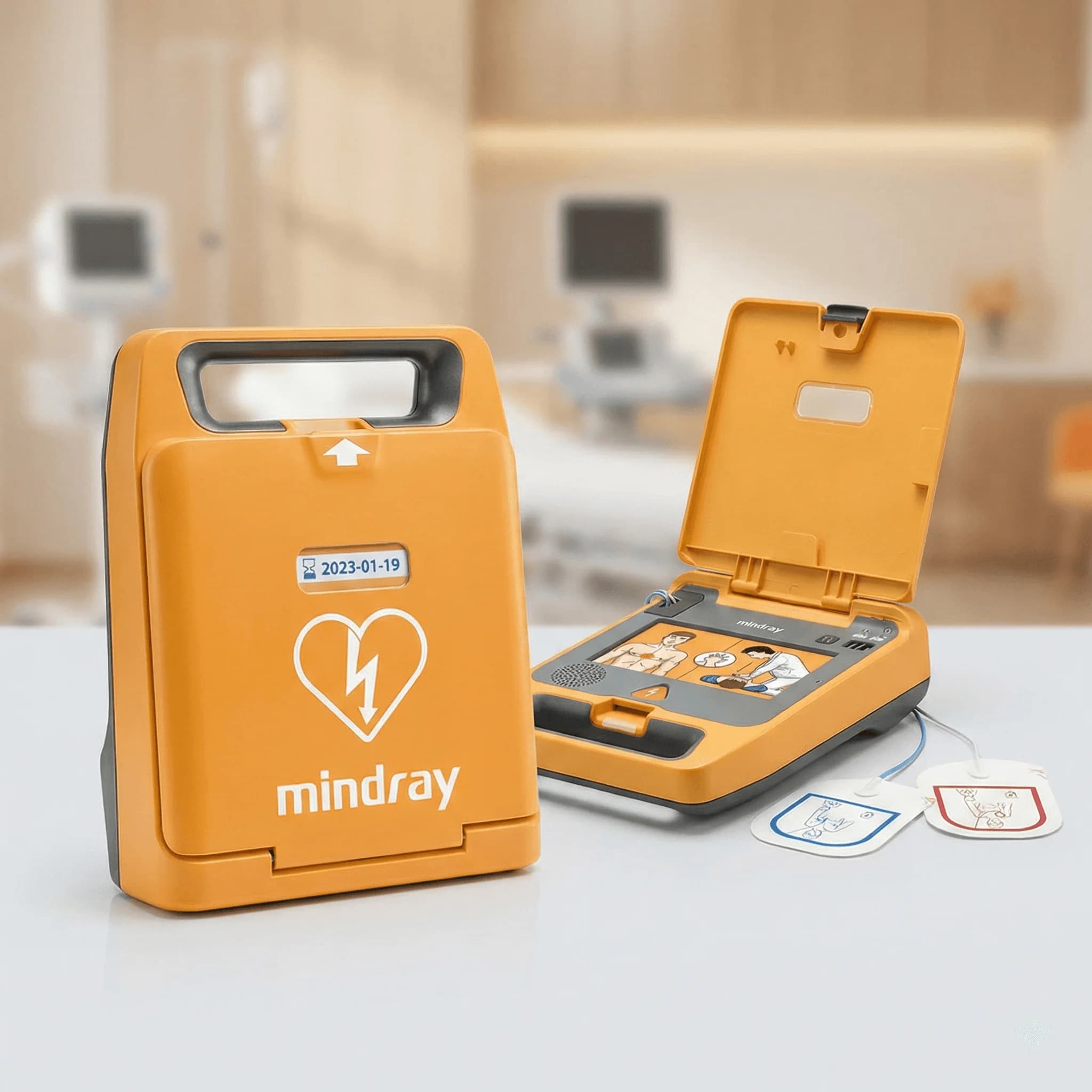
AED in a library or media library: obligations and best practice
Written by Cyrille GAGNAIRE, France Défibrillateur. Published on 30 September 2026.
A media library welcomes readers of all ages, from children on Wednesday afternoons to older visitors who come every week, often for hours and across several floors. A cardiac arrest can happen there as anywhere else. Here is what the person in charge of such a facility needs to know: obligations depending on the ERP category (public-access building), choice of location, maintenance, and staff training.
What the regulations require of a public reading venue
A library, media library or toy library open to the public is an ERP (établissement recevant du public, a building open to the public). The obligation to install an automated external defibrillator (AED, in French DAE) depends on its category, which is set by capacity: ERP of categories 1 to 3 have had to be equipped since 1 January 2020, category 4 since 2021, and certain category 5 ERP since 2022. The framework is set by loi 2018-527 (French law of 2018) and décret 2018-1186 (French decree of 2018).
Many municipal media libraries belong to a larger complex: a cultural centre, a community hub, a building shared with a performance hall. In that case the category is assessed for the whole building. The most reliable approach is to ask the town hall or the safety commission for the exact classification before sizing the equipment.
A loyal, sometimes fragile audience in a large building
France sees about 50,000 cardiac arrests a year, and every minute without defibrillation reduces the chance of survival by about 10%. Time is lost quickly in a multi-storey building: spotting the person on the floor, alerting a staff member, fetching the device, coming back.
Readers sit or stand among shelving that blocks the view. Someone who collapses between two rows may go unnoticed for a moment. Front desk staff and librarians move through the rooms and are often the first link in the chain of survival, so their training matters as much as the equipment.
Choosing the location and signage
The AED must be visible, accessible without a key and quickly reachable from any room. The front desk is a good candidate, provided it is staffed during all opening hours. In a building with several floors, consider one device per level if stairs or the lift slow the journey too much.
Signage follows the arrêté du 29 novembre 2018 (French ministerial order): a standard pictogram above the device and directional signs from the main circulation routes. Avoid tucking the cabinet behind a display stand or exhibition furniture. An indoor wall cabinet is enough if the building is closed to the public outside opening hours; if the AED must remain reachable from outside, a suitable outdoor cabinet is needed.
The site must also register the device in GéoDAE, which is mandatory. This registration lets emergency services locate it when a call comes in.
Maintenance: what remains the operator's responsibility
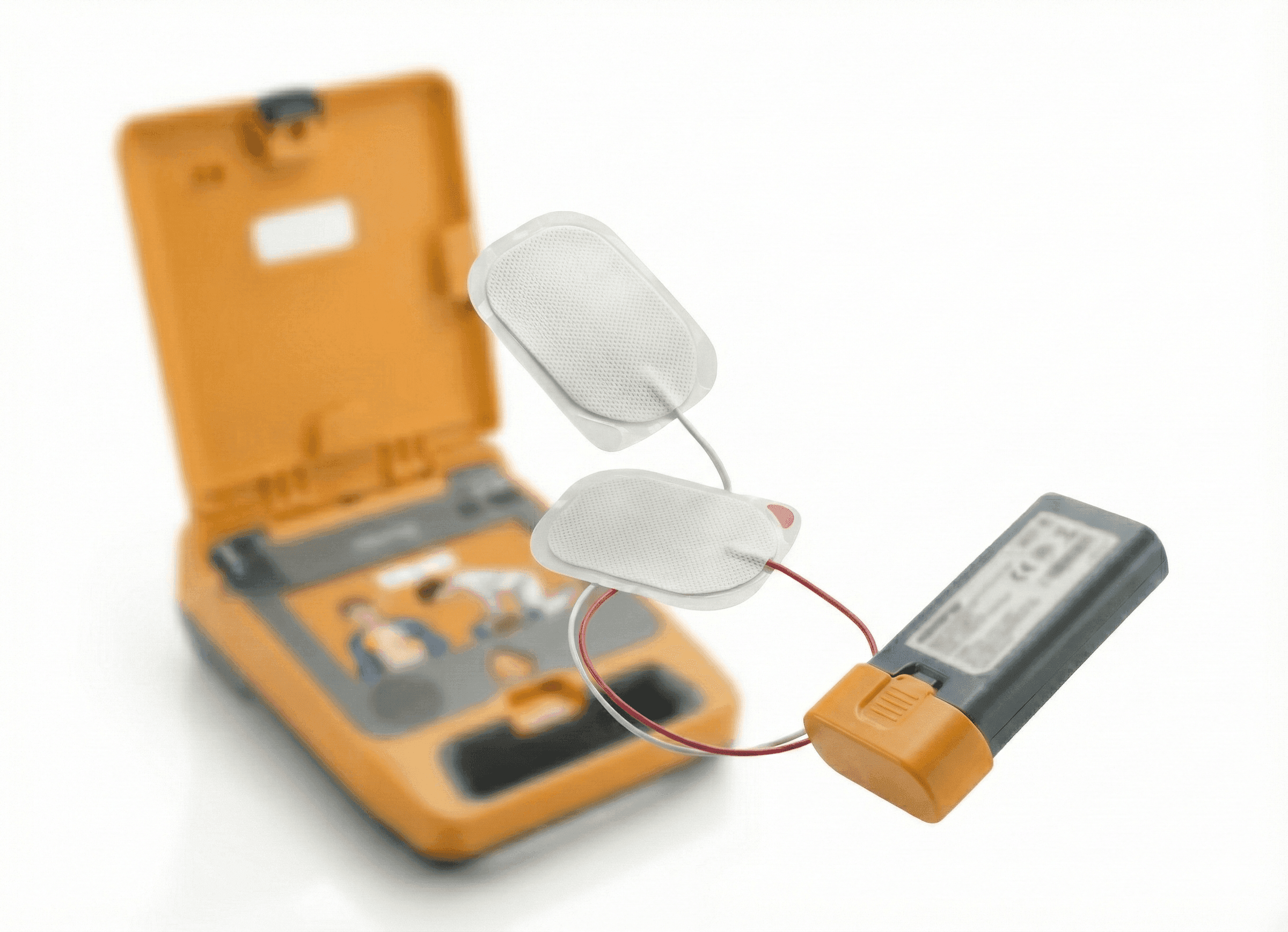
Maintenance of the defibrillator falls to the operator, under article R. 5212-25 du Code de la santé publique (French Public Health Code). In practice, this means monitoring the self-test, replacing consumables and keeping a record of checks. Electrodes last 2 to 5 years, batteries 3 to 5 years, and the device itself 8 to 10 years and more.
In a local authority, these tasks are often spread across several departments. Appoint one lead person, with a deputy, and enter expiry dates in a shared calendar. A visual check at each morning opening is enough to spot an indicator that has changed state.
| Item | Indicative lifespan |
|---|---|
| Electrodes | 2 to 5 years |
| Battery | 3 to 5 years |
| Defibrillator | 8 to 10 years and more |
Training staff and organising the response
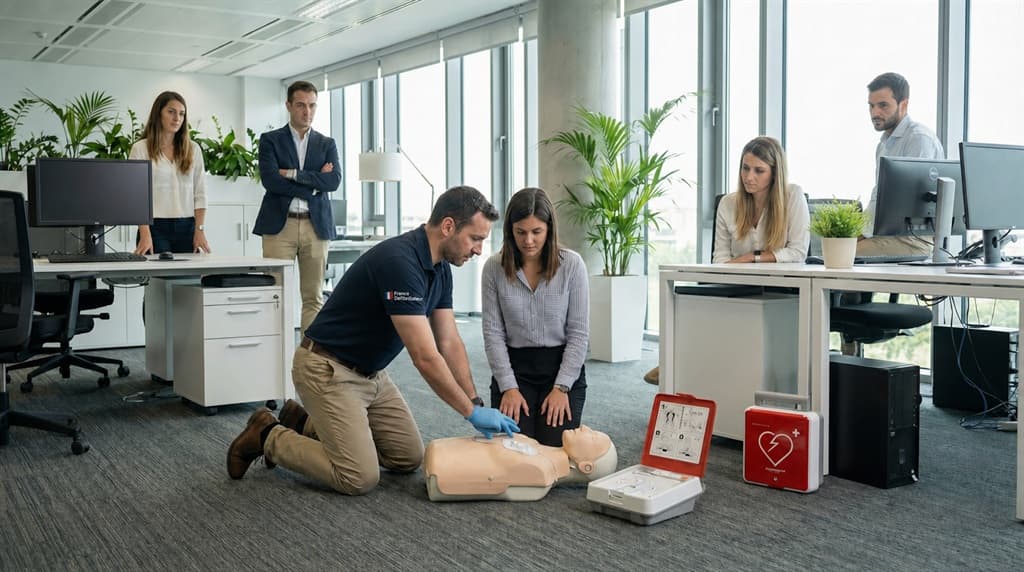
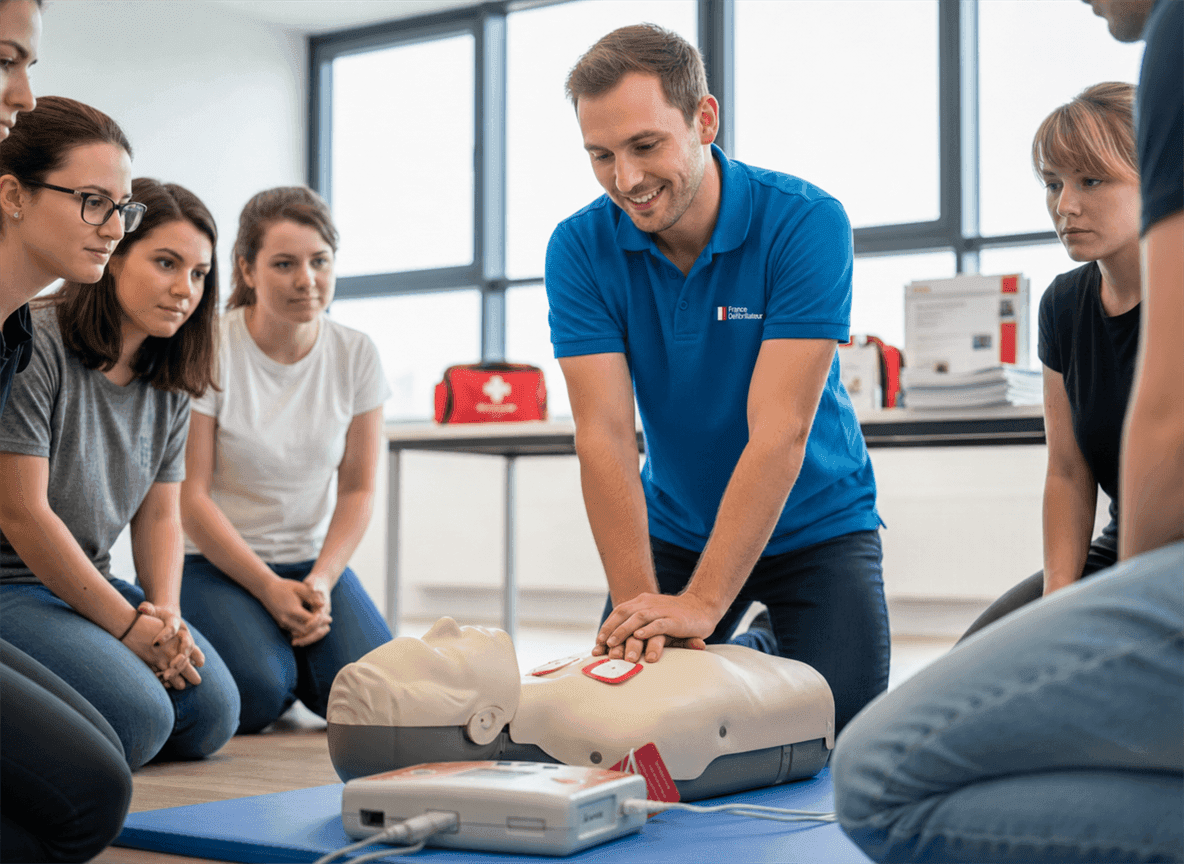
A defibrillator is designed to be usable by anyone, but a team that has already practised chest compressions and handled a training device reacts faster. A short awareness session for all staff, with regular refreshers, is a good starting point. More complete courses, such as SST (workplace first aid), suit a few key people present in every time slot.
Also provide a simple written instruction: who calls 15 or 112, who brings the AED, who meets the emergency services at the entrance and guides them to the casualty. These roles can be rehearsed in a drill of a few minutes, outside busy hours.
Buying or renting for a public facility
A small municipality or a managing association may prefer renting, from 50 € excl. VAT/month with maintenance included, to spread the cost and delegate consumables tracking. Buying suits a setup where a technical department carries out the checks itself. In both cases the warranty is 5 years, delivery takes 2 to 5 working days and a quote is provided within 24 hours.
Frequently asked questions
Does a media library have to have a defibrillator?
It depends on its ERP category. Categories 1 to 3 have been equipped since 2020, category 4 since 2021 and certain category 5 ERP since 2022. Ask the town hall or the safety commission for your building's exact classification before deciding.
Where should the defibrillator go in a library?
At the front desk or near a main circulation route, visible and keyless, with the standard pictogram and directional signs from the rooms. In a multi-level building, consider one device per floor if the journey becomes too long.
Who is responsible for maintenance in a local authority?
The operator, under article R. 5212-25 du Code de la santé publique. In a municipality it helps to appoint a lead person and a deputy to follow the self-test, the expiry dates of electrodes and battery, and the check register.
Must the defibrillator be registered in GéoDAE?
Yes, registration in GéoDAE is mandatory. It lets emergency services know where the device is and guide a bystander to it during an emergency call. Remember to update the record if the device is moved or replaced.
Can a defibrillator be rented for a media library?
Yes, rental starts at 50 € excl. VAT/month, maintenance included. It spares the authority from tracking consumables itself. A quote is provided within 24 hours, and delivery takes 2 to 5 working days.
Planning an AED project?
Purchase, rental from 50 EUR excl. VAT per month, installation with GéoDAE registration, servicing and training: our team replies within 24 hours.