AED in a Village Hall: Obligations and Practical Use
Written by Cyrille GAGNAIRE, France Défibrillateur. Published on 4 October 2026.
The village hall hosts weddings, club meals, bingo evenings, school shows and public meetings. Audiences change constantly, ages mix, and physical effort or emotion are never far away. For the municipality or association that runs the venue, the question of the defibrillator is very concrete: must one be installed, where, and who is answerable for it?
A village hall is a building open to the public
A village hall (salle des fêtes) or multipurpose room falls under the ERP regime, meaning établissements recevant du public, French buildings open to the public. Depending on its activity and capacity, it is classed in one of categories 1 to 5. This classification sets the timetable for equipping it with an automated external defibrillator (AED, known in France as DAE).
ERP of categories 1 to 3 had to be equipped from 1 January 2020, category 4 from 2021, and some category 5 ERP from 2022. These rules come from loi 2018-527 (the 2018 law) and décret 2018-1186 (the implementing decree). Most medium-sized municipal halls fall into category 4 or 5, but only the safety commission or the opening order can confirm this for a given venue.
Beyond the obligation, the logic is simple: for an evening, a village hall gathers more people than an entire street, often far from emergency departments and sometimes in rural areas where responders take longer to arrive. Having a device on site bridges that gap.
Who must equip the hall
The obligation rests on the operator of the building. For a municipal hall, in practice that is the municipality or the inter-municipal body that owns it. When management is entrusted to an association or a festival committee by agreement, the document should state in writing who buys, who maintains and who answers in case of failure.
One point comes up often: a hall hired occasionally to an individual or a club does not change who is responsible. The defibrillator belongs to the building, not to the event. The hirer need not bring one, but must know where the hall's device is.
Also consider insurance: the municipality or association should tell its insurer about the device and keep proof of the checks carried out, which helps in a dispute.
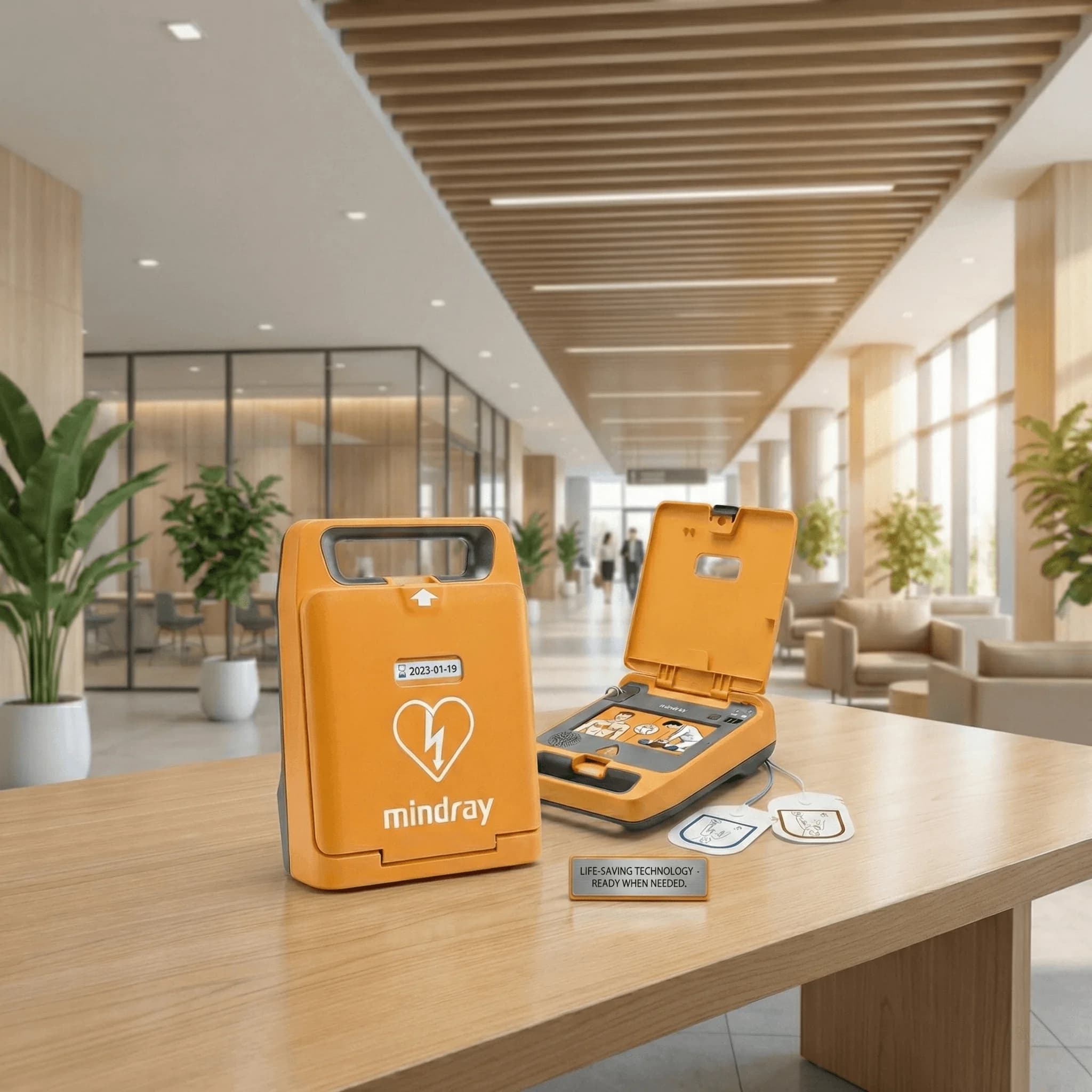
Choosing the location and the cabinet
A multipurpose hall often has several areas: main room, stage, kitchen, changing rooms, entrance hall. The defibrillator must be reachable from all of them without a key or code, which rules out a locked cupboard in the control room or storage space.
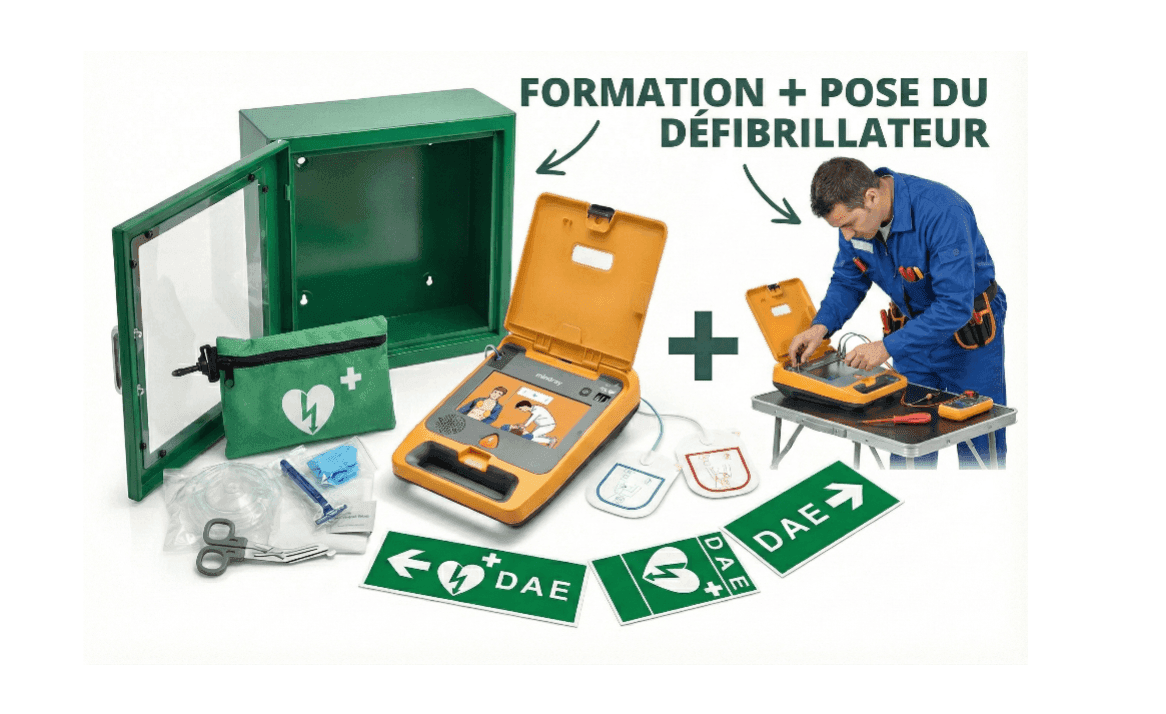
The entrance hall, near the main exit, is generally the best choice: visible, easy for responders to find, close to vehicle access. If the hall is used outside the opening hours of any other service, an outdoor cabinet, heated if needed, makes the device available to passers-by. Signage must follow the arrêté du 29 novembre 2018 (the 29 November 2018 order), with directional signs from the various points of the hall.
| Situation | Suitable solution |
|---|---|
| Hall used during the day only | Indoor cabinet in the entrance hall |
| Hall open evenings and weekends | Outdoor cabinet visible from the public road |
| Hall with a stage and separate areas | Directional signs from each zone to the device |
| Hall welcoming children | Paediatric pads or a suitable mode to plan for |
Maintenance and responsibility across rentals
Maintenance is the operator's responsibility, under article R. 5212-25 du Code de la santé publique (the French Public Health Code). A village hall defibrillator often goes several weeks without being handled: its self-test may then flag a pad or battery fault that nobody sees unless it is checked regularly.
To avoid this, appoint a lead person and add a check of the status light to the inventory of each hire. Pads are generally replaced every 2 to 5 years, batteries every 3 to 5 years, and the device itself lasts 8 to 10 years or more. A busy hall may also opt for a rental with maintenance included, from 50 € excl. VAT per month, which spares you from tracking these deadlines yourself.
Do not forget the GéoDAE registration, which is mandatory, so that emergency services can locate the device when the call comes in.
Informing and training the hall's users
A well-placed defibrillator is only useful if someone dares to use it. User associations, cleaning staff and elected officials who open the hall benefit from awareness training in life-saving first aid. It takes little time and reassures on one essential point: the device guides the user by voice.
Around 50,000 cardiac arrests occur in France each year, and each minute without defibrillation reduces the chances of survival by about 10%. In a place where people dance, eat and get emotional, those minutes count. Display the emergency number and the device's location at the entrance, and remind organisers of both in the hall's rules of use.
Frequently asked questions
Must a village hall be equipped with a defibrillator?
It depends on its ERP category. Categories 1 to 4 are subject to the obligation, and some category 5 ERP have been too since 2022. Even where the law does not require it, installation is strongly advised for a venue that regularly welcomes the public.
Who is responsible for the defibrillator when the hall is hired out?
The building operator, meaning the municipality or managing association, remains responsible for the device and its maintenance. The hirer simply needs to be told where it is and how to use it before the event.
Where should the defibrillator go in a multipurpose hall?
In the entrance hall or a central corridor, visible and reachable without a key or code from every zone. If the hall is used in the evening, an outdoor cabinet lets people reach it even when the building is closed, with compliant signage.
Must a municipal hall's defibrillator be registered?
Yes, registration in GéoDAE is mandatory. It lets emergency services know that the device exists and where it is, and guide a bystander to it during the emergency call.
Planning an AED project?
Purchase, rental from 50 EUR excl. VAT per month, installation with GéoDAE registration, servicing and training: our team replies within 24 hours.