AED Signage: Required Signs and Directional Markers
Written by Cyrille GAGNAIRE, France Défibrillateur. Published on 12 August 2026.
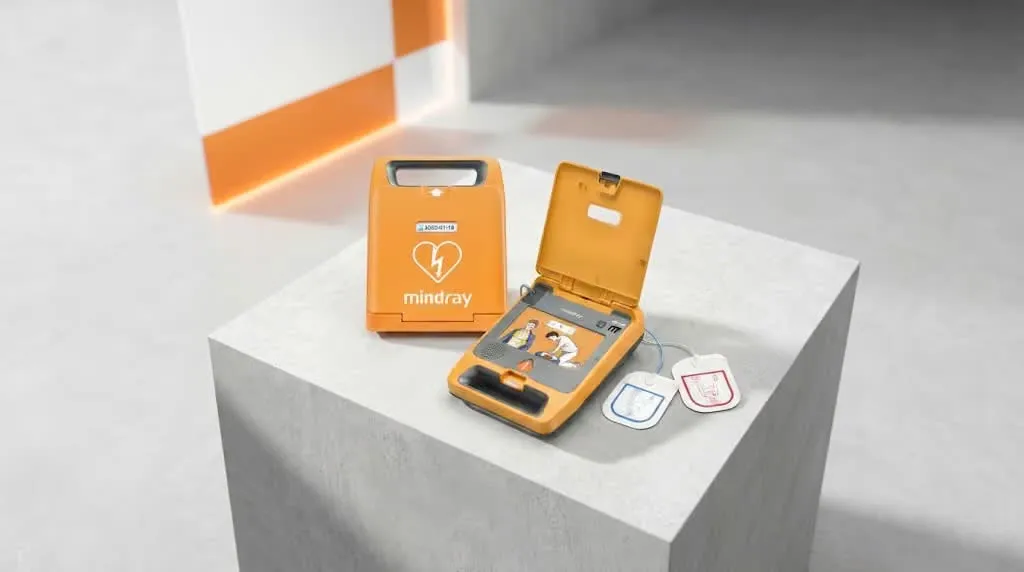
A well maintained defibrillator is useless if nobody knows where it is. In an emergency, every second spent searching for the device reduces the chances of survival. The French order of 29 November 2018 sets out the signage rules for automated external defibrillators (AED), so that a bystander can spot one and reach it without hesitation, even in an unfamiliar building.
What the order of 29 November 2018 requires
This French text sets the characteristics of the sign that must accompany every automated external defibrillator installed in a public place. It requires a standardised pictogram, recognisable regardless of the bystander's language, paired with the wording DAE or defibrillator.
The sign must stay visible at all times, day and night, and must not be hidden by furniture, a poster or a curtain. A sign that was correctly installed but later covered by new interior decoration is no longer compliant, even if the device itself works perfectly.
This requirement adds to the equipment obligation itself, which follows the schedule set by loi 2018-527 (the French AED law) and décret 2018-1186 (its implementing decree): category 1 to 3 sites since 1 January 2020, category 4 since 2021, and some category 5 sites since 2022. Installing the device without signing it only fulfils half the obligation.
Where to place the signs across a building
Signage works in two steps. A first sign announces the presence of the defibrillator right at the entrance of the building or site, so that anyone walking in knows a device is available. Directional markers then guide the way to the cabinet, at every corridor junction or change of floor.
In a large building, a car park or a site with several entrances, it is better to multiply reference points rather than rely on a single sign, however visible it may be. The goal stays the same: a visitor unfamiliar with the premises should find the device in under a minute.
On a multi-building site, such as a school campus or an industrial park, the location of the cabinet itself also matters. A centrally placed defibrillator with poor directional markers will be less effective than a slightly off-centre one, provided the path to reach it is clearly marked from every entry point.
| Area of the building | Recommended signage |
|---|---|
| Main entrance | AED sign visible from the access point, at eye level |
| Corridors and circulation routes | Directional arrows at every junction |
| Outdoor car park or secondary access | Dedicated sign if the cabinet is not visible from the entrance |
| Reception or front desk | Reminder of the exact location, useful for internal calls |
The pictogram and what a sign must show
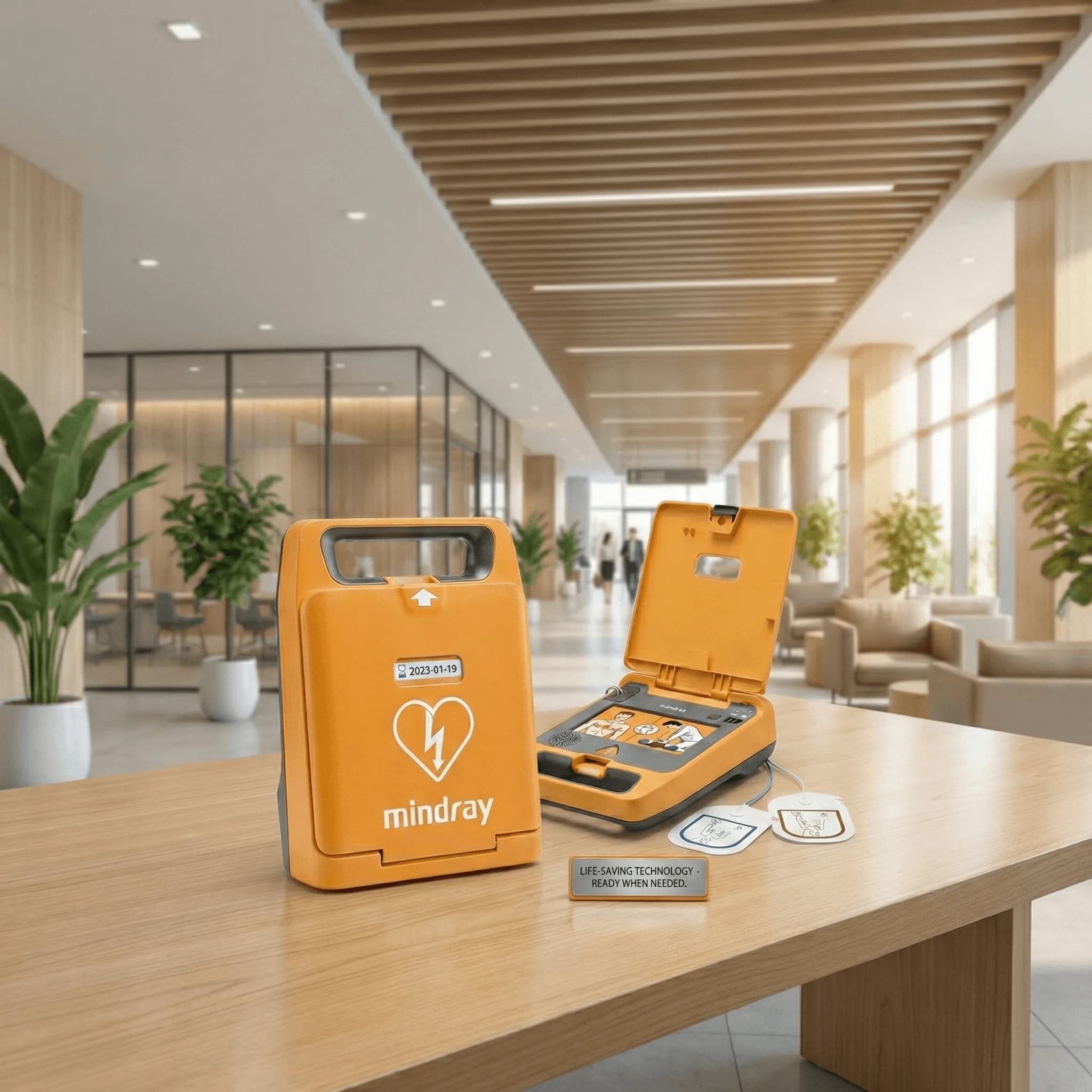
The pictogram set by the order shows a heart crossed by a lightning bolt on a green background, available in a rectangular or square version. This symbol is the same across all of France and is close to the models used in several other European countries, which helps a foreign visitor recognise it.
A compliant sign does not need to be customised or redesigned by the establishment. Defibrillator manufacturers and distributors supply ready-to-install models, often included in installation packs alongside the wall bracket and the maintenance label.
Some establishments add complementary signage, such as a reminder of the emergency number or a short instruction note near the cabinet. These additions remain optional and do not replace the regulatory sign, but they can reassure a bystander unfamiliar with this kind of situation.
Who is responsible for the signage
Installing and maintaining the signage falls to the site operator, on the same basis as maintaining the device itself under article R. 5212-25 of the French public health code (Code de la santé publique). A poorly signed defibrillator carries the same risk as a defibrillator out of service: in an emergency, it will not have fulfilled its purpose.
This point is regularly checked during safety inspections, alongside the maintenance log and the expiry dates of the pads. An operator who outsources maintenance to a provider should verify that signage is explicitly included in the contract, rather than treating it as a minor detail.
Keeping signage consistent with the GéoDAE registration
Physical signage and the GéoDAE registration (the French national AED database) pursue the same goal, making the defibrillator easy to find, but they address two different audiences. The sign guides a bystander already on site, while the registration lets the emergency dispatcher direct a caller to the nearest device.
It is worth checking that the address and location description entered in GéoDAE exactly match what the on-site signage indicates, for instance building A, entrance hall. A mismatch between the two needlessly slows down guidance for a caller in the middle of an emergency.
What to do when moving or relocating the device
Moving a defibrillator, even by a few metres, means reviewing the entire directional signage leading to it and updating the corresponding GéoDAE entry. An old sign left pointing to an empty spot misleads a bystander in a hurry, which can cost precious minutes.
During renovation work, a change of tenant or a reorganisation of the premises, it is advisable to add the defibrillator signage to the checklist reviewed before handing the premises back into service, alongside emergency lighting and fire exits.
Frequently asked questions
Is defibrillator signage really mandatory?
Yes, the order of 29 November 2018 requires a compliant sign for every automated external defibrillator installed in a place open to the public. This obligation comes on top of the requirement to equip qualifying establishments and is not merely a matter of good practice.
Does the sign differ depending on the type of building?
No, the national pictogram is the same everywhere, whether the site is a town hall, a shop or a sports hall. Only the layout of the directional markers changes, depending on the size of the site and the number of entrances to cover.
Who supplies the signs when buying a defibrillator?
Most installation packs include a set of compliant signs, delivered together with the wall bracket and the maintenance label. Otherwise, the models can be ordered separately from the defibrillator supplier.
What does an establishment risk without compliant signage?
During an inspection, missing or non-compliant signage can be flagged in the same way as a maintenance failure. More importantly, it actually delays access to the device during a cardiac arrest, which defeats the very purpose of the equipment.
How can visibility of the signage be checked over time?
Simply add this check to the maintenance rounds already carried out, looking for a sign hidden by a poster, furniture or renovation work. This check takes a few seconds and prevents a fault from going unnoticed for months.
Planning an AED project?
Purchase, rental from 50 EUR excl. VAT per month, installation with GéoDAE registration, servicing and training: our team replies within 24 hours.