Registering your defibrillator on Geo'DAE and signposting it correctly
Written by Cyrille GAGNAIRE, France Défibrillateur. Published on 28 July 2026.
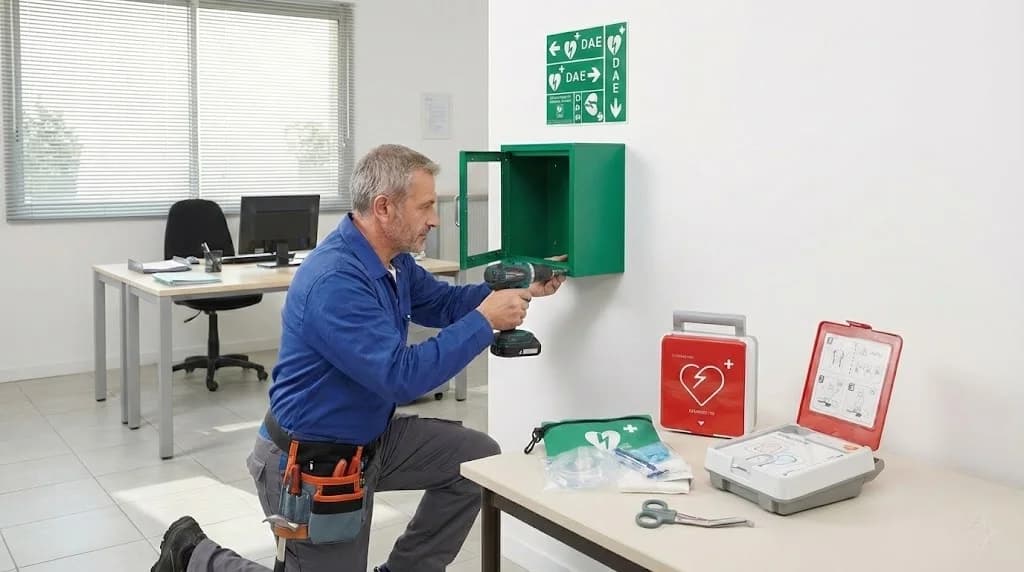
Installing a defibrillator is not enough to meet your obligations. Two administrative steps determine whether it is genuinely useful: registering the unit on the national Geo'DAE database, and displaying the signage set out in the regulations. The first makes the DAE (AED) visible to emergency services and public alert apps, the second allows a bystander to find it in under a minute. Here is the procedure, step by step, for anyone operating a site.
A national database created by decret n° 2018-1259
Decret n° 2018-1259 du 27 decembre 2018 (French decree of 27 December 2018) makes the ministry responsible for health the manager of the national database of automated external defibrillators, created by article L. 5233-1 du Code de la sante publique (French Public Health Code). The arrete du 29 octobre 2019 (ministerial order of 29 October 2019) sets out how this database, known as Geo'DAE, operates, along with the list of information that operators must submit: precise location, hours of accessibility and technical characteristics of each unit.
The stakes are far from theoretical. The data feeds emergency services and the public apps used to locate defibrillators. An unregistered unit remains invisible to the chain of survival: the SAMU dispatcher cannot direct a bystander towards it, and no app will display it. With around 50,000 cardiac arrests a year in France and roughly a 10 percent drop in the chance of survival for every minute without defibrillation, registration matters as much as buying the device.
Who registers the device, and with what information
Registering on the geodae.atlasante.fr portal is a legal obligation for the operator, meaning the individual or organisation that makes the defibrillator available to the public. Neither the manufacturer nor the distributor carries this responsibility, even though a service provider may complete the process on your behalf. The operator may be held liable for any omission, including for a rented unit: the rental company supplies the equipment, but the site operator remains responsible for registering it.
Gather the details before you log in, as data entry takes a few minutes. You will need the full address of the site and the exact position of the unit within the building, a description of the landmark that helps people find it from the entrance, the hours during which it is genuinely accessible to the public, and the technical characteristics of the DAE as shown on the manufacturer's label. Also note the name and contact details of the person responsible for monitoring the device within your organisation.
Step by step registration on geodae.atlasante.fr
Start by creating an operator account on the portal, using a generic organisational email address rather than a personal one: whoever succeeds the person who registered must be able to take over. Then register the site, followed by each unit attached to that site. An organisation with several premises creates one record per address, and an address equipped with several defibrillators creates one record per unit.
Place the marker on the map carefully. A correct postal address paired with a marker dropped in the middle of a site covering several hectares wastes precious time. Fill in the plain language location field as though you were guiding a stranger over the phone: entrance hall, right-hand wall, next to the reception desk. Enter the real access hours without rounding them: a defibrillator behind a door that is locked at weekends must be declared as such, otherwise emergency services will send a bystander to a unit they cannot reach.
Confirm the record, then keep the registration acknowledgement with the device documentation: this proof will be useful during an inspection or a change of operator. Take the opportunity to record the commissioning date and the expiry dates of the pads and the battery.
Relocation, replacement, decommissioning: when to update
The record must be updated after every installation, every relocation and every removal of a unit. The logic adopted by the legislation is event driven: it is not an annual review that triggers the change, it is the event itself. Treat updating the Geo'DAE record as a task for the same day as the physical work on the device, rather than a formality to be batched up later.
The table below summarises the most common situations and the matching action. Good practice is to assign each line to a named person and to file screenshots of the updated record in the safety register, alongside maintenance reports and staff training certificates.
| Event | Action in Geo'DAE | On site |
|---|---|---|
| Installation of a new DAE | Create the site record, then the device record | Put up the entrance sign, the directional signs and the label |
| Relocation within the building | Correct the map marker and the location description | Move the directional signs onto the new route |
| Change of opening hours | Update the hours of accessibility | Check that no locked door blocks the advertised access |
| Replacement of a unit at end of life | Update the technical characteristics of the new DAE | Renew the label carrying the maintenance information |
| Decommissioning or end of rental | Register the removal of the unit | Take down all signage that has become misleading |
Standard signage under the arrete du 29 octobre 2019
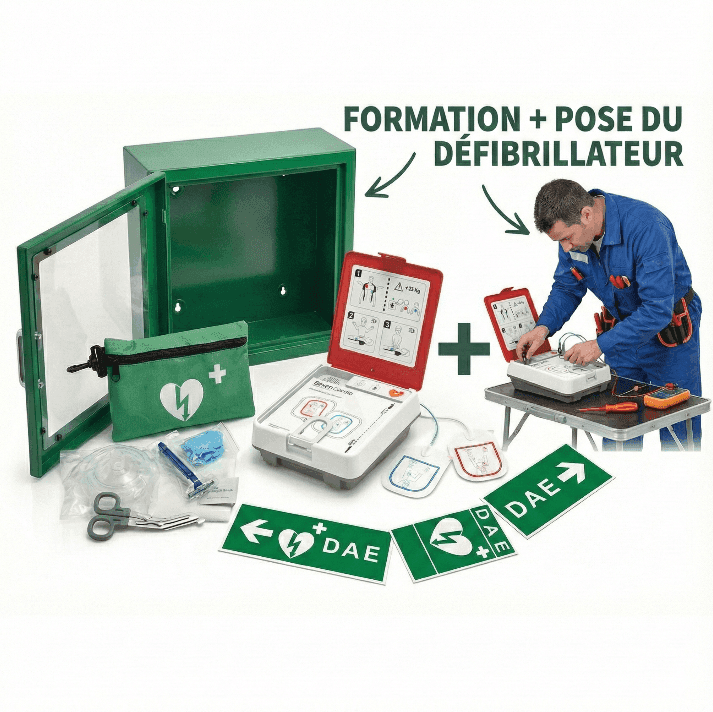
The arrete du 29 octobre 2019 (ministerial order of 29 October 2019), published in the Journal officiel of 13 November 2019, sets the mandatory signage templates for automated external defibrillators in public places and in French public-access buildings (ERP). Three items are expected. A sign indicating the presence of a DAE is displayed at each entrance to the building. Directional signs show the location of the unit and the route to reach it. A label is fixed to the unit or nearby, carrying the maintenance information in particular.
The templates and their graphic specifications, covering colours, typography and minimum sizes, are set out in the annexes to the order and cannot be altered. A sign redrawn in your own brand colours is not compliant, even if it remains legible. Use the official templates exactly as issued, print them at no less than the minimum size required, and place directional signs at every junction along the route, at eye level, checking that no open door or display stand hides them.
The defibrillator must remain easily accessible and usable at all times. When installed outdoors, it must be protected from the weather by a suitable cabinet. While you are there, check that the maintenance label is properly filled in and legible: it is what tells an inspector, or a first aider, whether the unit has been checked. Our technicians update it at every preventive visit.
Installations dating from before 2019
The arrete du 29 octobre 2019 repeals the arrete du 16 aout 2010 (ministerial order of 16 August 2010) and its annexes. Signage put up under the previous rules must therefore be brought into line with the new templates. If your defibrillator was installed before 2019 and nobody has touched the signs since, you are very probably non-compliant, even though the unit itself works perfectly.
Review your estate against a simple checklist: unit registered on Geo'DAE, record up to date, compliant entrance sign, directional signs present along the whole route, maintenance label filled in, permanent accessibility verified. Any shortcomings can be put right in a single visit. Many organisations discover at this point that they have defibrillators installed but never registered, which is the most common situation and the easiest to put in order. Our teams carry out this audit during a maintenance visit and handle registration for every installation, anywhere in France.
Frequently asked questions
Who must register the defibrillator on Geo'DAE?
The operator of the place where the unit is made available to the public. This legal obligation falls on neither the manufacturer nor the distributor, and it also applies to rented units: the rental company supplies the equipment, but the operator remains responsible for registration. A service provider may complete the process on your behalf, yet the liability stays with you.
What information must be submitted when registering?
The arrete du 29 octobre 2019 sets the list of information to be submitted: the precise location of the unit, its hours of accessibility and its technical characteristics. In practice, prepare the full address, the exact position on the map, a location description a stranger could follow, the real access hours and the references of the model installed.
What should be done when the defibrillator is moved or removed?
The record is updated after every installation, every relocation and every removal. Correct the map marker and the location description on the day of the move itself, and register the removal as soon as the unit is decommissioned or a rental ends. Take down the matching signage at the same time: an arrow pointing to an empty spot wastes critical time.
Is signage installed before 2019 still valid?
No. The arrete du 29 octobre 2019 repeals the arrete du 16 aout 2010 and its annexes, and signage put up under the previous rules must be brought into line with the new templates. Replace the entrance sign, the directional signs and the label with the official templates in force, without changing their colours, their typography or their minimum sizes.
Can the signs be customised in the organisation's colours?
The templates and their graphic specifications are set out in the annexes to the arrete du 29 octobre 2019 and cannot be altered. A sign redrawn to match your brand guidelines is not compliant. You do remain free to choose the printing material, the fixings and the exact position, provided visibility and legibility are assured along the whole route.
Planning an AED project?
Purchase, rental from 50 EUR excl. VAT per month, installation with GéoDAE registration, servicing and training: our team replies within 24 hours.