Theft and vandalism: protecting a public-access defibrillator
Written by Cyrille GAGNAIRE, France Défibrillateur. Published on 27 October 2026.
Installing a defibrillator outdoors makes it available to everyone, including people who mean it no good. Theft, blows, graffiti, forced cabinets: these incidents happen and rightly worry operators. Yet they justify neither locking the device away nor hiding it. Here is how to combine immediate access with protection, and which steps to take if the worst happens.
Why public access remains the right choice
Each minute without defibrillation reduces the chances of survival by about 10%. Faced with a cardiac arrest, nobody has time to look for a caretaker, ask for a key or wait outside a closed door. A device locked behind a padlock loses most of its value.
The risk of damage must therefore be handled through the design of the installation, not by restricting access. The aim is to make a malicious act harder, more visible and less rewarding, without ever delaying a good-faith bystander.
Malicious incidents remain rare compared with the number of devices installed. An operator who gives up public access for fear of an incident actually takes a far greater risk: the device being missing or out of reach during a real cardiac arrest.
Choosing a cabinet suited to the exposure
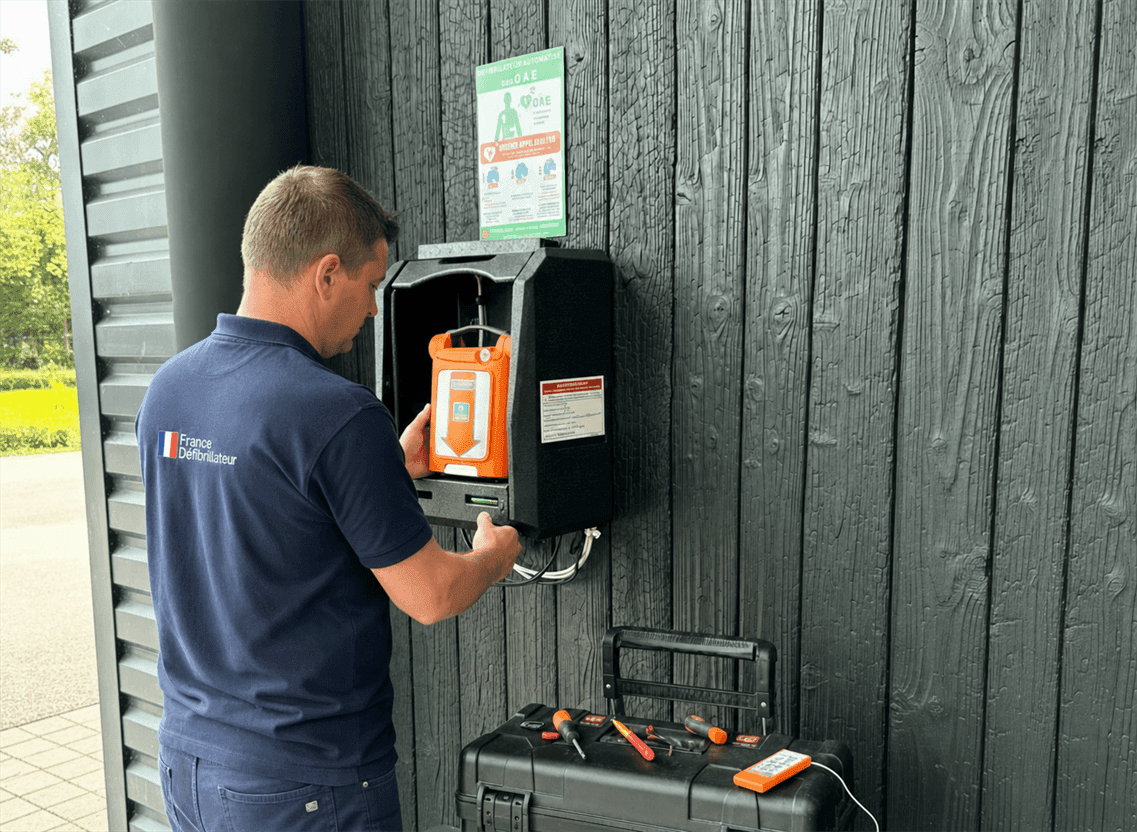
An outdoor cabinet is not just a box. It protects against rain, frost and heat, but also against impacts. A rigid casing, a simple handle or fragile-glass closure and an audible alarm on opening make a good basis for an exposed location.
The alarm plays a double role. It deters the curious person who opens the cabinet for fun, and it tells people nearby that a device has just been taken, whether for a real emergency or not. In a busy place, this signal often attracts additional witnesses, which helps in both cases.
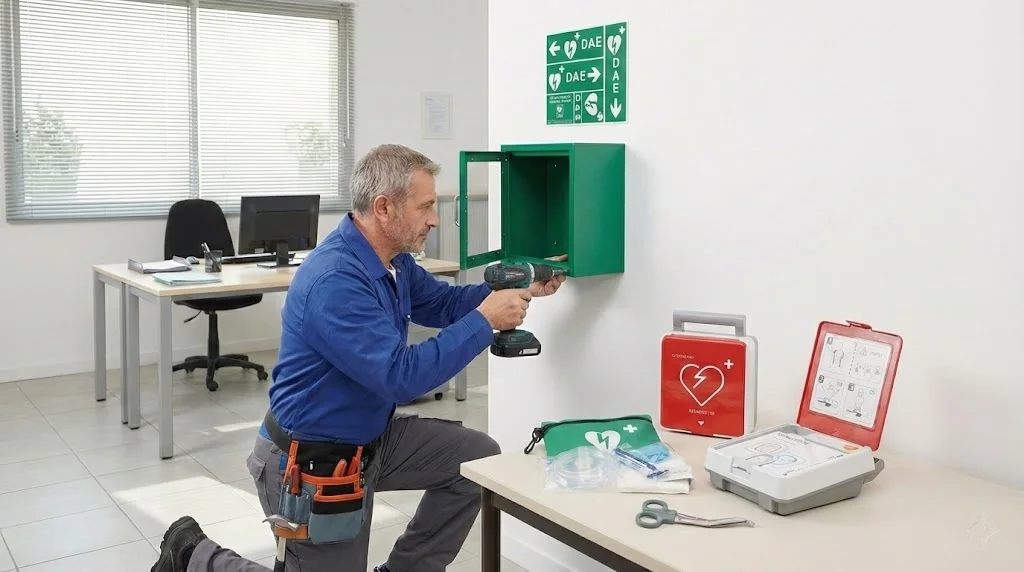
Also think about the fixing. A cabinet firmly sealed to the wall, with screws that cannot be reached from outside, resists tearing off better than a box simply placed or hung. This detail is settled at installation and costs little compared with a replacement.
Location accounts for half of the protection
A defibrillator placed in a dark corner, far from any activity, is both easier to damage and harder to find in an emergency. Conversely, a wall visible from an entrance, a counter, a shop window or a busy street naturally reduces the risk.
Three criteria help decide: visibility from occupied areas, adequate lighting at night, and proximity to a camera if the site already has one. The regulatory signage (arrêté du 29 novembre 2018) must remain legible, because signs also help people spot the device from afar.
| Situation | Possible measure |
|---|---|
| Facade on a busy street | Outdoor cabinet with alarm, existing lighting |
| Isolated courtyard or car park | Move the device to the busiest entrance |
| Premises closed at night | Indoor cabinet, clearly visible from outside if possible |
| Site already under video surveillance | Place the cabinet within the camera's field of view |
Planning ahead for contract and insurance
Maintenance of the defibrillator is the operator's responsibility under article R. 5212-25 of the Code de la santé publique (French Public Health Code). This includes replacing missing or unusable equipment. It is better to know in advance how replacement works and how long it takes.
Review your insurance policy and, where applicable, your maintenance contract: are theft and vandalism covered, with what excess, and on what evidence? A rental with maintenance included, offered from €50 excl. VAT per month, often simplifies the matter, but check exactly what the contract provides if the device disappears.
What to do if the device has disappeared or been damaged
Record the facts, photograph the cabinet and file a police report to obtain a receipt useful to your insurer. Then tell people on site that the device is unavailable, and display a temporary notice indicating the nearest defibrillator.
Update the GéoDAE registration (the French national AED database), which is mandatory: a device listed as active but missing can send a bystander to an empty cabinet at the worst moment. Log the incident in the safety register, then arrange the replacement. Delivery generally takes 2 to 5 working days, and a quote is issued within 24 hours.
A good habit: checking the cabinet regularly
Much damage goes unnoticed for weeks: a cracked pane, a torn seal, a moved device, missing electrodes. A regular visual round, combined with reading the self-test indicator, is enough to detect it early.
Appoint a person in charge and give them a deputy. Without a name at the end of the chain, the check eventually stops. A few minutes of checking beat a device that cannot be used on the day it is needed.
Use these visits to check the expiry dates of the electrodes and battery, as well as the legibility of the sign. Electrodes last 2 to 5 years and batteries 3 to 5 years: regular checks avoid unpleasant surprises.
Frequently asked questions
Can a defibrillator cabinet be locked with a key?
It is not recommended for a device intended for the public. A key lock delays action in an emergency, when every minute counts. Prefer a simple closure that is easy to open, combined with an audible alarm that discourages misuse and alerts people nearby.
Who pays to replace a stolen defibrillator?
Maintenance and availability of the device remain the operator's responsibility. Depending on your insurance or rental contract, all or part of the replacement may be covered. Check the theft and vandalism cover, the excess and the supporting documents required.
Should a police report be filed after a defibrillator theft?
Yes, it is recommended. The receipt serves as proof for the insurer and records the incident. Also photograph the damage, note the facts in the safety register and update the GéoDAE registration so that no bystander is sent to an empty location.
Is an alarm on the cabinet mandatory?
No, none of the rules we cite requires it. It is the operator's choice, useful for public outdoor access. It discourages playful opening and signals that a device has been taken, which helps mobilise witnesses.
Where should a defibrillator be placed to limit vandalism?
Choose a spot visible from a busy area, well lit at night and ideally within the field of an existing camera. Avoid isolated corners. A busy location protects the device and lets people find it faster when an emergency occurs.
Planning an AED project?
Purchase, rental from 50 EUR excl. VAT per month, installation with GéoDAE registration, servicing and training: our team replies within 24 hours.