Training defibrillators: what they are really for
Written by Cyrille GAGNAIRE, France Défibrillateur. Published on 8 November 2026.
During an awareness session, the trainer often takes out a small unit that looks like a defibrillator without being one. This training device is used to rehearse the steps safely. But you need to know what it offers, what it does not simulate, and how to prevent it being mistaken for the real device hanging on the wall of your premises.
What a training device does
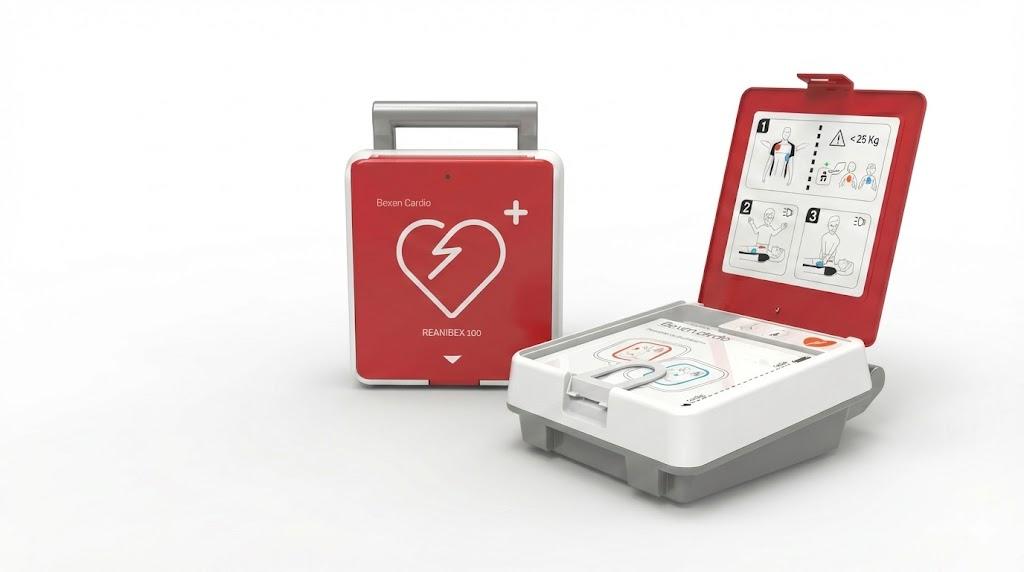
A training defibrillator reproduces the interface of an AED (automated external defibrillator): casing, dummy pads, indicator lights and voice prompts. It delivers no shock and contains no defibrillation circuit. The trainer triggers the phases of the procedure, from placing the pads to the prompt to resume compressions.
Its value is educational. Participants handle the device, open the lid, stick the pads on a manikin and follow the instructions. Many lose their apprehension at the first attempt, because they see that the device guides every step.
This tool does not replace the training itself. It is a teaching aid, just like the chest compression manikin.
Why not practise on the real device
Using the premises' AED for a demonstration seems economical. It is nonetheless a poor idea. The pads are single use: a pair placed on a manikin cannot be used again and must be replaced before the device is operational once more.
There is also the risk of forgetting. A device taken out of its cabinet for a session must go back, with new pads in place and a green self-test. If the session ends in a rush, the premises end up with an unusable defibrillator just when it is needed.
Finally, repeated handling wears the equipment and can trigger alerts or drain the battery faster than expected. It is better to leave the real device in place and keep exercises for a dedicated one.
The limits of simulation
A training device remains an approximation. The voice prompts may differ from those of the model installed on your premises: order of phrases, pace, voice, sound signal. A participant used to one sequence may be surprised by another in a real situation.
Simulation also does not reproduce stress, noise, onlookers or the difficulty of exposing a chest in a cluttered place. It therefore does not replace a realistic drill, which confronts the team with these constraints.
Finally, tell participants that the real defibrillator analyses the rhythm and decides by itself whether or not to advise a shock. On the training device, the trainer imposes the scenario.
| Criterion | Training device | Real AED |
|---|---|---|
| Shock delivered | No | Yes, if the analysis advises it |
| Pads | Dummy, reusable | Single use |
| Rhythm analysis | Scenario chosen by the trainer | Performed by the device |
| Place in the premises | Case or training room | Accessible, signposted cabinet |
Choosing a device close to the installed model
Whenever possible, practise on a device whose interface resembles that of your premises' defibrillator. If the training provider works with another model, remind participants that the principles are identical, even if the phrases change.
For a site that trains its staff regularly, owning a training device makes sense. It can be used for new-employee onboarding, internal drills or refreshers, without calling on an outside trainer each time.
The France Défibrillateur team can advise you on pairing training equipment with the installed AED. A quote is provided within 24 hours.
Avoiding confusion with the real equipment
The main danger is confusion. A training device left in an office or stored in the AED cabinet can be taken for the real one, with serious consequences. It must be clearly identified with a visible label, a distinct colour and separate storage.
In the safety register, note the existence of the training device, its location and the person responsible for it. This traceability prevents it from being counted by mistake among operational defibrillators during an inspection or a GéoDAE declaration.
Never register a training device on GéoDAE. This database helps emergency services and the public locate real defibrillators, and a false entry can cost a bystander precious time.
Building the device into your training plan
Good practice is to alternate. A first session presents the steps with the training device, a second applies them in an unexpected scenario, for example a victim with a wet chest or a noisy place.
Also set aside time to show the real defibrillator without handling it: where it is, how to open the cabinet, what the indicator lights look like. Participants then leave knowing its actual location, which matters as much as mastering the steps.
Finally, record these sessions in your training log, with the date and the list of attendees. This makes it easier to organise refreshers.
Frequently asked questions
Can a training defibrillator deliver a shock?
No. It imitates the interface and prompts of an AED, but it has no shock mechanism. It is designed so that participants can rehearse the procedure safely, on a manikin, under the guidance of a trainer.
Can the premises' AED be used to train staff?
This is not recommended. The pads are single use and must be replaced after handling. The risk is leaving the device unusable. A dedicated training device avoids this problem and protects the installed equipment.
Should the training device be declared on GéoDAE?
No. The GéoDAE declaration (the French national AED database) concerns only real, operational defibrillators. Listing a training device could send a bystander to a unit unable to deliver a shock, wasting precious time.
How can it be kept from being mistaken for the real defibrillator?
Label it clearly, choose a distinct colour, store it separately and record it in the safety register. It should never be placed in the cabinet or right next to the real AED.
Does the training device replace a course?
No. It is a teaching aid used with a trainer and a manikin. It helps people memorise the steps, but learning chest compressions, raising the alarm and the right course of action remains the purpose of the training.
Planning an AED project?
Purchase, rental from 50 EUR excl. VAT per month, installation with GéoDAE registration, servicing and training: our team replies within 24 hours.