Defibrillators and disability: making them reachable by all
Written by Cyrille GAGNAIRE, France Défibrillateur. Published on 9 November 2026.

A defibrillator on the wall is only useful if the person running to it can reach it. A bystander who uses a wheelchair, is short, blind or deaf sometimes meets obstacles the operator never considered: a step in front of the cabinet, a narrow corridor, a case mounted too high, a message that is audible only. Here are the most common barriers and the simple adjustments that make the device usable by as many people as possible, without overhauling the installation.
Who is affected, and why plan for it at installation
The defibrillator must be usable by any bystander, including one with a motor, visual or hearing disability, or simply a small build, such as a teenager or an older person. In a public-access building (ERP, établissement recevant du public), these people are visitors, employees and potential rescuers all at once. They may also be the victim, in which case others must reach the device quickly.
Thinking about accessibility when choosing the location costs almost nothing. Fixing it afterwards often means moving the cabinet, redoing the signage and updating the GéoDAE declaration. It is better to ask the question from the start, walking the route as a hurried bystander would, without knowing the premises.
The route to the cabinet
The first obstacle is rarely the device itself. It is the route: a heavy door, a single step, a threshold, stairs with no alternative, a corridor cluttered with boxes or displays. A bystander in a wheelchair must be able to reach the cabinet without help and without a detour, and the signage must show the right route, not just the direction as the crow flies.
Try it with a colleague pushing a wheelchair or a trolley. If the passage requires a delicate manoeuvre, the location deserves a second look. Signage follows the arrêté du 29 novembre 2018 (French order of 29 November 2018); it must remain visible from walkways, including at the eye level of a seated person, and not be hidden by a plant, a clothes rail or a poster.
Height, opening and handle of the cabinet
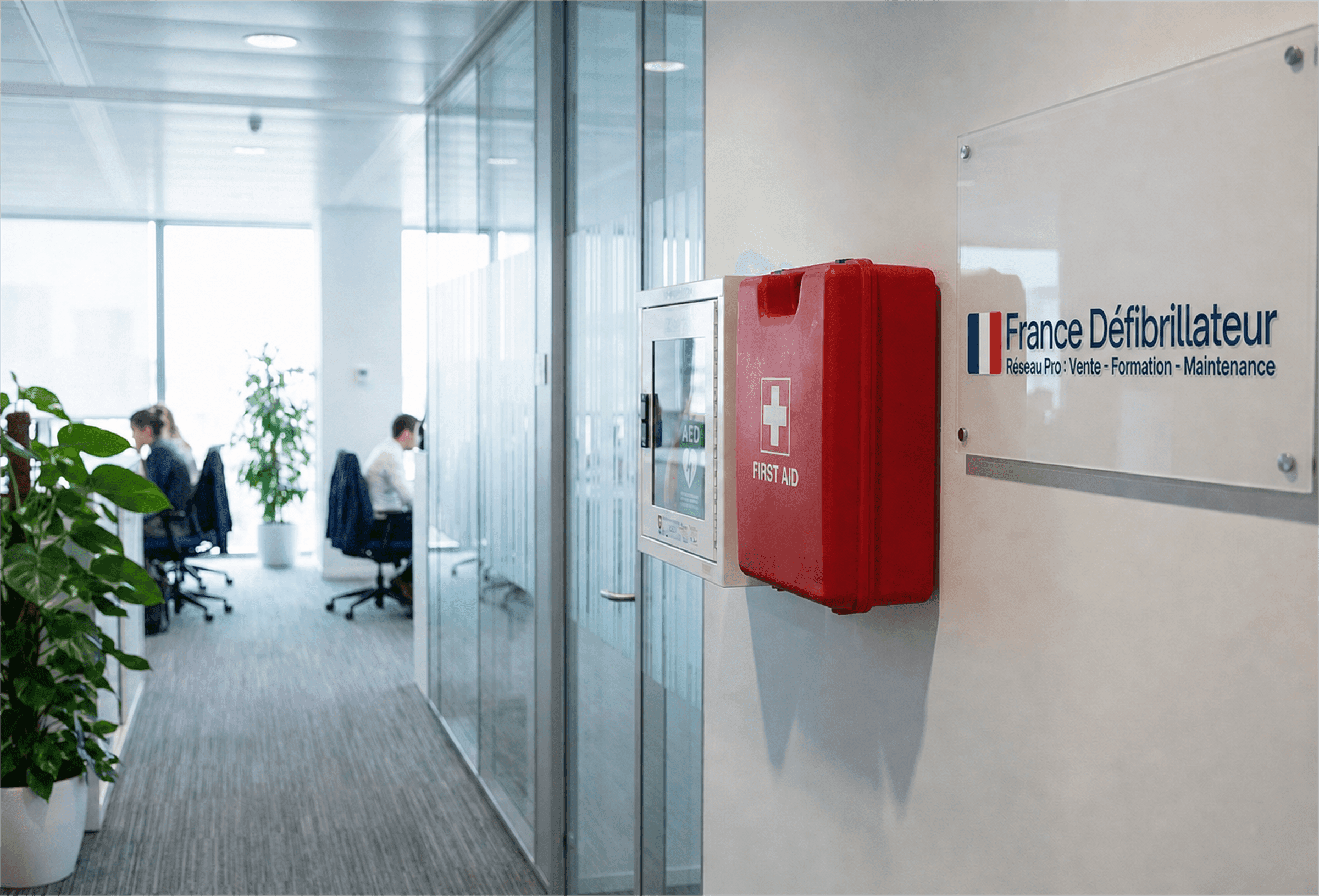
A cabinet fixed very high to protect it from children or theft becomes unreachable for a seated or short person. Conversely, a case mounted too low forces people to bend down, which is hard for those with back or knee pain. The right setting puts the device at a height reachable both standing and seated, without contortion or standing on tiptoe.
Look at the opening mechanism too. A handle that needs strength or two-handed use is difficult for someone with a hand disability or a tremor. An access code the bystander does not know wastes precious time, when each minute without defibrillation reduces the chance of survival by about 10%. A simple, clearly marked opening is better than a complicated system.
Seeing and hearing the instructions
The device guides the rescuer by voice and by pictograms. A deaf or hard-of-hearing person relies on the images, the indicator lights and the screen if there is one; a blind or partially sighted person relies on the voice. When choosing, check that the device offers both channels, and that the volume remains audible in the place where it will be installed.
In a noisy place or one used by varied audiences, good lighting of the cabinet and a high-contrast pictogram help people spot it. A short message displayed near the device, in large print, completes the setup without overloading it. The goal is for one person to be able to act alone, even if they perceive only part of the information.
Sharing roles and checking the route every year
No physical adaptation replaces having several people able to act. In a team, not everyone can necessarily run to fetch the device, perform compressions or talk to the emergency services: sharing roles lets each person contribute according to their abilities. One person calls, another brings the device, a third does the compressions, and everyone knows what to do.
Build this thinking into training and drills, then include it in the remit of the designated lead. An annual check of the route is enough to spot a new obstacle. Since maintenance remains the operator's responsibility (article R. 5212-25 du Code de la santé publique, French Public Health Code), this check fits naturally into the self-test round. France Défibrillateur advises on location and cabinet, with a quote within 24 hours.
Frequently asked questions
Is there a specific defibrillator for people with disabilities?
No, a standard AED is suitable. The location, height, route and opening mode of the cabinet determine whether the device can be reached by everyone. The adaptation therefore concerns the installation, rarely the equipment itself.
At what height should the cabinet be fixed to remain accessible?
There is no single rule to quote here. The practical criterion is that a seated person and a short person can grasp the device without effort or contortion. Test with several people before fixing the cabinet in place.
Who is responsible for the accessibility of the defibrillator?
The operator of the premises, who chooses the location, provides the signage and bears the maintenance. Appointing a designated lead helps check regularly that the route stays clear and that the signage is visible.
Can the cabinet be moved if it is badly placed?
Yes. Afterwards, remember to redo the signage and update the declaration in GéoDAE, so that the emergency services and the public know the new position. It is better to do so without delay than to leave an unsuitable location.
Planning an AED project?
Purchase, rental from 50 EUR excl. VAT per month, installation with GéoDAE registration, servicing and training: our team replies within 24 hours.