Defibrillators on university campuses: rules and best practices
Written by Cyrille GAGNAIRE, France Défibrillateur. Published on 13 September 2026.
A university campus is not a single site. Lecture halls, a library, a student restaurant, a gym and halls of residence often form several separate buildings, sometimes spread over several hectares, each subject to its own safety rules. This layout raises real questions for a higher education institution that wants to install automated external defibrillators (AEDs): how many are needed, where to place them, and how to organise their maintenance across such a large site.
A campus, several buildings, different rules
A university campus rarely consists of a single building. Lecture halls, teaching units, the university library, the student restaurant, the gym and halls of residence are often separate premises open to the public, each classified in its own category according to its capacity. The obligation to install an automated external defibrillator depends on this category: it has applied to premises in categories 1 to 3 since 1 January 2020, to category 4 since 2021, and to some category 5 premises since 2022, under French law 2018-527 and its implementing decree 2018-1186.
In practice, a university may face different obligations from one building to another: a large lecture hall or a busy library falls into the relevant categories more easily than a small administrative office. The institution's estates or safety department should carry out this classification building by building rather than treating the whole campus as a single unit.
A young population, but a real cardiac risk
A campus brings together mostly young students, but also teaching staff, administrative and technical personnel, as well as many visitors during open days, conferences or exams. In France, around 50,000 cardiac arrests occur every year, and every minute without defibrillation reduces the chances of survival by around 10 percent. No age group is immune, and the sheer number of people present on a large campus increases the likelihood that an incident will happen there one day.
University sports activities, often intense and sometimes competitive, add a further risk factor, as do peak periods such as the start of term or student parties held on the institution's premises.
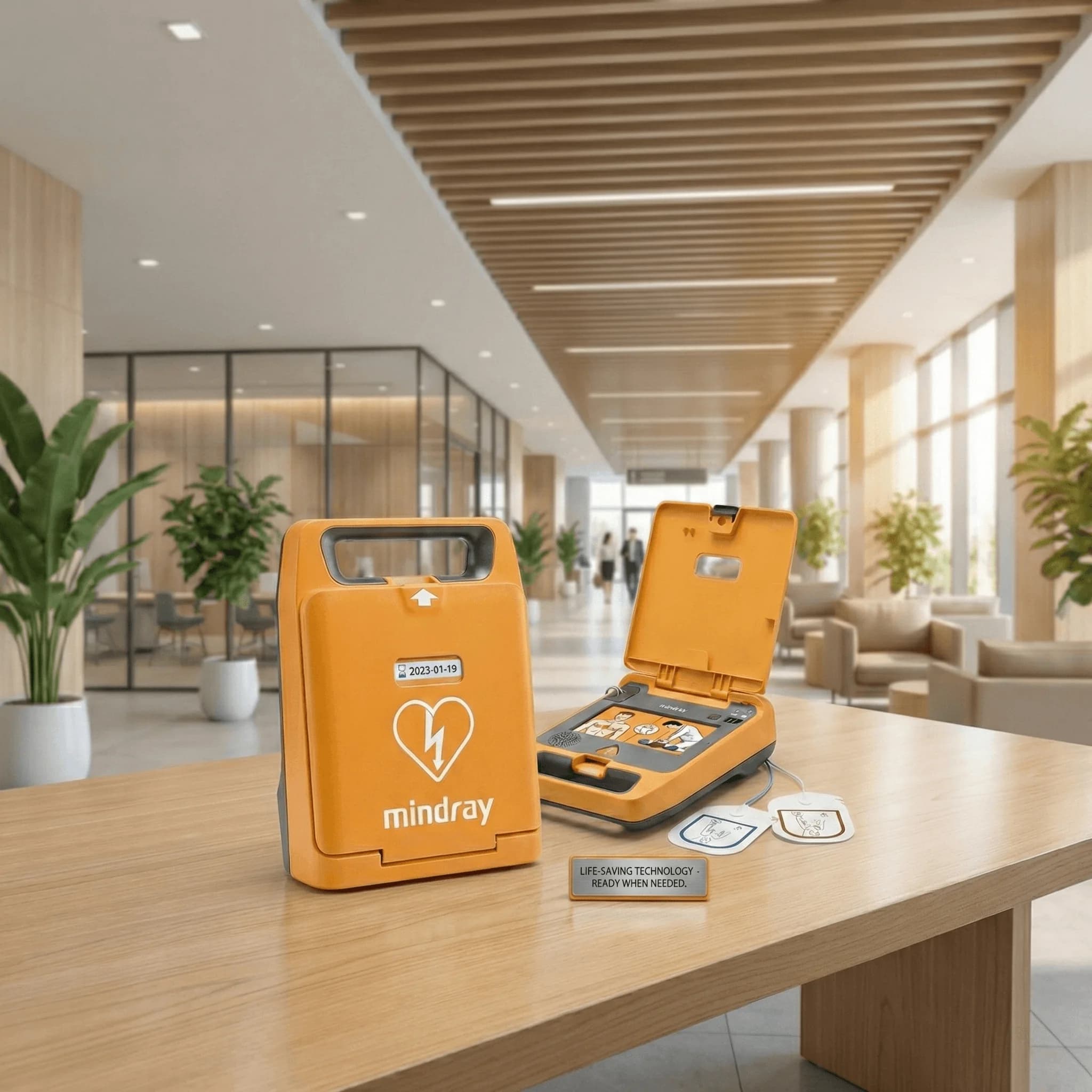
Where to place defibrillators on a large site
On a campus, the distance between two buildings can exceed several hundred metres. Relying on a single central defibrillator leaves some areas without quick access to a device, even though every minute matters. It is better to spread several AEDs according to actual footfall rather than the administrative size of each building alone.
| Campus area | Typical footfall | Value of a dedicated defibrillator |
|---|---|---|
| Main entrance or administration | Continuous during the day | Easy landmark for emergency services |
| University library | High, including evenings | Large public, sometimes isolated on upper floors |
| Student restaurant | Peaks at mealtimes | High, short-lived concentration of people |
| Gym and sports facilities | Intense physical effort | Higher cardiac risk during exercise |
| Hall of residence | Present day and night | Coverage outside class hours |
Signage and Géo'DAE registration for each building
Signage for each defibrillator must comply with the French order (arrêté) of 29 November 2018, with a visible sign at the entrance of each building indicating the direction and exact location of the nearest device. On a multi-building campus, this signage is particularly useful, since a visitor or a new student does not always know their way around.
Each device must also be registered individually in the Géo'DAE database, with as precise a location as possible: building, floor, corridor. This level of detail allows emergency dispatch services to guide a bystander to the right device when a campus has dozens of buildings.
Centralising maintenance across the institution
As with any operator, responsibility for maintaining defibrillators rests with the institution, under article R. 5212-25 of the French public health code. On a campus that may have dozens of devices, a single centralised register makes tracking much easier: inspection dates, self-test results, replacement of pads every two to five years and batteries every three to five years, and the eight to ten year (or more) lifespan of the device itself.
Rental, available from 50 euros excl. VAT per month with maintenance included, simplifies managing a fleet spread across several sites: tracking consumables and self-tests is handled by the provider rather than by each building department separately. Devices are delivered within two to five working days, and a quote to equip an entire campus can be obtained within 24 hours.
Raising awareness among students and staff
A well-installed defibrillator is useless if no one dares to use it. Including a short awareness session on lifesaving actions in the induction programme for new students, alongside the presentation of internal rules, helps multiply the number of bystanders able to act in the first minutes.
Administrative and technical staff, often present year-round on campus, benefit from regular first-aid training, renewed periodically. Student first-aid associations, where they exist, are also a valuable resource for running regular workshops and keeping skills fresh from one intake to the next.
Frequently asked questions
Is a university required to install a defibrillator?
The obligation depends on the public-premises category of each building on the campus. Category 1 to 3 premises have been equipped since 1 January 2020, category 4 since 2021, and some category 5 premises since 2022. A large lecture hall or a busy library falls into these categories more easily than a small administrative building.
Does every building on a campus need its own defibrillator?
Nothing legally requires one device per building, but it is often the most effective solution. On a large site, a single defibrillator leaves entire areas without quick access. Spreading devices according to actual footfall, library, student restaurant, gym and halls of residence, ensures access within a few minutes from anywhere on campus.
Who decides where to place defibrillators on a campus?
The institution's estates, safety or health and safety department, together with management, decides where to place the devices. The analysis should factor in circulation flows, opening hours of each building and areas of intense physical activity, such as sports facilities, before any registration in Géo'DAE.
Can students use a defibrillator in an emergency?
Yes. French law allows anyone, even without training, to use an automated external defibrillator on a person in cardiac arrest. The device guides the user by voice at every step and only delivers a shock if it detects a heart rhythm that requires it, which makes it safe for an untrained student to use.
Who is responsible for maintaining defibrillators on a university campus?
Maintenance is the responsibility of the operating institution, under article R. 5212-25 of the French public health code, regardless of how many devices are installed on the campus. A centralised register and, where relevant, a rental contract with maintenance included make it easy to track self-tests and consumable replacement dates across all buildings.
Planning an AED project?
Purchase, rental from 50 EUR excl. VAT per month, installation with GéoDAE registration, servicing and training: our team replies within 24 hours.