AED in stadiums and sports venues: obligations and best practices
Written by Cyrille GAGNAIRE, France Défibrillateur. Published on 19 September 2026.
A stadium brings together athletes exerting themselves and, at times, thousands of spectators in a single place. That concentration raises the odds that a cardiac arrest will happen far from help, on a site large enough that every minute matters. French regulation now requires a defibrillator in most sports venues open to the public. What remains is knowing how many units to install, where to place them, and who must maintain them throughout the season.
A stadium, a site with a particular cardiac risk
On a stadium, cardiac risk touches two distinct groups. Professional or amateur athletes can suffer a cardiac arrest during exertion, often without warning signs. Spectators, more numerous and sometimes older, are also exposed, particularly during emotionally intense matches. Every minute without defibrillation reduces the chances of survival by about 10 percent, a figure that matters greatly in a venue where the distance between the pitch and the upper stands can exceed a hundred metres.
Distance from emergency services makes this worse. A stadium is rarely located downtown, and ambulance access can be slowed by gates, security checks or crowds on match days. A defibrillator reachable within three minutes from any point on the site becomes a decisive link in the chain of survival, well before professional responders arrive.
What regulatory obligations apply to a stadium
French law 2018-527 and its implementing decree 2018-1186 require a defibrillator in establishments open to the public (ERP, French term for public-access buildings), based on their category. Large stadiums, classified in category 1, 2 or 3 depending on their capacity, have been required to be equipped since 1 January 2020. Smaller venues, in category 4, have been required since 2021, and some category 5 venues since 2022.
This classification applies equally to municipal stadiums and to grounds managed by a sports association. Regardless of the status of the club using the ground, the equipment obligation falls on the operator of the establishment, meaning the local authority or organisation that owns the facilities, who must verify the equipment is in place before opening to the public.
How many defibrillators to install and where
A single defibrillator is generally not enough to cover a stadium as a whole. The number of units depends on the size of the site, the number of entrances, and how the public is spread across stands, pitch and adjoining areas. A useful benchmark is to aim for access within three minutes from every frequented zone, which often calls for several units rather than one central point, especially when a stadium has opposing stands or separate levels.
| Zone of the stadium | Recommendation |
|---|---|
| Main entrance and reception | An AED (automated external defibrillator) visible as the public arrives |
| Stands | One unit per stand if capacity is significant |
| Pitch and playing area | An AED accessible pitch-side for athletes |
| Changing rooms and technical area | A dedicated unit, out of public view |
| Clubhouse or refreshment area | An AED if the area stays open after matches |
Registering and signposting each unit
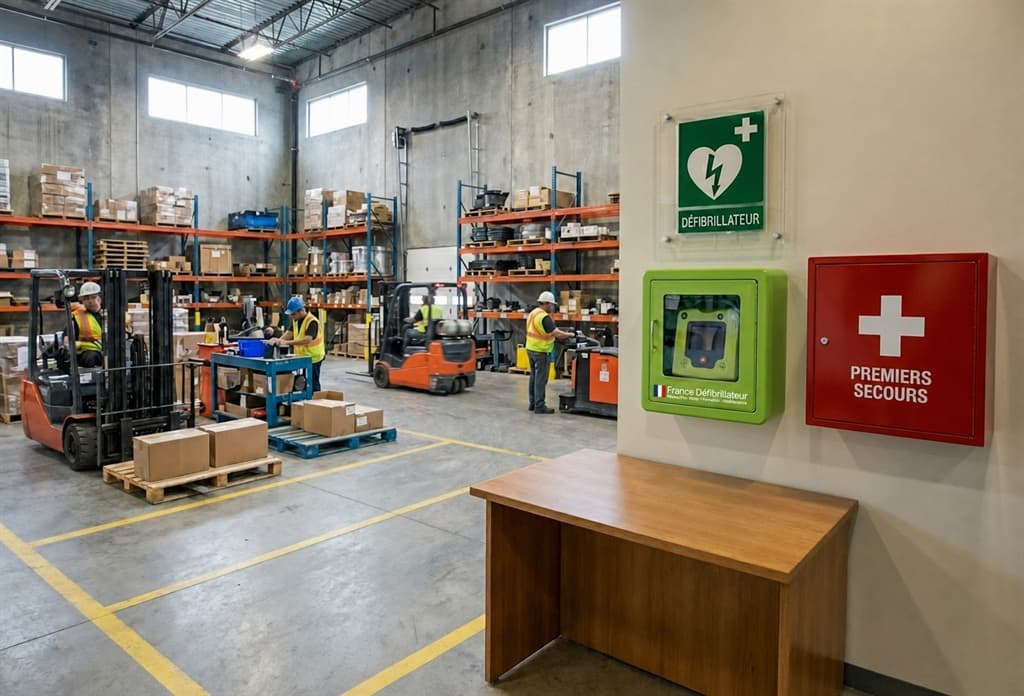
Every installed defibrillator must be registered in the GéoDAE database (the French national AED registry), with its precise location and contact details. This registration lets emergency services locate the nearest unit when a call comes in, which matters particularly on a site as large as a stadium.
Signage follows the French order (arrêté) of 29 November 2018: the standardised sign must be visible from the public's circulation routes. With several entrances and several stands, a stadium generally needs more signs than an ordinary shop, so that no part of the site is left without a visual marker pointing to the nearest unit.
Training volunteers and club staff
A sports club relies heavily on volunteers: coaches, referees, officials, stewards on match days. Training these people in life-saving actions and in using the defibrillator genuinely changes the outcome of an incident, since the first few minutes almost always depend on whoever is present rather than on a health professional.
A short awareness session is enough to learn how to recognise a cardiac arrest, call for help and use an AED, which guides the user with voice prompts. A full first-aid course remains advisable for at least a few permanent club members, to be renewed periodically to keep the reflexes fresh. Working this reminder into the club's start-of-season meeting, before the season begins, keeps it from being addressed only after an incident.
Maintaining a defibrillator exposed to the weather
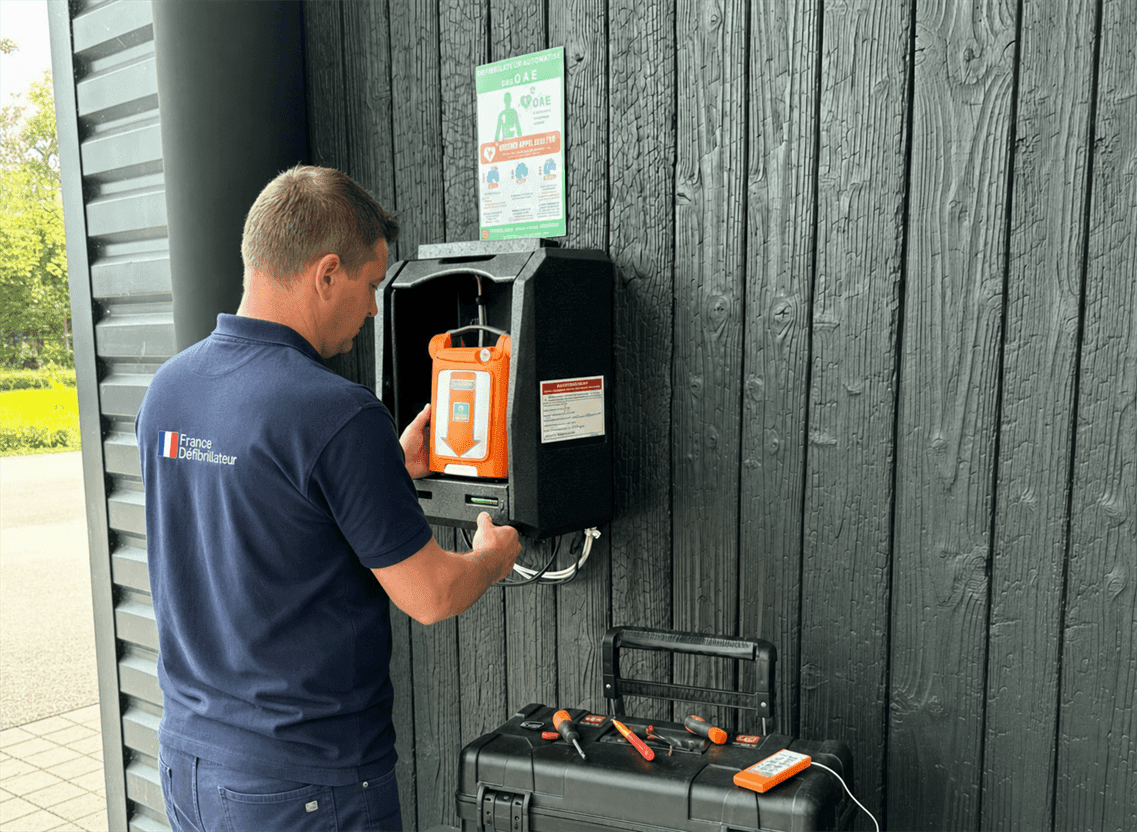
A defibrillator installed outdoors, near a pitch or a stand, endures more temperature swings and humidity than a unit placed in a reception hall. A suitable outdoor cabinet, heated if possible, protects the unit and its consumables from weather conditions throughout the season.
Maintenance remains the operator's responsibility, under article R. 5212-25 of the French public health code. Electrode pads are replaced every two to five years, the battery every three to five years, and the unit itself generally lasts eight to ten years. A rental agreement that includes maintenance, starting from 50 euros per month excl. VAT, simplifies this follow-up for a club that does not always have the internal resources to handle it.
Frequently asked questions
Does an amateur club's stadium have to have a defibrillator?
Yes, as soon as the stadium is an establishment open to the public classified in category 1 to 4, or even certain category 5 establishments since 2022. The size of the club does not matter, only the site's capacity determines the obligation. The operator, often the municipality that owns the ground, must check this classification and equip the establishment accordingly.
Who pays for and maintains the defibrillator at a municipal stadium?
The obligation falls on the operator of the establishment, generally the municipality that owns the facilities, even if a sports club uses the ground daily. A usage agreement can split responsibilities between the local authority and the club, but the legal responsibility for maintenance remains tied to the operator named in the site's administrative documents.
Does a separate defibrillator need to be placed in the changing rooms?
It is not a separate legal requirement, but it is good practice. A cardiac arrest can occur right after exertion, as an athlete returns to the changing rooms, an area often far from the pitch and closed to the public. A dedicated unit close to the changing rooms reduces response time at that exact moment.
Must a stadium's defibrillator be checked before every match?
A modern AED runs an automatic self-test and signals any fault with an indicator light or sound alert. Checking that indicator before the gates open is enough, without opening the unit itself. This quick check adds to the periodic consumables check included in the maintenance contract.
Can an outdoor sports venue install a defibrillator in the open air?
Yes, provided an outdoor cabinet designed to withstand weather, dust and temperature swings is used. Some models offer a heated option, useful in winter, which protects the battery and electrodes from the cold and extends the lifespan stated by the manufacturer.
Planning an AED project?
Purchase, rental from 50 EUR excl. VAT per month, installation with GéoDAE registration, servicing and training: our team replies within 24 hours.