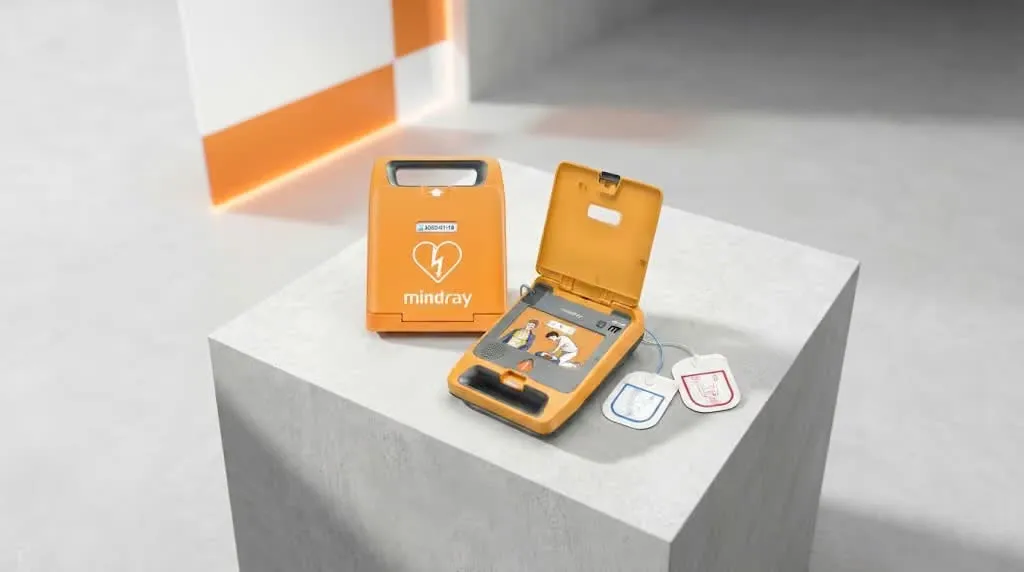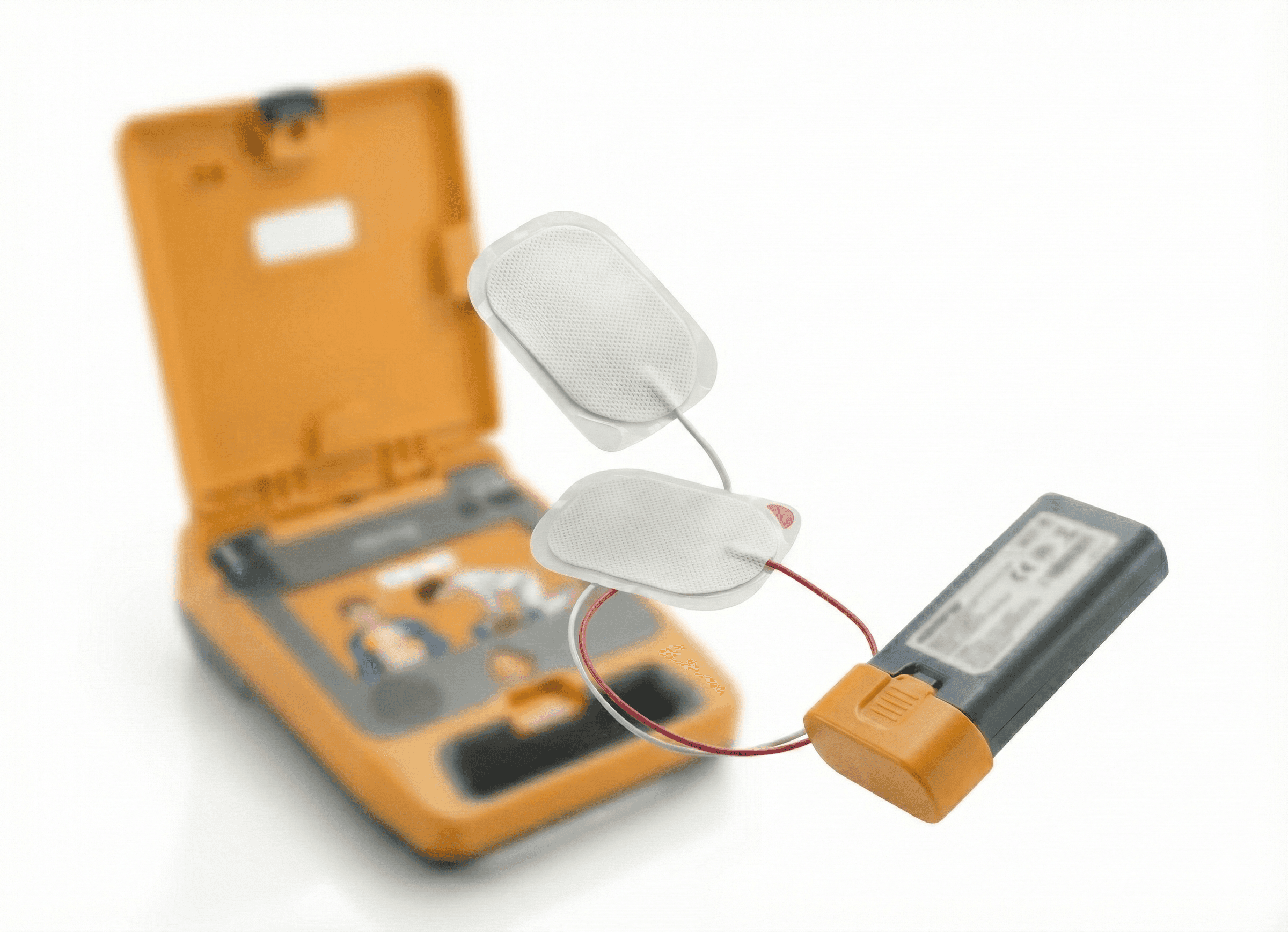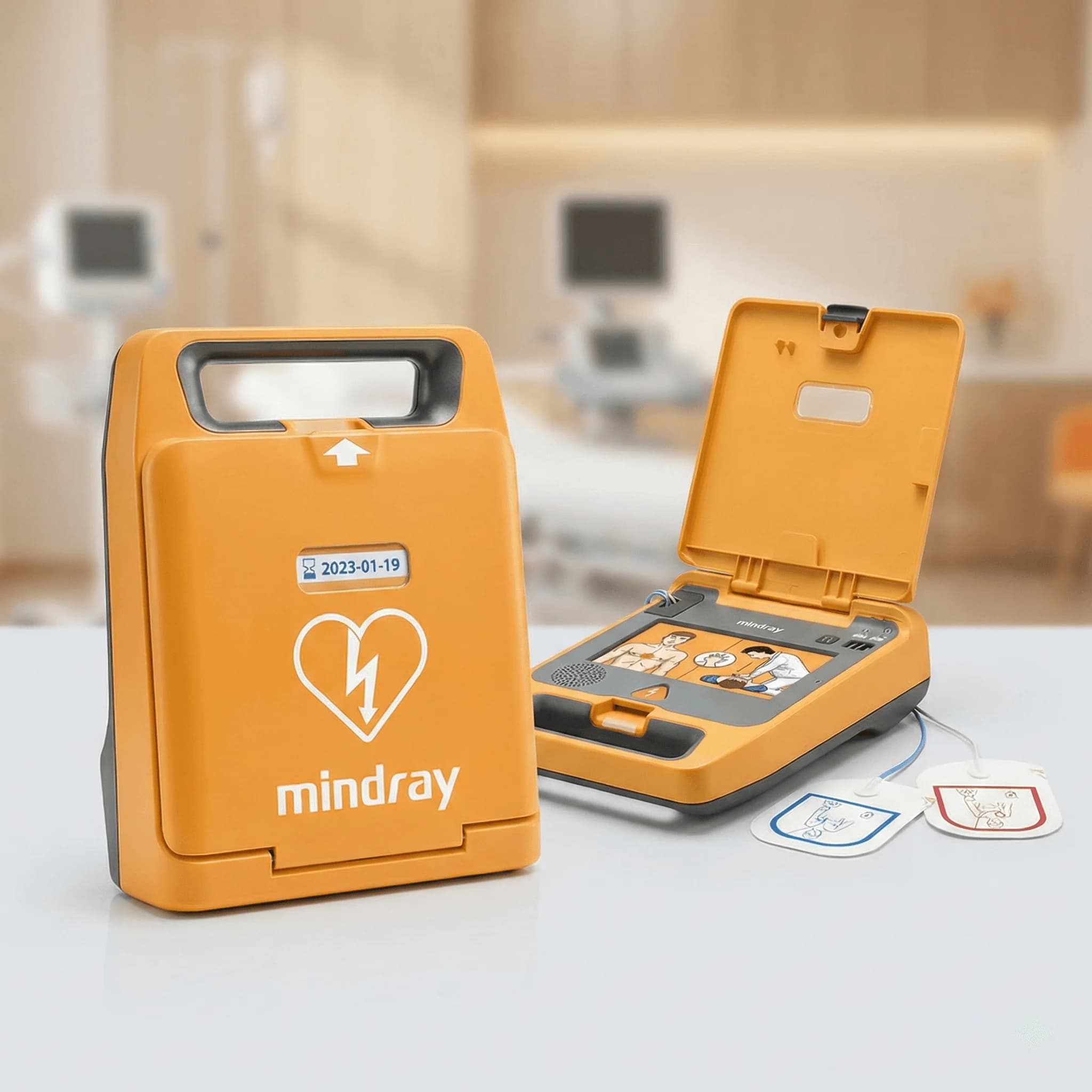
AED in a gym or fitness club: obligations and good practice
Written by Cyrille GAGNAIRE, France Défibrillateur. Published on 2 October 2026.
In a gym, members of every age push their hearts hard, sometimes without a recent medical check-up. Cardiac arrest remains rare there, but it can strike on a treadmill as easily as in a group class. This guide explains what the operator must do: check the venue's classification, choose where to put the defibrillator, train the team and keep the equipment in working order.
Why intense exercise exposes people to cardiac arrest
Around 50,000 cardiac arrests occur in France every year. A fitness club brings together situations where the heart works hard: cardio sessions, heavy weight training, high-intensity classes, a sauna after exercise. In a member who does not know they are vulnerable, a rhythm disorder can start with no warning sign.
Each minute without defibrillation reduces the chances of survival by about 10%. Waiting for the emergency services without acting therefore wastes precious time. A device placed a few dozen seconds from the training floor changes the outcome.
An obligation that depends on the venue's classification
Loi 2018-527 and décret 2018-1186 (the French law and decree) require certain ERP (établissements recevant du public, buildings open to the public) to have an AED (automated external defibrillator): categories 1 to 3 since 1 January 2020, category 4 since 2021, and some category 5 ERP since 2022. A gym falls under this scheme depending on its type of activity and its capacity.
The simplest approach is to ask the safety commission or the town hall to confirm your classification, then compare it with the calendar above. Even where the obligation does not yet apply, equipping the venue is sensible for a place where people train at the limit of their abilities.
Once the device is installed, registering it on GéoDAE (the French national AED database) is mandatory, and signage must follow the arrêté du 29 novembre 2018 (the French order of 29 November 2018).
Where to place the defibrillator in the gym
The device must stay visible, accessible without a key or code, and quickly reachable from every area: weights floor, group class studio, changing rooms, wellness zone. The reception desk is often a good compromise, provided it is not hidden by a counter or a closed door.
In a large venue, a single device may not be enough if classes take place upstairs or in an annex. You then need to measure the real access time by walking from the far end of each zone to the cabinet.
Think about opening hours too. Some gyms run on badge-only access with no staff on site. A defibrillator locked behind a staff-only door becomes unusable exactly when members are alone. A wall cabinet reachable from the training area solves this.
Training coaches and front-desk staff
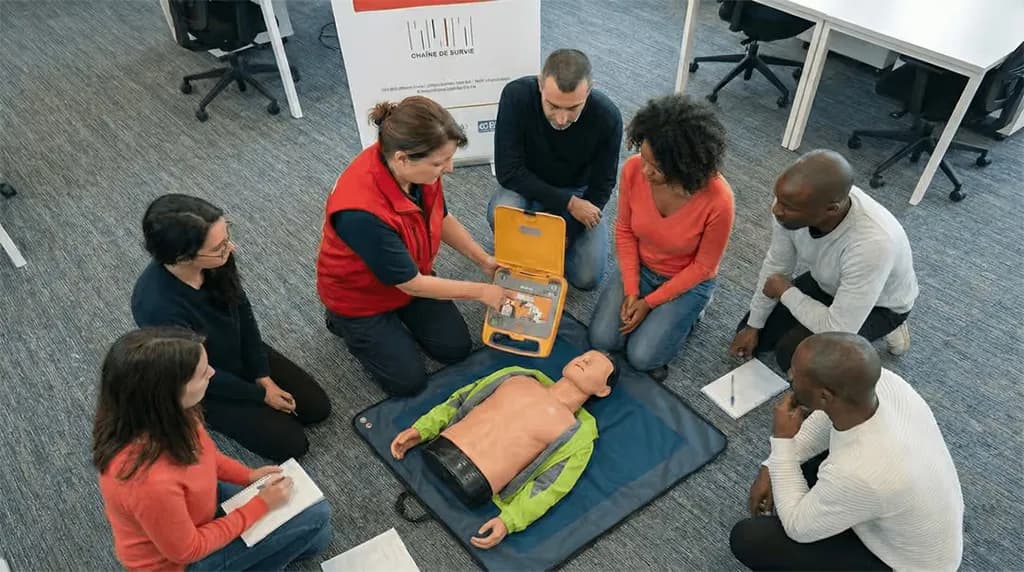
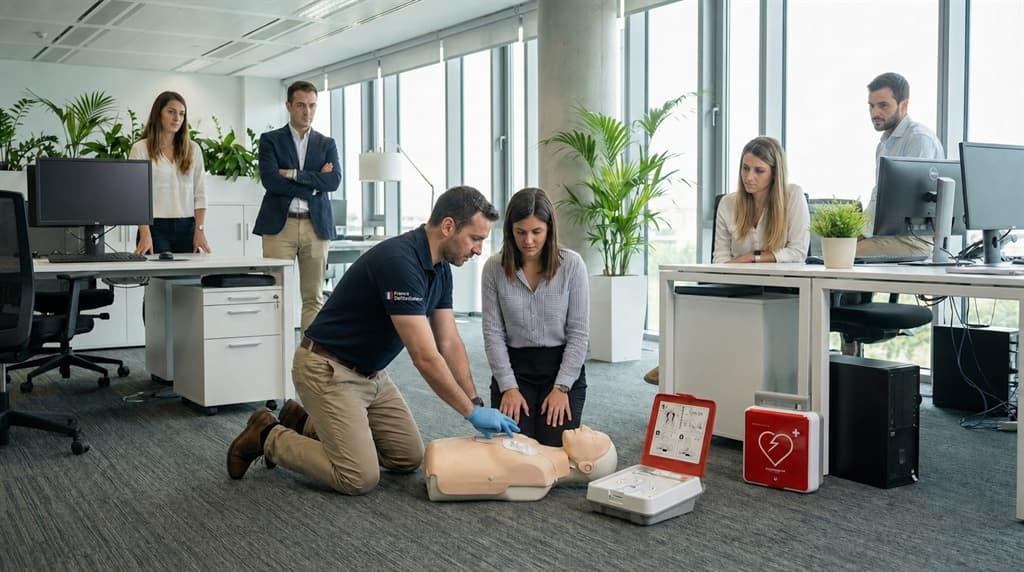
An AED guides the user by voice, and the law allows anyone to use it. Even so, a team that has already practised chest compressions and handled a training device reacts faster and with less hesitation.
Sports coaches often hold a qualification that includes some first-aid content, but it is best to check the dates. A short awareness session, repeated regularly, is enough to keep reflexes sharp. A simulation exercise in real conditions, with both the evening and morning teams, exposes weaknesses: the emergency number on display, someone assigned to open the door for the emergency services, the cabinet location known to everyone.
Monitoring and maintaining the device
Maintenance is the operator's responsibility under article R. 5212-25 du Code de la santé publique (the French Public Health Code). The device runs self-tests, but someone must check the status indicator and record the check in a log.
Reference lifespans: electrodes 2 to 5 years, batteries 3 to 5 years, the device itself 8 to 10 years and more. In a heated, humid venue, check that the cabinet protects the device from condensation and knocks. After any use, replace the electrodes and have the device checked before returning it to service.
Buying or renting for a gym
Buying suits an operator who wants to control the budget over ten years. Renting, from 50 € excl. VAT per month with maintenance included, spreads the cost and shifts consumables monitoring to the provider, which helps managers with a small team.
France Défibrillateur offers a 5-year warranty, delivery in 2 to 5 working days and a quote within 24 hours, so you can compare both options for the size of your gym.
Frequently asked questions
Does a gym have to have a defibrillator?
It depends on the venue's ERP classification and category. Deadlines run from 2020 for categories 1 to 3 to 2022 for some category 5 ERP. Ask the town hall or the safety commission to confirm, then register the device on GéoDAE.
Can members use the defibrillator themselves?
Yes, the law allows anyone to use an AED in front of a cardiac arrest. The device gives clear voice instructions and only delivers a shock if the rhythm calls for it. What matters is that it is visible and accessible at all times.
Who should check the device day to day?
The operator remains responsible for maintenance. In practice, they appoint a person to check the status indicator, record checks in a log and track the expiry dates of the electrodes and battery.
Do you need one device per floor?
No numerical rule requires it here. What counts is the access time from each zone. If the device is too far from a studio or a floor, a second unit may be justified. Measure the real walking distance before deciding.
Planning an AED project?
Purchase, rental from 50 EUR excl. VAT per month, installation with GéoDAE registration, servicing and training: our team replies within 24 hours.