Defibrillators for sports clubs: rules and equipment
Written by Cyrille GAGNAIRE, France Défibrillateur. Published on 4 August 2026.
A sports club brings together dozens, sometimes hundreds of people around regular physical exertion, a context where the risk of cardiac arrest is not theoretical. Gymnasiums, outdoor grounds, pools and fitness rooms welcome the public and are therefore subject to precise obligations regarding defibrillators. This guide explains who must equip their venue, how to choose a device suited to sports use, where to place it and how to organise its upkeep.
Sport strains a heart that may be fragile without anyone knowing
Intense physical effort strains the heart well beyond its resting rate. In a person whose heart muscle carries an undetected abnormality, this strain can trigger a serious rhythm disorder and cause a cardiac arrest, even in young players who appear perfectly healthy.
In France, around 50,000 cardiac arrests occur every year, and some happen during or right after a sporting effort, on a field, in a gymnasium or a fitness room. Every minute without defibrillation reduces the chances of survival by around 10 percent, which makes having a device (AED) on site decisive before emergency services arrive.
What the rules require for sports facilities
Gymnasiums, sports halls, pools and stadiums open to the public fall under the regulations for establishments receiving the public (ERP, a French classification for venues open to the public). Loi 2018-527 and its implementing décret 2018-1186 require an AED according to the venue's category: categories 1 to 3 since 1 January 2020, category 4 since 2021, and some category 5 venues since 2022.
A club that rents or uses a municipal hall should check with the town hall or facility manager who carries the equipment obligation, since responsibility lies with the operator of the site, not only the owner of the building. For a club affiliated with a federation, clarifying this in writing avoids situations where each side assumes the other has dealt with it.
The same check applies to associations organising one-off events, tournaments or training camps in a venue that is not normally open to the public. Coverage should extend to every session where members or spectators are present on site, not just regular training.
Choosing a defibrillator suited to sports use
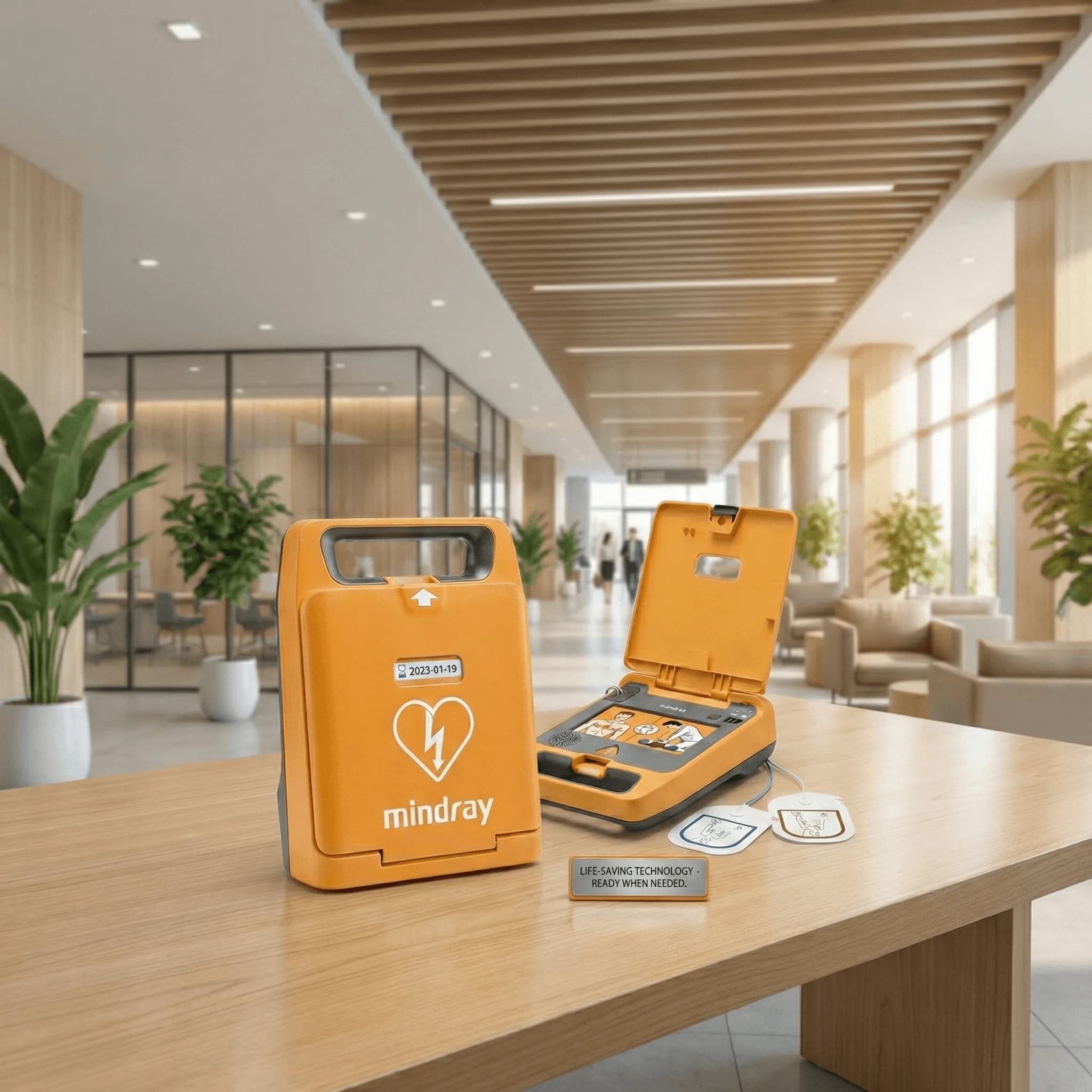
A sports facility often combines several constraints: frequent foot traffic, handling by volunteers with no medical training, exposure to dust or humidity depending on the discipline, and sometimes outdoor use for a stadium or an open-air field. A weatherproof outdoor wall cabinet, visible from the site entrance, suits this better than a cabinet designed for an office corridor.
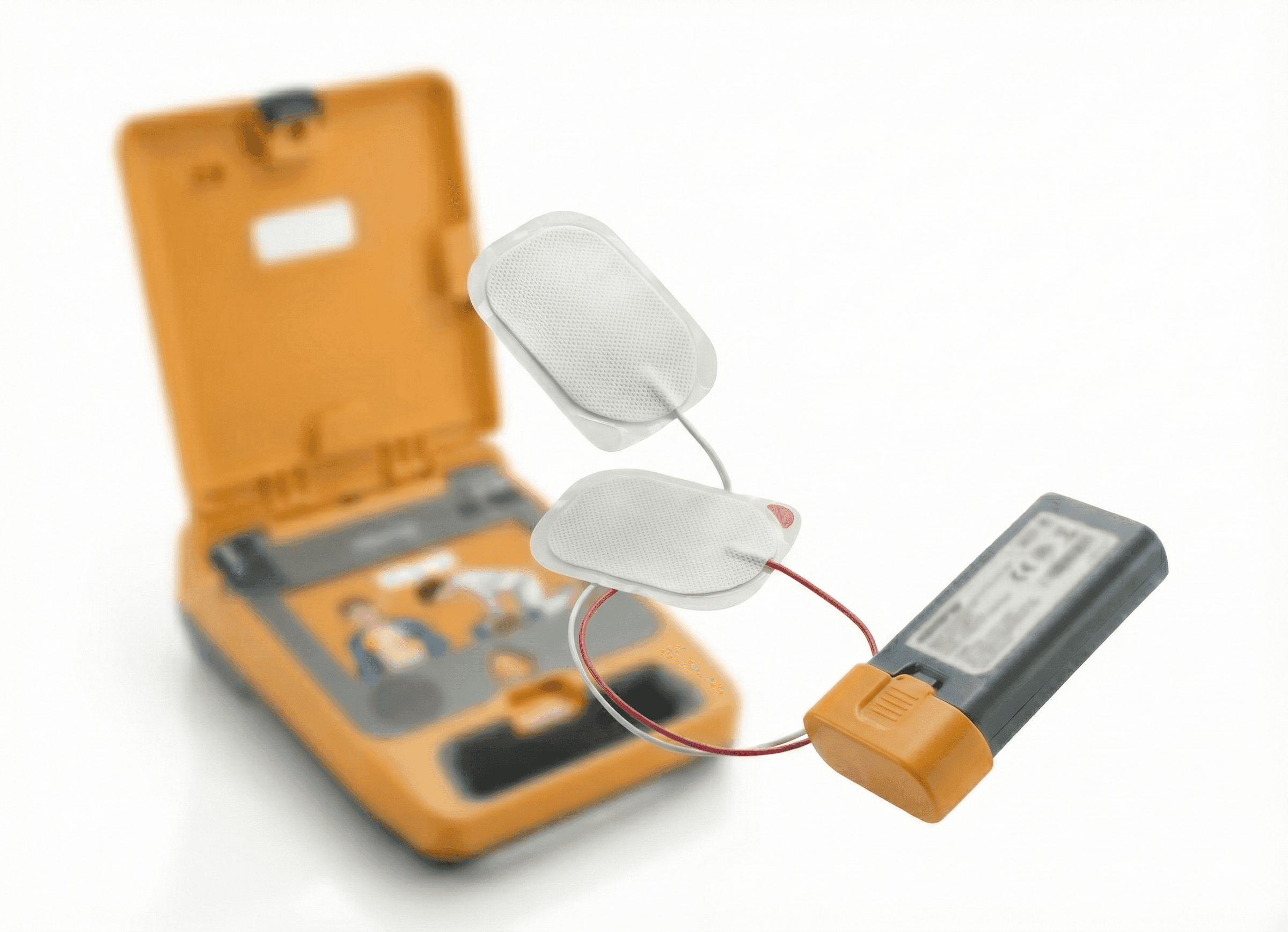
The choice between a fully automatic and a semi-automatic device depends mainly on the profile of the people present on site. A club that welcomes children should also stock paediatric electrode pads, since adult pads are not suitable below a certain weight. A 5-year warranty and delivery within 2 to 5 business days help equip a facility without tying up the season's budget for long.
Placement, signage and registration
The defibrillator must be installed somewhere accessible at all times, including during evening training sessions or weekend matches, not just during office hours. A central spot, visible from the main practice areas, cuts down the time lost in an emergency.
Signage follows the models set out in the arrêté of 29 November 2018 (the French decree defining official AED signage) and must remain visible from passageways. Once installed, the device must be registered in Géo'DAE, the national database that lets emergency services locate available defibrillators around an intervention site.
Keeping up maintenance through the sporting season
Maintenance of the defibrillator remains the operator's responsibility, under article R. 5212-25 of the French public health code. In a club, that means appointing someone, often on the board or among paid staff, to regularly check the device's self-test indicator and track the expiry dates of consumables.
| Component | Typical lifespan |
|---|---|
| Electrode pads | 2 to 5 years |
| Battery | 3 to 5 years |
| Defibrillator | 8 to 10 years or more |
Training coaches, volunteers and members
A defibrillator is only useful if someone is willing to use it. Training coaches, referees and volunteers present during matches or training sessions gives the club a chain of people able to step in without hesitation, especially since the device itself talks the user through each step once switched on.
Raising awareness among adult members too, particularly in disciplines with an older membership such as tennis, golf or recreational running, strengthens the club's culture around this life-saving action, and carries over into members' own families. A simple reminder at the start of the season, posted near the defibrillator, is often enough to make dozens of people register where the device is, something they would otherwise never have noticed.
Frequently asked questions
Should a sports club that rents a municipal hall install its own defibrillator?
It depends on the arrangement with the town hall or facility manager. If the hall is already equipped and the device stays accessible during the club's time slots, no extra installation is needed. Otherwise, this should be settled in writing, since responsibility for operating the venue can fall on the club.
Does an outdoor field need a different defibrillator than an indoor gymnasium?
An outdoor field calls for a cabinet resistant to weather and dust, placed somewhere shielded from direct sun to protect the battery and pads. An indoor gymnasium can use a simpler cabinet. In both cases, the device and its consumables must stay within their operating temperature range all year round.
Do children playing sport in a club need specific electrode pads?
Yes, below a certain weight, generally around 25 kilograms, adult pads deliver too much energy. A club with youth sections should stock paediatric pads or an energy attenuator, alongside the adult pads used for older members.
Who should be trained first in a sports club?
Coaches and the people present during training sessions and competitions, since they will be on site at the moment of a collapse. Board volunteers and referees also benefit from awareness training, as the device is designed to guide someone with no medical background through each step verbally.
Can a club on a tight budget rent a defibrillator instead of buying one?
Yes, renting suits a tight association budget well, with offers starting at 50 euros excl. VAT per month including maintenance. This avoids paying the full purchase price upfront and shifts tracking of consumables and servicing to the supplier.
Planning an AED project?
Purchase, rental from 50 EUR excl. VAT per month, installation with GéoDAE registration, servicing and training: our team replies within 24 hours.