Defibrillator in a spa or wellness centre: obligations
Written by Cyrille GAGNAIRE, France Défibrillateur. Published on 3 October 2026.
A spa or wellness centre welcomes clients who go from heat to pool to treatment, sometimes without realising the strain on their heart. When someone collapses in a closed treatment room or beside a pool, every minute counts. Here is how to know whether your venue must be equipped, where to place the device and how to organise maintenance and training.
A venue that brings together several risk factors
France sees about 50,000 cardiac arrests a year, and each minute without defibrillation reduces the chance of survival by about 10%. In a relaxation venue the clientele is mixed: older people, athletes recovering after training, guests trying a hammam or sauna for the first time.
The layout also complicates the response. Treatment rooms are closed, corridors can be long, and therapists often work alone with a client. The defibrillator should therefore be treated as local equipment, not an item stored at the back of a technical room.
What the regulations say for a wellness ERP
A spa or wellness centre open to the public is an ERP (établissement recevant du public, a French public-access building). The duty to equip comes from loi 2018-527 and décret 2018-1186 (the 2018 French law and decree): categories 1 to 3 since 1 January 2020, category 4 since 2021, and some category 5 ERPs since 2022.
The category depends on the number of people admitted, clients and staff included. A large centre inside a hotel or thermal complex rarely falls in the same category as a small neighbourhood salon. If in doubt, the safety commission or the relevant town hall department can confirm your venue's classification.
Even without a formal obligation, equipping a place where people are exposed to heat and immersion remains a coherent preventive choice. It can be financed by purchase or by rental.
Where to place the defibrillator in a spa
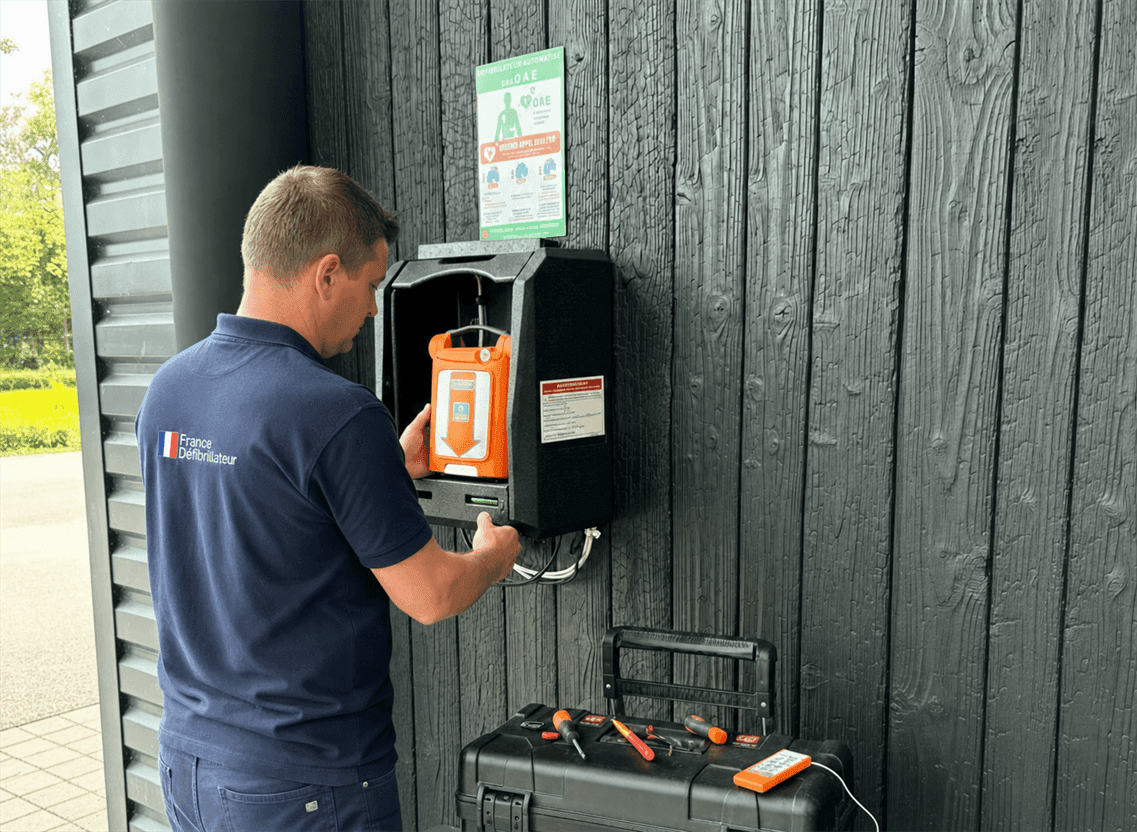
The device must be reachable within a few dozen seconds from any area, including treatment rooms and wet zones. The reception desk, usually staffed at all times, is a natural location. A second device may be justified if the site is large or spread over several floors.
Wet zones raise a practical constraint: avoid storing the device in the saturated atmosphere of a hammam. A wall cabinet in a dry corridor, right next to the area, does the job better. To compare models, see our article on indoor and outdoor cabinets.
A response plan posted behind the scenes also helps the team: who calls the emergency services, who brings the device, who meets the firefighters at the entrance. These roles are shared out in seconds if everyone knows them in advance.
Signage and registration
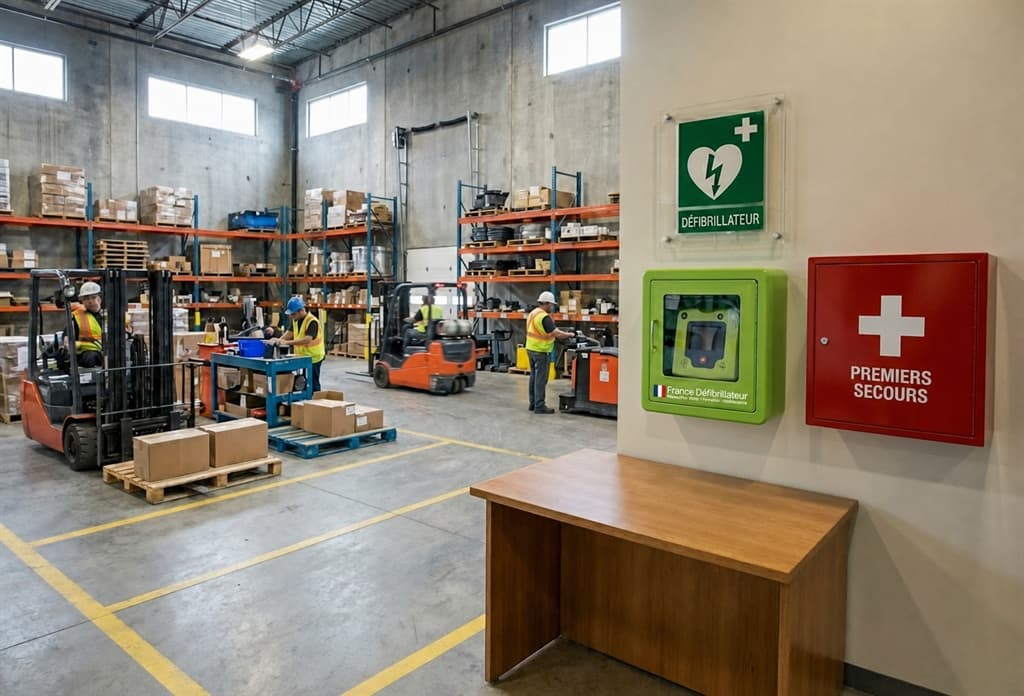
The defibrillator must be signposted according to the arrêté du 29 novembre 2018 (the French order of 29 November 2018), with directional signs from traffic areas so that a client or colleague can find it without knowing the premises. Make sure the signs are visible from reception and the changing rooms.
Registration in GéoDAE is mandatory. It lets the emergency services locate your device when a call comes in. Enter the real access hours, which match the centre's opening hours.
If the centre is part of a hotel, residence or sports complex, check that a single device is not declared for the whole site while it sits at the other end of the building. Each device must appear with its exact position.
Maintenance is the operator's responsibility
Maintenance falls to the operator under article R. 5212-25 du Code de la santé publique (French Public Health Code). In practice, this means regularly checking the self-test indicator, tracking expiry dates and keeping a register.
The orders of magnitude to remember: pads 2 to 5 years, batteries 3 to 5 years, the device itself 8 to 10 years and more. Rental from 50 € excl. VAT per month includes maintenance, which spares a small business from managing these deadlines itself.
| Item | Indicative lifespan |
|---|---|
| Pads | 2 to 5 years |
| Battery | 3 to 5 years |
| Defibrillator | 8 to 10 years and more |
Training the team in life-saving skills
A device with no trained person loses much of its value. Therapists, reception staff and any lifeguards should know chest compressions and how to use an AED. A short awareness session is enough to start, and workplace first-aider training goes further.
A simulation exercise on the premises, along the real route between a treatment room and the device, quickly reveals obstacles: a locked door, a cluttered corridor, a poorly relayed alert. It is worth repeating whenever the team changes.
Finally, think of seasonal staff and replacements: a short introduction to the device when each person arrives means nobody discovers it on the day of an emergency.
Frequently asked questions
Does a spa have to have a defibrillator?
It depends on the ERP category. Categories 1 to 3 have been subject to the obligation since 2020, category 4 since 2021 and some category 5 ERPs since 2022. Classification is based on the number of people admitted, clients and staff included, and can be confirmed by the safety commission.
Can the defibrillator be kept in the wet zone?
It is better to avoid it. Place it in a dry corridor, right next to the treatment rooms and pools, in a suitable cabinet. The aim is for it to be reachable within a few dozen seconds without exposing the device to a humidity-saturated atmosphere.
Who handles maintenance of the defibrillator?
The centre's operator, under article R. 5212-25 du Code de la santé publique. They check the self-test, replace pads and battery when due and keep a register. Rental from 50 € excl. VAT per month includes maintenance.
Must the device be registered in GéoDAE?
Yes, registration is mandatory. It lets the emergency services know where the device is when a call comes in. Give access hours that match the centre's opening hours and update the entry if the device is moved.
Planning an AED project?
Purchase, rental from 50 EUR excl. VAT per month, installation with GéoDAE registration, servicing and training: our team replies within 24 hours.