Defibrillator at a trade show or exhibition centre: duties
Written by Cyrille GAGNAIRE, France Défibrillateur. Published on 9 October 2026.
An exhibition centre can welcome thousands of visitors in a single day, from exhibitors building their stands to congress delegates and the general public. The halls are huge, the aisles crowded, and access routes change with every event. In that setting, a cardiac arrest raises a very practical question: where is the device, and who knows how to use it? Here are the points to settle before the doors open.
An exhibition venue is almost always an ERP
An exhibition centre, a congress hall or an events venue receives the public, so it falls under the rules for établissements recevant du public, or ERP (public-access buildings in France). Depending on capacity, it is placed in one of five categories, and large sites fall in categories 1 to 3.
The obligation to install an automated external defibrillator (AED, known in France as a DAE) comes from loi 2018-527 and décret 2018-1186. It has applied to category 1 to 3 ERP since 1 January 2020, to category 4 since 2021 and to some category 5 ERP since 2022.
Around 50,000 cardiac arrests occur in France every year, and each minute without defibrillation lowers the chances of survival by about 10%. In a hall of several thousand square metres, the distance to cover matters as much as the presence of the device.
Site manager and show organiser: who does what
The site often belongs to a manager, while each show is set up by a different organiser who rents the halls for a few days. Without a written agreement, this split creates a grey area.
Maintenance is the operator's responsibility under article R. 5212-25 of the Code de la santé publique (French public health code). For the venue's permanent equipment, that is usually the site manager. The organiser makes sure the emergency arrangements planned for the event suit the expected attendance and are known to everyone involved.
The hall rental contract is worth specifying the number of devices on site, where they are, who checks them and who coordinates emergency response during the event. A few lines avoid discovering the problem on the day of an emergency.
Placing devices in large spaces
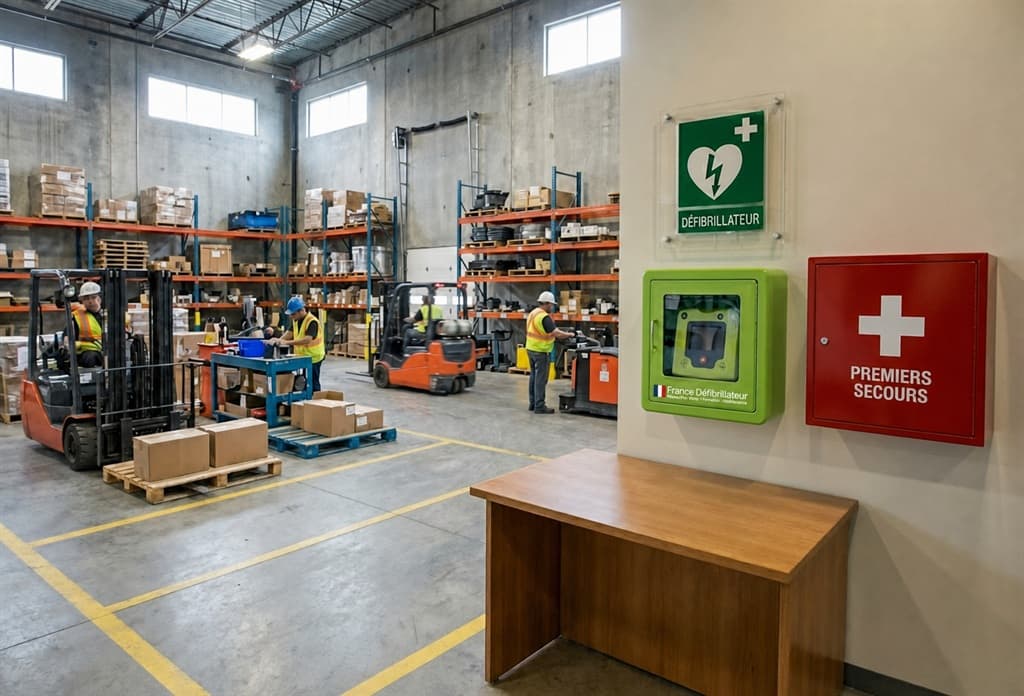
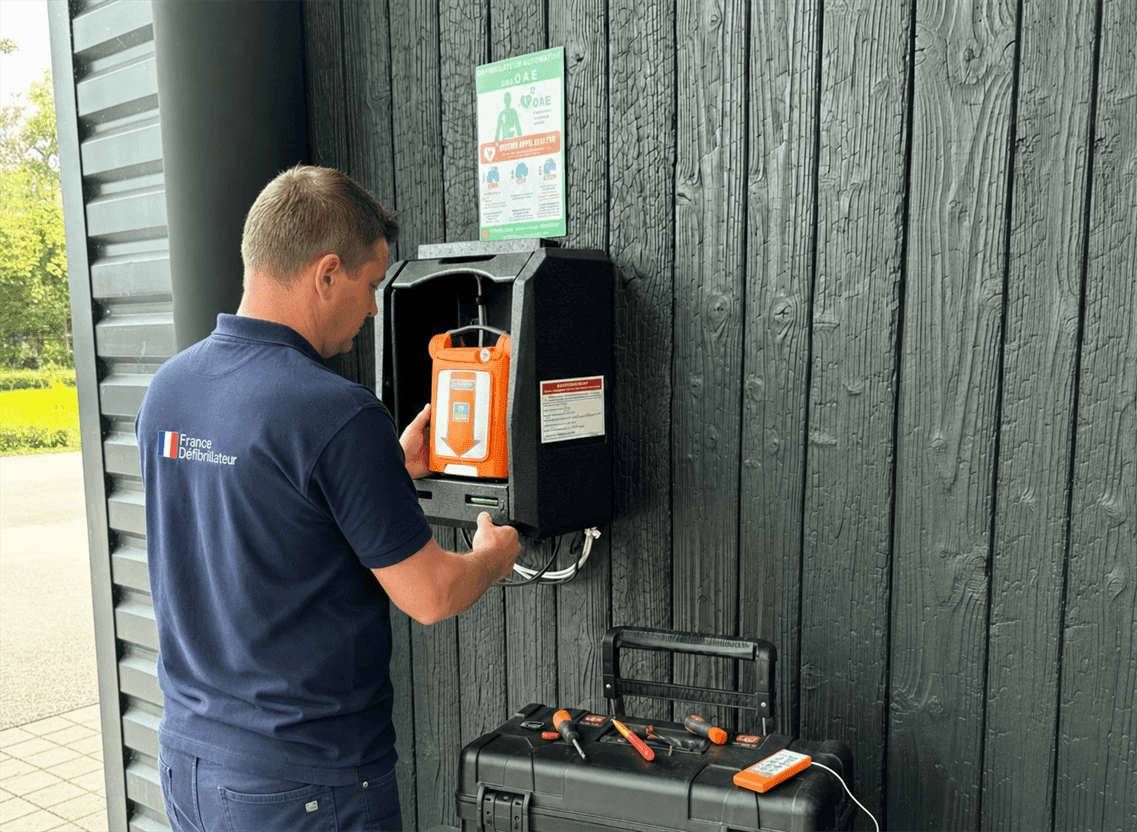
In an exhibition hall, the defibrillator must not vanish behind a stand partition. It belongs at a fixed point, visible from several aisles, with signage compliant with the arrêté du 29 novembre 2018 and directional signs that remain readable even when stands change the sightlines.
Several devices are often needed. The deciding criterion is the time needed to reach one from the most distant points, including during peak attendance when aisles are saturated. Entrances, catering areas, conference rooms and build-up halls are all places to review.
Set-up and dismantling deserve particular attention: accidents at work are frequent then, and although the public is absent, teams are scattered across isolated areas.
Situations found on an exhibition site
Answers vary with the type of event and the way the venue is run. The table below covers the most common cases.
| Situation | Point to watch | Right reflex |
|---|---|---|
| Permanent exhibition centre | Large surface, several halls | One device per hall or zone |
| Busy public show | Saturated aisles, slower access | Visible, signposted devices and an identified first-aid post |
| Congress in a congress hall | Rooms closed during sessions | Device in the shared circulation areas |
| Temporary show under a marquee | Temporary site with no fixed equipment | Plan a mobile or rented device for the duration |
| Stand build-up and dismantling | Scattered teams, no public | Remind contractors where the device is |
Informing exhibitors and training teams
An automated defibrillator guides the user by voice, but people still need to know it exists. The exhibitor guide, the show plan and the briefing of the reception team are the right places to state where the devices are and which emergency number to call.
Training permanent staff, security officers and reception hosts in life-saving first aid gives a real chance to act in the first minutes. A short awareness session, repeated before the biggest events of the year, is enough to build the right reflexes.
For follow-up, check the self-test indicator regularly and record the checks in the register. Electrodes generally last 2 to 5 years, batteries 3 to 5 years and the device itself 8 to 10 years or more. Registration in GéoDAE is mandatory and lets emergency services locate the device.
Buy for the site, rent for the event
For permanent halls, buying is usually the answer: the device stays in place for years and carries a 5-year warranty. The site manager then plans the replacement of electrodes and batteries.
For a temporary show or a one-off event, renting is more flexible. It starts at 50 € excl. VAT per month, maintenance included, and avoids tying up equipment that would only be used a few days a year.
In both cases, France Défibrillateur provides a quote within 24 hours and delivers in 2 to 5 working days, leaving time to be equipped before opening.
Frequently asked questions
Is an exhibition centre an ERP?
Yes, in the vast majority of cases. A venue that welcomes the public for shows, congresses or performances falls under the rules for établissements recevant du public (ERP, public-access buildings). Its category depends on capacity and should be checked with the site manager or the safety commission.
Who should provide the defibrillator: the site manager or the organiser?
The venue's permanent equipment is generally the site manager's responsibility, who handles maintenance as the operator. The organiser checks that the arrangements suit the event. The hall rental contract should state these responsibilities to avoid any grey area.
How many devices are needed in a large hall?
There is no single number. The deciding criterion is the time needed to reach a device from the most distant points, including when aisles are saturated. One visible, signposted device per hall or zone is a common starting point.
Can I rent a defibrillator for a temporary show?
Yes. Rental starts at 50 € excl. VAT per month, maintenance included. It suits one-off events or temporary sites, because it avoids buying equipment used a few days a year and relieves the organiser of tracking consumable expiry dates.
Planning an AED project?
Purchase, rental from 50 EUR excl. VAT per month, installation with GéoDAE registration, servicing and training: our team replies within 24 hours.