AED in cinemas, theatres and concert halls: what applies
Written by Cyrille GAGNAIRE, France Défibrillateur. Published on 2 September 2026.
A multiplex cinema, a municipal theatre or a concert hall welcome the public under particular conditions: darkness during the show, narrow aisles, crowds concentrated in a few time slots. These venues fall under the same public facility rules as a shop or a town hall, but running them calls for specific choices about where to place the defibrillator, how to train front of house and security staff, and how to maintain the equipment between two performances.
A performance venue remains a facility open to the public
A cinema, a theatre, a concert hall or a cabaret fall into the same category of public facility as a shop or a town hall. French law 2018-527 and its implementing decree 2018-1186 require an automated external defibrillator (AED) depending on the facility category: categories 1 to 3 since 1 January 2020, category 4 since 2021, and part of category 5 facilities since 2022. A municipal hall seating 180 people and a multiplex with several thousand seats therefore do not fall under the same timeline or the same requirements.
The classification depends on the maximum capacity authorised, stated in the opening permit issued after review by the local safety commission. An operator who enlarges the hall, adds tiered seating or changes the seating layout must check whether this figure changes the category, and therefore the compliance deadline. Any doubt should be cleared with the prevention department of the prefecture or the local fire and rescue service, which holds the facility's safety file.
What darkness and noise change during a performance
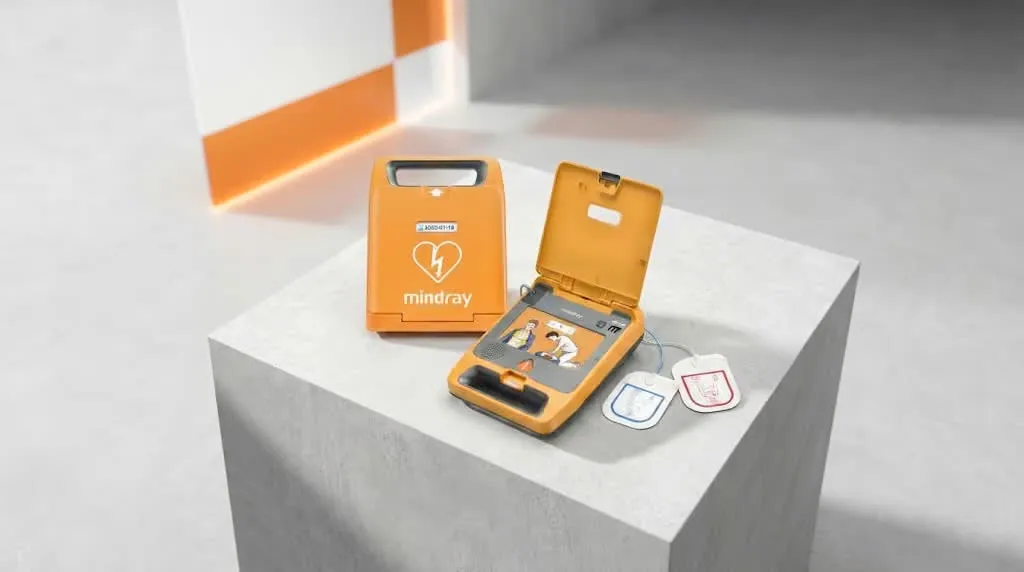
A performance venue carries a constraint few other public facilities share: the audience stays still, in the dark, for a long stretch, and the staff available to react is often limited to a few ushers or fire safety officers. The defibrillator must remain usable by a non medical person, under stress, with no immediate visual cue. A device with clear voice guidance and short instructions compensates for the lack of natural light and the residual noise of a hall emptying in a hurry.
The choice between a fully automatic device, which delivers the shock without human validation, and a semi automatic one, which requires pressing a button, takes on particular weight here. In a venue where staff turn over often and volunteers reinforce the team during major events, an automatic model reduces the risk of hesitation at the critical moment.
Where to install the defibrillator in a performance venue
The entrance hall is the most obvious location, accessible before and after the show, visible to both the public and box office staff. But a hall with several levels, a stalls area and a balcony, or multiple emergency exits, benefits from spreading the equipment: one unit near the entrance, a second near the control booth or the dressing rooms, where technicians and performers spend long hours. The principle stays the same as for any facility: no more than three minutes' walk from any point accessible to the public.
Backstage areas and dressing rooms deserve particular attention, often overlooked. Technicians, performers and production teams sometimes spend more time in these spaces than in the hall itself, with slower access to outside emergency services.
Making the defibrillator visible despite the darkness
The French order of 29 November 2018 requires standardised signage, with the white pictogram on a green background, visible and lit. In a hall plunged into darkness during the performance, this sign loses part of its usefulness unless it is backed up by emergency lighting or a photoluminescent coating that stays visible for several minutes after the lights go down.
The staff briefing before each performance, already common in well run venues for fire safety instructions, should include a reminder of where the defibrillator is. Ushers, often the first witnesses of a medical emergency in the audience, need to know where the device is without having to search for it in the dark.
Training permanent teams and occasional reinforcements
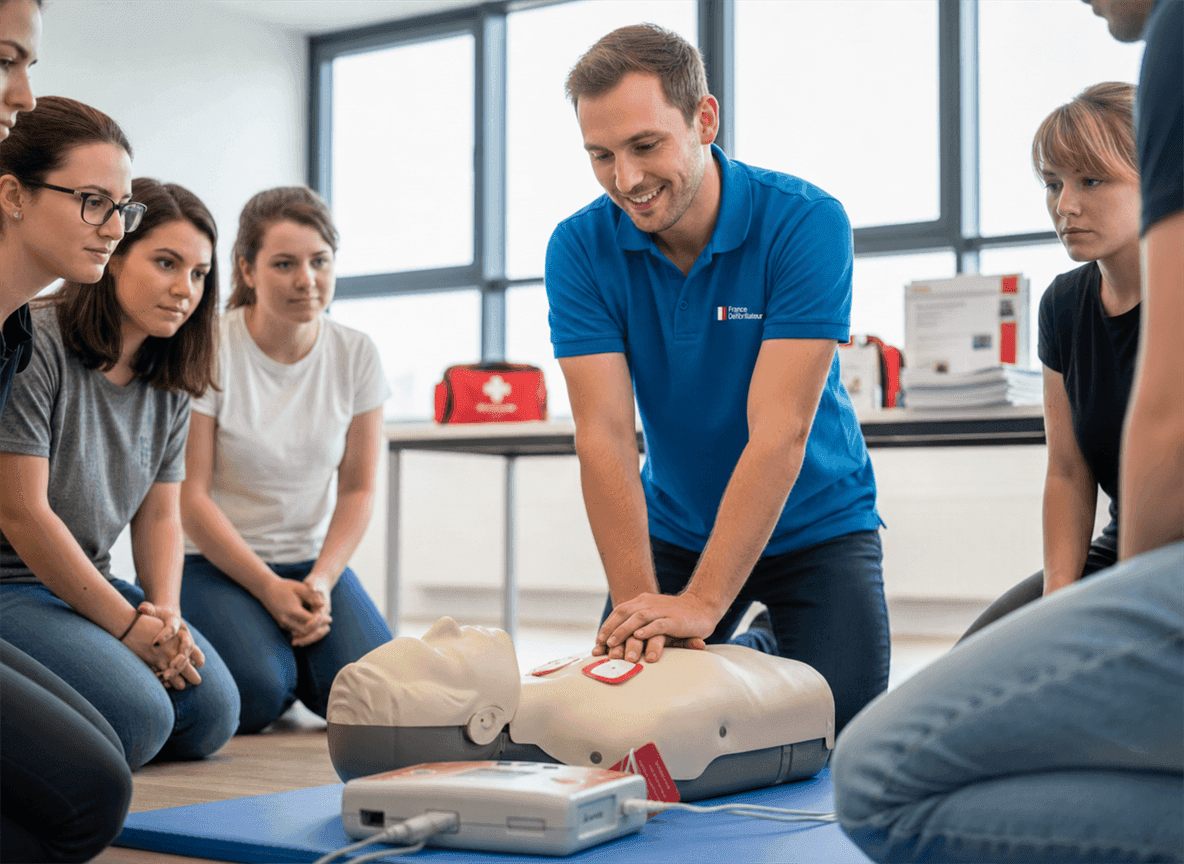
A performance venue rarely employs a fixed team: qualified fire safety officers, seasonal ushers, association volunteers during a festival, touring technical crews. This turnover means prioritising training for permanent positions, the people who return week after week, while adding a minimal briefing for occasional reinforcements before each major event.
First aid training, whether a short one hour awareness session or a fuller certified course, gives staff the ability to recognise cardiac arrest, perform chest compressions and use the device without waiting for emergency services. Regular refresher training matters as much as the initial course, since these gestures fade quickly if never practised.
Maintaining the defibrillator between two performances
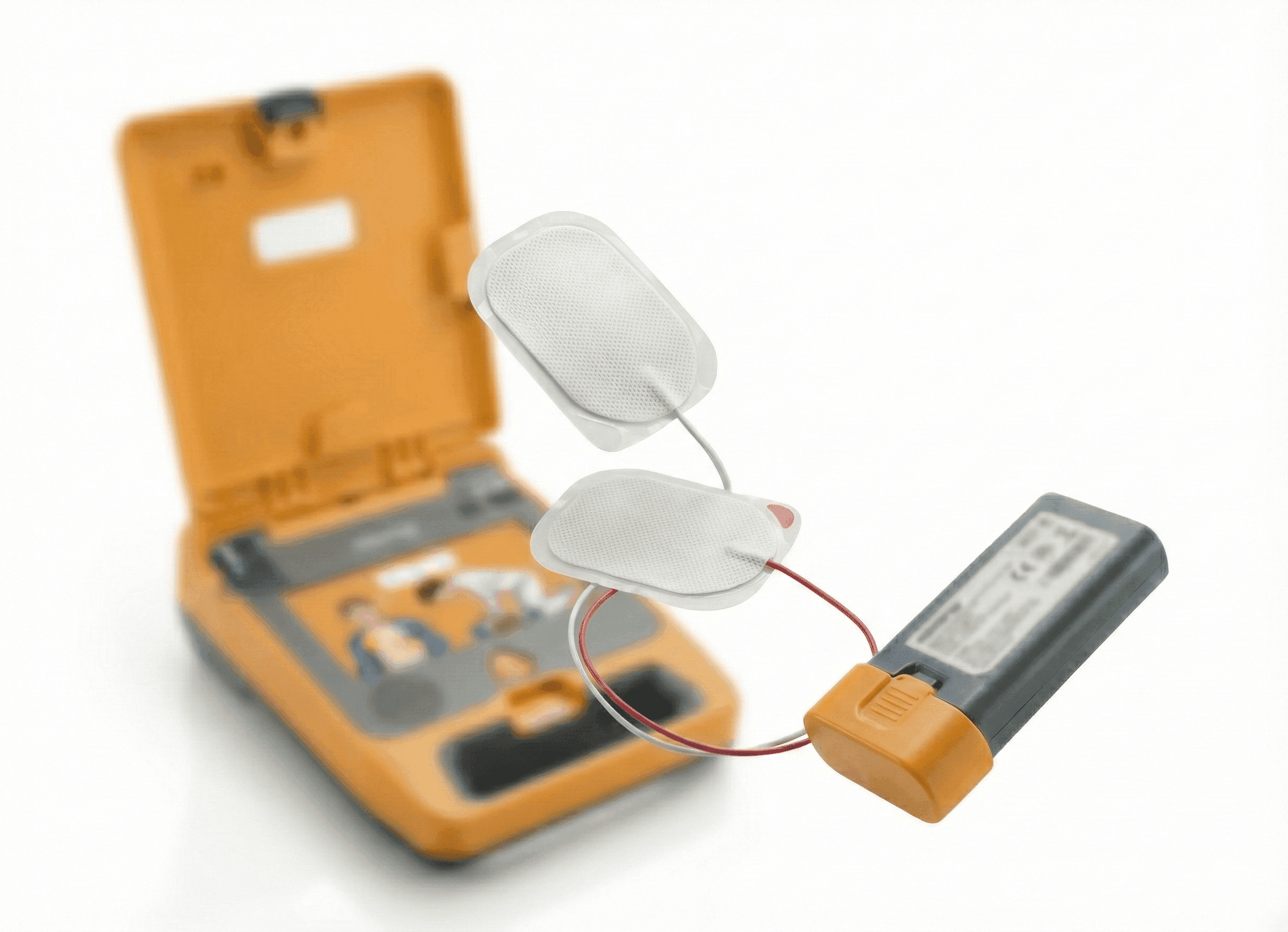
The defibrillator stays installed all year round, including during the summer break or renovation works, while the hall itself may stay closed for several weeks. The device's automatic self test still needs regular checking, and consumables tracked: electrode pads replaced every two to five years, battery every three to five years, the full unit renewed after eight to ten years of use.
Renting, from 50 euros excl. VAT per month with maintenance included, convinces many cultural venues with tight budgets, particularly association run halls or municipal theatres that prefer to spread the cost rather than tie up capital. Buying remains an option, with a five year warranty, delivery within two to five working days and a quote provided within 24 hours to compare both options.
Frequently asked questions
Does a small association run theatre with under 100 seats need a defibrillator?
It depends on the facility category assigned by the safety commission, based on maximum capacity, not on the number of performances. A category 5 venue with seated audiences may be concerned since 2022 depending on its activity. The safest approach is to check the facility's opening permit or contact the local fire and rescue service.
Does the dressing room area need a different defibrillator than the entrance hall?
No, the same model works everywhere, as long as it stays accessible and easy to spot. What changes is the placement and number of units depending on the size of the building, whether it has several levels, and the distance between technical areas and the public entrance.
Does the defibrillator need to be registered even for a venue that only opens a few nights a month?
Yes, registration in Geo'DAE (the French national AED registry) is mandatory as soon as a device is installed, regardless of how often the venue opens to the public. This database lists accessible defibrillators to guide emergency services in real time, including towards a venue that only operates occasionally.
Who trains volunteers recruited for a one off festival?
The organiser can call on a provider for a short awareness session, focused on recognising cardiac arrest and using the defibrillator, ahead of the event. This is not an individual legal obligation, but a recommended practice whenever a volunteer might be the first witness of a medical emergency.
Must the defibrillator stay accessible during renovation works at the venue?
If the venue closes completely to the public, the immediate access obligation lapses, but the device must be kept operational for reopening. It remains useful to keep it accessible to the construction teams on site, who can also face a cardiac emergency.
Planning an AED project?
Purchase, rental from 50 EUR excl. VAT per month, installation with GéoDAE registration, servicing and training: our team replies within 24 hours.