Defibrillator in covered markets and market halls: duties
Written by Cyrille GAGNAIRE, France Défibrillateur. Published on 25 October 2026.
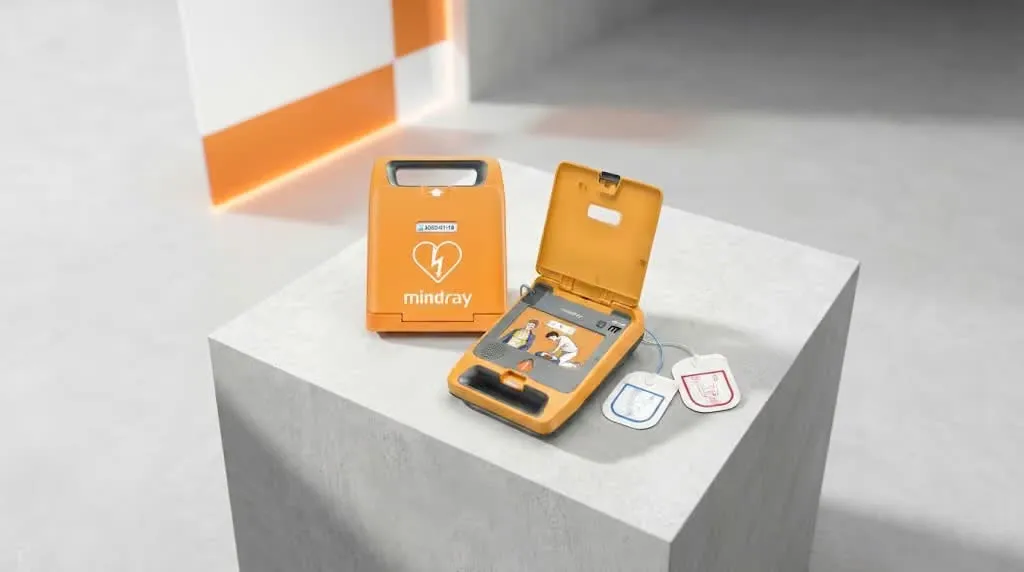
A covered market welcomes hundreds of visitors every week, many of them elderly, along with traders who work on their feet from dawn. In a place like this, a cardiac arrest can strike between two stalls, in the middle of the crowd. The questions are who must equip the hall, where to put the device and how to organise its upkeep when the people on site change from one day to the next.
A busy place with a real risk
In France, about 50,000 cardiac arrests occur every year. Each minute without defibrillation reduces the chance of survival by about 10%. A market hall fills mostly in the morning, with many elderly customers, heavy carrying and sometimes marked heat or cold.
Crowd density also complicates the response. Aisles are narrow, stalls clutter the walkways and emergency services must be able to make their way through. A defibrillator on site allows care to begin before they arrive, which changes the outcome.
What the regulations require for a market hall
Covered markets and halls are ERP (établissements recevant du public, French public-access buildings). The duty to equip depends on the category: categories 1 to 3 have had to be equipped since 1 January 2020, category 4 since 2021, and some category 5 ERP since 2022, under loi 2018-527 (the 2018 French law on AED deployment) and décret 2018-1186 (its implementing decree).
A small neighbourhood hall is often category 5, a large central hall category 4 or above. The classification appears in the building's safety file, which the town hall or the manager must be able to produce. When in doubt, it is better to equip: the step remains useful even where the obligation does not yet apply.
Who equips and who maintains when occupants change
In most cases the hall belongs to the municipality or to a delegated manager, and traders operate there under an occupancy arrangement. The duty to equip falls on the operator of the building, meaning whoever runs the site, not on individual stallholders.
Maintenance is the operator's responsibility under article R. 5212-25 of the Code de la santé publique (French Public Health Code). A reference person must therefore be appointed in writing to check the device and keep the safety register. Without this appointment nobody looks at the self-test indicator, and that is how a device becomes unusable without anyone noticing.
A private hall run by a traders' association follows the same logic: the operating association carries the obligation. The internal rules are best used to specify who pays, who checks and who replaces consumables.
On market days the hall runs at several speeds: deliveries before opening, heavy traffic mid-morning, tidying in the afternoon. The reference person should know these rhythms in order to check the device outside peak hours and make sure nothing hides the cabinet, whether a stacked crate, a tarpaulin or an extra stall set up on busy days.
Where to place the device in a hall
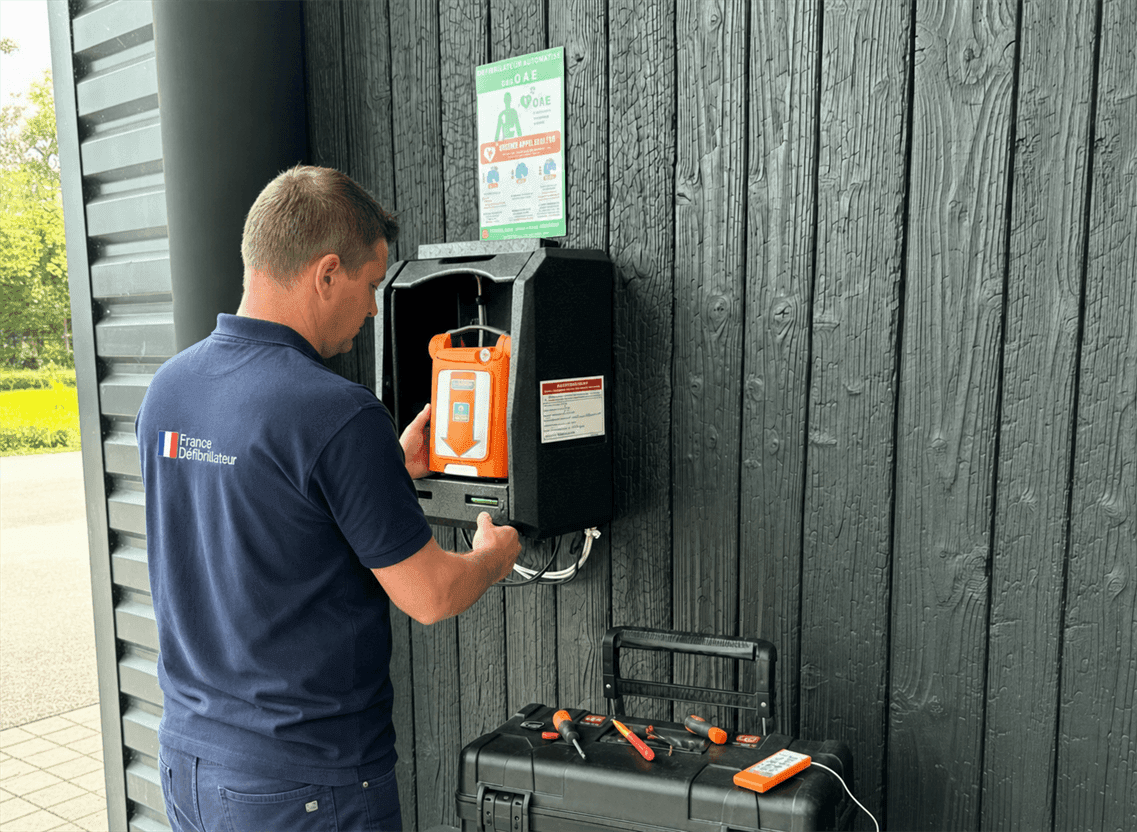
Location determines effectiveness. The defibrillator should be at the main entrance or near a central crossing point, visible from the aisles, accessible without a key and without going behind a stall. Avoid technical rooms, manager offices closed after noon or a storeroom.
For a hall open to the street or used in the evening, a heated, protected outdoor cabinet works better than a simple indoor box. Signage follows the arrêté du 29 novembre 2018 (the French order of 29 November 2018), with directional signs from the entrances. Also remember to register the device in GéoDAE, a mandatory declaration that makes it visible to emergency services.
A simple notice near the cabinet also helps: emergency number, three-step instructions and the name of the reference person. Traders, who know each other and meet every week, quickly remember these cues and can pass the information on to newcomers.
Points to check before choosing
The table below summarises the most useful criteria for a hall, depending on how it is run.
| Criterion | Neighbourhood hall | Large central hall |
|---|---|---|
| Number of devices | One, near the entrance | Several, spread across zones |
| Cabinet type | Indoor is enough | Outdoor or heated if accessible at night |
| Reference person | Municipal employee or site manager | Dedicated team with a deputy |
| Acquisition mode | Purchase or rental | Rental with maintenance included |
Buying, renting and training the teams
Rental suits managers who do not want to handle consumables: it starts at €50 excl. VAT per month, maintenance included. Purchase makes sense for a fleet of several devices managed in-house. Electrodes last 2 to 5 years, batteries 3 to 5 years, and the device itself 8 to 10 years or more. The warranty is 5 years, delivery takes 2 to 5 working days and the quote arrives within 24 hours.
The device alone is not enough. Training hall staff, reception agents and volunteer traders in alerting, chest compressions and using the DAE (AED, automated external defibrillator) reduces the time lost at the critical moment. A short awareness session, repeated regularly, is enough to build reflexes.
Frequently asked questions
Must a market hall have a defibrillator?
A hall is an ERP. It must be equipped if its category is concerned: categories 1 to 4 under the timetable of loi 2018-527, and some category 5 ERP since 2022. The classification appears in the safety file held by the operator.
Who pays for a covered market's defibrillator?
The operator of the building, that is the municipality, the delegated manager or the association running the hall. Occupying traders do not individually bear this cost, unless the internal rules or the occupancy agreement provide otherwise.
Where should the defibrillator go in a hall?
At the main entrance or near a central crossing point, visible from the aisles and accessible at any time without a key. Avoid closed rooms. An outdoor cabinet is suitable if the hall remains accessible outside opening hours.
Must the defibrillator be registered in GéoDAE?
Yes, registration in GéoDAE is mandatory. It lets emergency services locate the nearest device during a call. Remember to update the record if the device is moved, replaced or withdrawn.
Is rental suitable for a market hall?
Often yes. Rental starts at €50 excl. VAT per month, maintenance included, so the municipality or association does not have to track electrodes and battery itself. It simplifies management when the reference person changes.
Planning an AED project?
Purchase, rental from 50 EUR excl. VAT per month, installation with GéoDAE registration, servicing and training: our team replies within 24 hours.