Defibrillators for town halls and local authorities: the rules
Written by Cyrille GAGNAIRE, France Défibrillateur. Published on 8 August 2026.
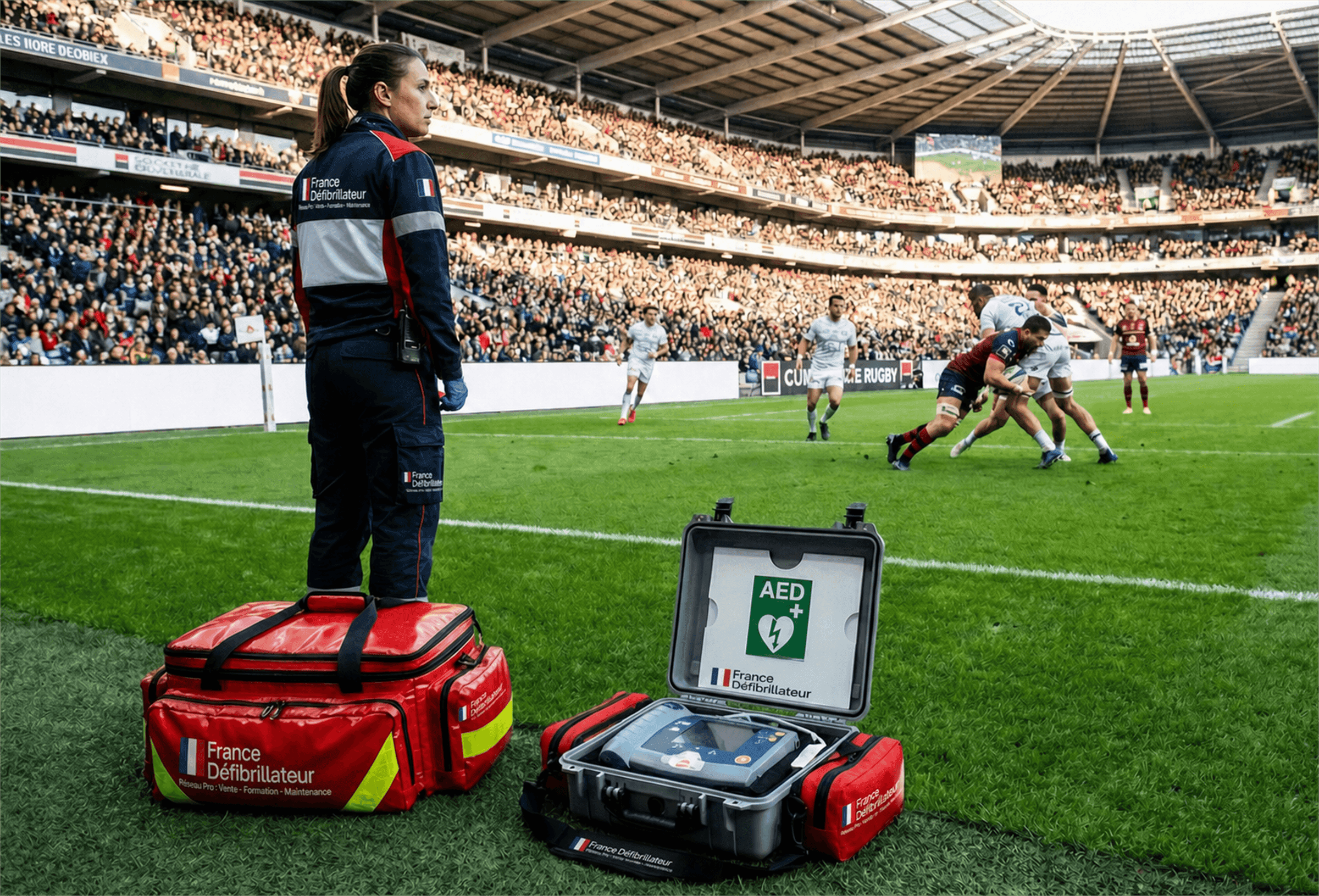
A local authority rarely manages a single building open to the public. Town hall, gymnasium, community hall, library or school each fall into a distinct category of establishment receiving the public, with its own equipment timeline and its own usage constraints. Here is how a local authority can organise its defibrillator obligations, building by building, without leaving anything out or limiting the effort to the town hall alone.
A municipal building remains an establishment open to the public
Being a local authority does not exempt anyone from the obligations that apply to establishments receiving the public. A town hall, a municipal gymnasium, a community hall or a library are each classified in a category of establishment receiving the public based on their capacity and their activity, exactly like a shop or a private company.
This means a municipality cannot reason at the scale of its entire property portfolio. Each building must be assessed separately to determine its category, then its deadline for installing an automated external defibrillator (AED). A gymnasium hosting several hundred people during a competition does not carry the same obligation as a small village town hall open a few hours a week.
The legal timeline and GeoDAE registration
French law 2018-527 and its implementing decree 2018-1186 set a phased timeline. Establishments receiving the public in categories 1 to 3 were required to be equipped from 1 January 2020, category 4 from 2021, and certain category 5 establishments from 2022. A town hall or a municipal facility that falls into one of these categories is therefore already expected to have its device installed.
Once the device is installed, registering it in the GeoDAE database is mandatory. For a public building, this step matters twice over: it lets emergency medical services guide a bystander to the nearest device during a call, and it also serves as proof of compliance in the event of an inspection. The signage placed at the entrance and along the route to the device must follow the models set out in the French order (arrete) of 29 November 2018.
Indoor or outdoor cabinet, a choice made building by building
Opening hours vary enormously from one municipal facility to another. A town hall closes its doors in the evening, while a gymnasium or a community hall welcomes local associations until late in the evening and sometimes on weekends. The choice between an indoor and an outdoor cabinet should therefore be made facility by facility, depending on whether the public may need the device outside the building's opening hours.
For a building closed to the public in the evening, an indoor wall-mounted cabinet is enough. For a site used without staff on duty, such as a gymnasium or a stadium, a heated, alarmed outdoor cabinet protects the device from the weather and signals any unjustified attempt to open it.
| Model | Recommended use | Price incl. VAT |
|---|---|---|
| ARKY metal indoor cabinet | Town hall, library, staffed reception | 99.00 EUR |
| Wall cabinet with alarm and key | Municipal corridor or hall | 94.99 EUR |
| ARKY outdoor cabinet with alarm | Gymnasium, stadium, outdoor facade | 359.00 EUR |
| AIVIA 210 heated outdoor cabinet | Site without permanent staff presence | 619.99 EUR |
Pooling purchasing and maintenance across buildings
A local authority managing several sites has an interest in handling equipment as a group rather than building by building over time. A single maintenance contract covering all municipal defibrillators simplifies tracking self-tests, replacing electrodes every two to five years and batteries every three to five years, while still keeping one safety log per building but a single point of contact.
Rental, starting from 50 euros excl. VAT per month and per device with maintenance included, allows the cost to be spread over the operating budget rather than the investment budget, a point that often matters for a small municipality. Purchasing remains the right choice for the busiest buildings, with a five-year warranty, delivery within two to five working days and a quote within 24 hours to compare both options before deciding.
Training municipal staff and facility managers
A defibrillator does not replace people trained in life-saving actions. Town hall reception staff, gymnasium caretakers, library personnel and the leaders of associations using municipal halls are the first people present when someone collapses. A short, regularly repeated awareness session lets them recognise a cardiac arrest, alert emergency services and start chest compressions while waiting for the device.
This training effort is best organised at the scale of the whole local authority, often with the same provider that handles device maintenance. It also concerns elected officials and association volunteers who oversee one-off events in municipal halls, particularly during sports events or large gatherings.
Who carries the operator's responsibility
For a municipal building, the operator within the meaning of article R. 5212-25 of the French public health code (Code de la sante publique) is the local authority itself, represented by the mayor or the president of the intermunicipal body depending on which property is concerned. It is therefore the municipality that must ensure every defibrillator installed on its territory works properly, whichever building it sits in.
In practice, this responsibility means monitoring self-test indicators, replacing consumables before they expire and keeping each site's safety log up to date. A defibrillator whose maintenance is neglected exposes the local authority in the event of an incident, which is a strong reason to centralise this tracking rather than leaving it to each building manager separately.
Frequently asked questions
Must a local authority equip every one of its municipal buildings with a defibrillator?
Only buildings classified as establishments receiving the public in a category covered by the legal timeline are legally required to be equipped. A small, lightly used association hall may not be concerned, but it is best to assess each building individually rather than assume it is exempt.
Who pays for the purchase and maintenance of municipal defibrillators?
The cost falls on the local authority that owns or manages the building, which is the operator under the regulation. Some municipalities split the cost between an investment budget for the purchase and an operating budget for maintenance, or choose rental, which combines both in a single monthly fee.
Does a gymnasium used by local associations fall under different obligations than a town hall?
The principle is the same, only the category of establishment can differ depending on how many people attend. A gymnasium hosting the public during competitions may fall into a different category than a town hall, which changes the equipment deadline and sometimes the choice between an indoor and outdoor cabinet.
Does every municipal defibrillator need to be registered in GeoDAE?
Yes, every device installed in a municipal building must be registered individually in GeoDAE, with its precise location. This registration lets emergency medical services locate the nearest device during an emergency call and serves as proof of compliance for the local authority.
Do municipal staff need specific training?
No medical qualification is required to use an automated external defibrillator, since the device guides the user with voice prompts. An awareness session on life-saving actions is nonetheless recommended for staff in contact with the public, so they react quickly and without hesitation when someone collapses.
Planning an AED project?
Purchase, rental from 50 EUR excl. VAT per month, installation with GéoDAE registration, servicing and training: our team replies within 24 hours.