Defibrillators in Supermarkets and Shopping Centres: Rules and Best Practices
Written by Cyrille GAGNAIRE, France Défibrillateur. Published on 9 September 2026.
A supermarket or shopping centre combines heavy footfall with long aisles and sometimes several floors, which makes every minute count in the event of a cardiac arrest. French regulation requires an automated external defibrillator (AED) in almost all these establishments, but the picture gets more complex once several retailers share a single roof. Here is how the obligation, the installation and the upkeep of the device are organised in this particular setting.
A regulation that depends on the ERP category
Shops and shopping centres fall under ERP type M, the French classification for establishments receiving the public that is dedicated to retail. As with other ERP types, the obligation to install a defibrillator follows a classification into categories from 1 to 5, based on the number of people who can be present at once. A hypermarket spanning several thousand square metres is usually classed in category 1 or 2, while a small neighbourhood store may fall into category 5.
French law 2018-527 and its implementing decree 2018-1186 set a phased timeline. The busiest large stores, already classed in categories 1 to 3, have had to be equipped since 1 January 2020. Category 4 establishments have been covered since 2021, and some category 5 ERPs since 2022. A shopping centre almost always exceeds these thresholds and has therefore been concerned since the first deadline.
Does every shop need its own defibrillator, or just one for the whole centre?
In a stand alone hypermarket, the answer is straightforward: a single operator manages the whole site and installs as many defibrillators as its floor area requires. A shopping centre bringing together several independent retailers raises a different question, since each shop is its own establishment receiving the public, yet they share common areas managed by a landlord or a management company.
In practice, the most effective solution is to install one or more defibrillators accessible from the common areas, funded and maintained by the centre's management, alongside the devices that large anchor stores, such as an integrated hypermarket or a home improvement store, install themselves for their own floor area. This shared arrangement should be formalised in the commercial lease or the centre's internal rules, so everyone knows who maintains which device.
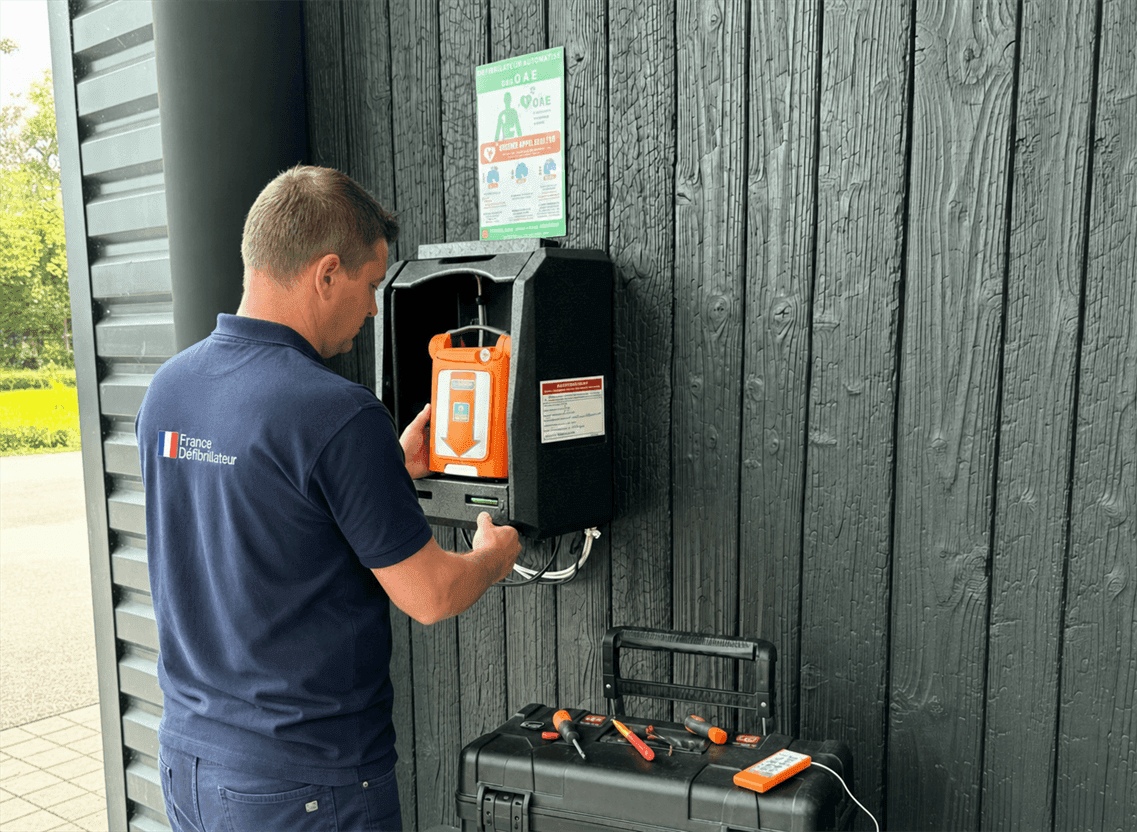
Timeline of deadlines by establishment category
The table below summarises the thresholds that apply to shops and shopping centres under current regulation.
| ERP category | Establishments concerned | Equipment deadline |
|---|---|---|
| Categories 1 to 3 | Large hypermarkets, shopping centres with more than 300 people | Since 1 January 2020 |
| Category 4 | Mid sized retail floor areas | Since 2021 |
| Category 5 | Small shops below the thresholds, some of which are concerned | Since 2022 |
Where to place the device for a fast response
The defibrillator's location should let a bystander retrieve it and return to the victim in under three minutes. In a supermarket, this usually means a cabinet near the reception desk or the central checkouts, a spot every staff member knows and one that is generally visible to shoppers from the entrance.
Across several floors or in a large shopping mall, a single device is not enough to cover the whole customer journey. It is advisable to spread cabinets near major circulation points, escalators, central malls or dining areas, and to sign them according to the French order (arrêté) of 29 November 2018, with clear directional signage visible from the main aisles.
Training sales and security staff
Cashiers, front desk staff and security guards are the most likely witnesses of a cardiac event on the shop floor. A short awareness session on lifesaving actions, which requires no medical qualification, allows them to recognise a cardiac arrest, alert emergency services and use the defibrillator with confidence, since the device itself guides every step aloud.
High staff turnover in retail and seasonal teams make it necessary to repeat this training regularly, rather than limiting it to a new hire's first day. A quick reminder during team briefings or onboarding sessions is enough to keep the whole site responsive.
Maintenance, records and Géo'DAE registration
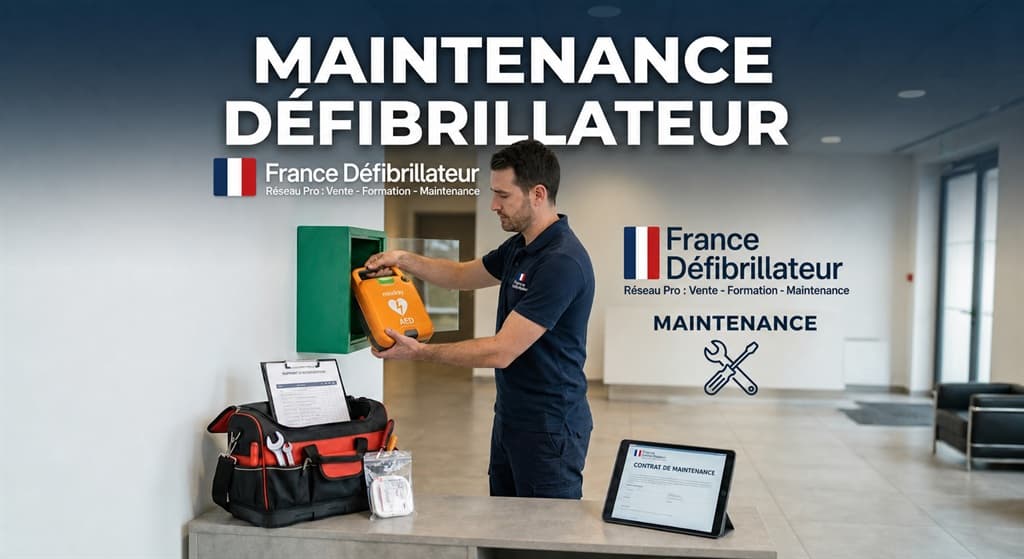
Every defibrillator installed, whether it belongs to the centre's management or to a retailer, needs its own tracking: regular checks of the self test, electrode replacement every two to five years, battery replacement every three to five years, and replacement of the unit itself after eight to ten years of use. This maintenance remains the operator's responsibility, under article R. 5212-25 of the French Public Health Code.
Registration in Géo'DAE is mandatory for every device, including those installed in common areas, so emergency services can locate the nearest defibrillator when a call comes in. An up to date safety log, accessible to every retailer, makes checks easier and prevents a device from expiring without being replaced. Rental offers start at 50 euros per month excl. VAT with maintenance included, backed by a five year warranty, delivery within two to five working days and a quote within 24 hours.
Frequently asked questions
Does every shop in a shopping centre need its own defibrillator?
No, the regulation requires equipment per establishment receiving the public, but a shopping centre can share one or more defibrillators installed in common areas to cover small shops, as long as access stays fast. Large anchor stores, such as an integrated hypermarket, generally install their own device in addition to the one in the common areas.
Who pays for maintaining the defibrillator in the common areas?
Article R. 5212-25 of the French Public Health Code places maintenance under the operator's responsibility. In a shopping centre, this means the manager of the common areas is responsible for shared devices, a point worth clarifying in the commercial lease or the centre's internal rules to avoid confusion between landlord and tenants.
Do staff need training to use the defibrillator?
No training is legally required to use an automated external defibrillator, since the device is designed to guide anyone present through voice prompts. A short awareness session is nonetheless recommended for sales and security staff, to save time recognising a cardiac arrest and alerting emergency services.
Does a shared defibrillator need to be registered in Géo'DAE?
Yes, every defibrillator must be registered in Géo'DAE, including one installed in the common areas of a shopping centre. This registration lets emergency services locate the nearest available device when a call comes in, which shortens response time and improves the victim's chances of survival.
How much does it cost to equip a shopping centre with defibrillators?
The budget depends on how many devices the floor area and layout require. Rental, maintenance included, starts at 50 euros per month excl. VAT per device, backed by a five year warranty. A large shopping centre spread across several floors or zones may need several cabinets to meet recommended response times.
Planning an AED project?
Purchase, rental from 50 EUR excl. VAT per month, installation with GéoDAE registration, servicing and training: our team replies within 24 hours.