AED in spas and thermal treatment centres: obligations
Written by Cyrille GAGNAIRE, France Défibrillateur. Published on 10 October 2026.
A thermal establishment welcomes guests every day, many of them older or following treatment for a chronic condition. Treatments take place in heat, sometimes in water, far from the front desk. In that setting cardiac arrest gives no warning, and every minute without defibrillation reduces the chance of survival by about 10%. Here is how to equip and organise a thermal site.
A public and treatments that raise the risk
About 50,000 cardiac arrests occur in France each year, and a thermal establishment combines several vulnerability factors. Guests are often older, some take heart or respiratory medication, and treatments combine heat, humidity and strain on the body.
Care staff and reception agents are used to handling faintness. Yet fainting is not cardiac arrest, and the difference is decided in moments. Having an automated external defibrillator (AED) within reach lets the team act before emergency services arrive.
Finally, attendance varies with the treatment seasons, and treatments start early in the morning. The device must therefore be accessible throughout opening hours, including when reception is quiet.
What the regulations provide
The equipment obligation rests on the loi 2018-527 (French law of 2018) and the décret 2018-1186 (implementing decree). It applies to public-access buildings (ERP, établissements recevant du public) according to their category: categories 1 to 3 since 1 January 2020, category 4 since 2021, and some category 5 ERP since 2022. A large thermal establishment usually falls in the higher categories, but the exact category depends on the number of people admitted and must be confirmed with the safety commission.
The site must also be registered in GéoDAE, and signage must comply with the arrêté du 29 novembre 2018 (ministerial order of 29 November 2018). Maintenance is the operator's responsibility under article R. 5212-25 of the Code de la santé publique (French Public Health Code). Even without a strict obligation, an operator who receives vulnerable guests has every reason to equip the site.
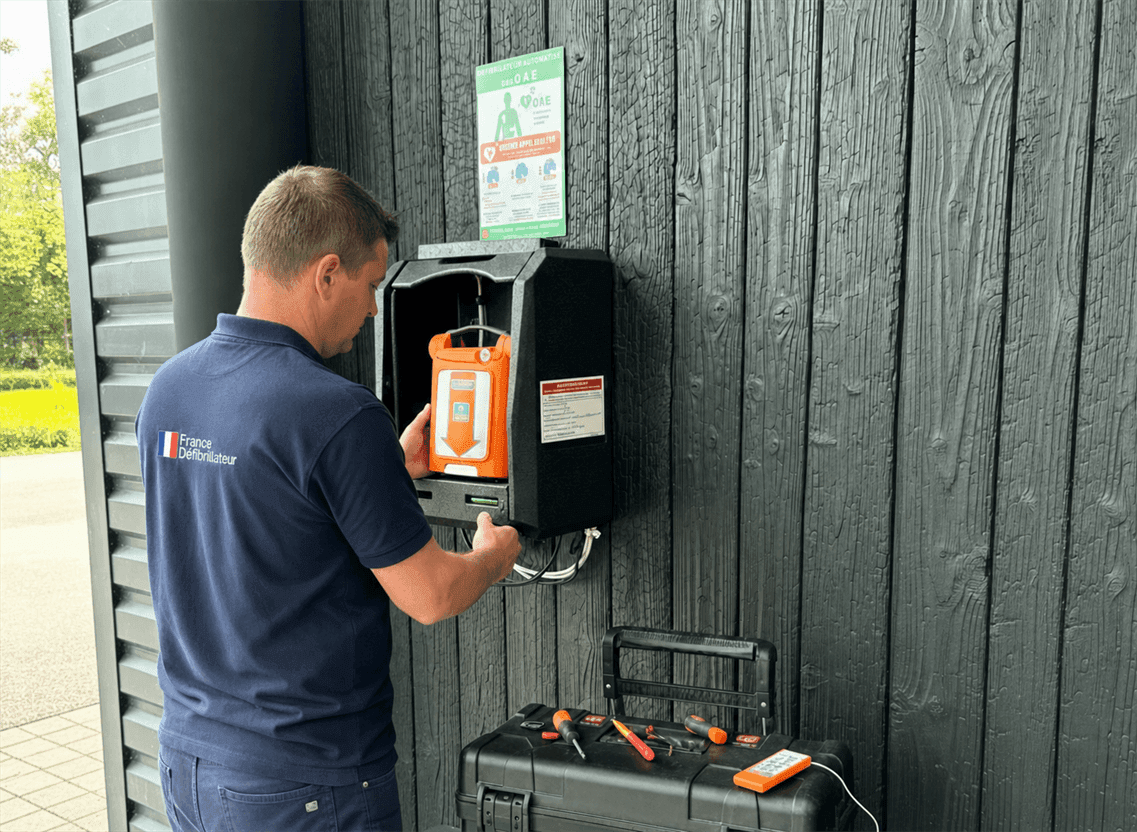
Where to place devices on a large site
A thermal centre often combines a reception hall, treatment cabins, pools, a rest area and sometimes a hotel or restaurant. A single device at reception may be several minutes from a distant cabin, which is too long.
The goal is to reach a person in cardiac arrest within a few minutes, round trip included. The simplest approach is to walk the site with a stopwatch from the furthest points. The priority zones are listed below.
| Zone | Point to check |
|---|---|
| Reception and hall | Visible, signposted location, accessible at all times during opening hours |
| Treatment cabin corridor | Device close to treatments, where staff are present continuously |
| Pool area | Cabinet protected from humidity, away from water splashes |
| Adjoining hotel or restaurant | Device identified and known to the staff of these services |
Humidity, heat and choice of equipment
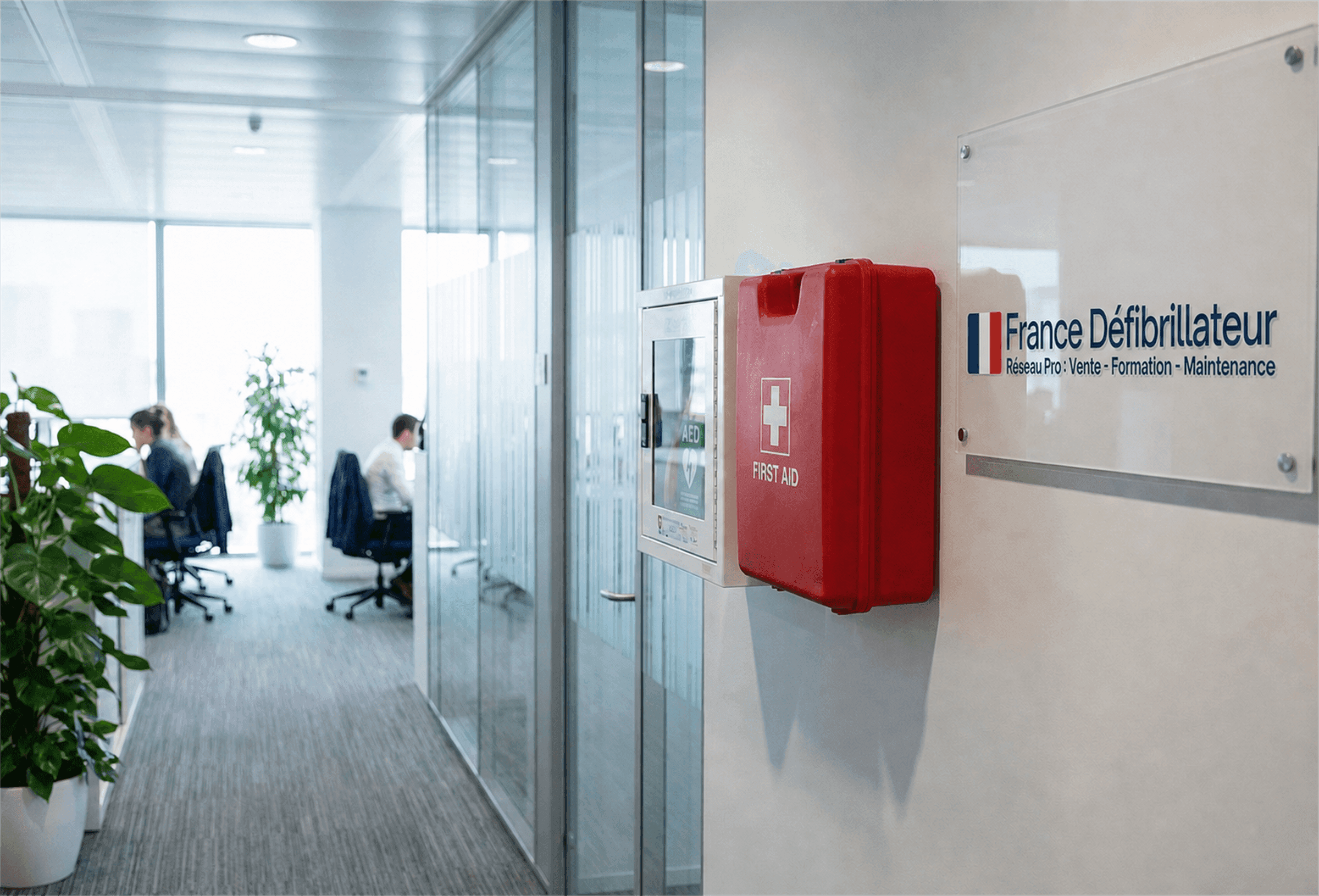
The thermal environment is demanding for equipment. Steam, high temperatures and humidity speed up the deterioration of poorly protected devices. A suitable cabinet, which keeps the AED at acceptable temperatures, is an integral part of the setup.
Check the manufacturer's instructions for operating and storage temperature and humidity ranges, then choose a location that respects them. An indoor cabinet is enough in most rooms, while a device placed outdoors needs a model designed for that use. For older guests, also consider how clear the device's voice prompts are.
Training the team and organising the response
An automated defibrillator guides the user step by step, and anyone can use it. It is still preferable for care staff, reception agents and pool lifeguards to be trained in chest compressions and AED use, with regular refreshers.
Plan a written procedure: who calls 15 or 112, who brings the device, who meets the emergency services at the entrance. One simulation exercise a year, on a realistic scenario in a cabin or near a pool, helps spot obstacles before a real case occurs.
Maintenance, rental and purchase
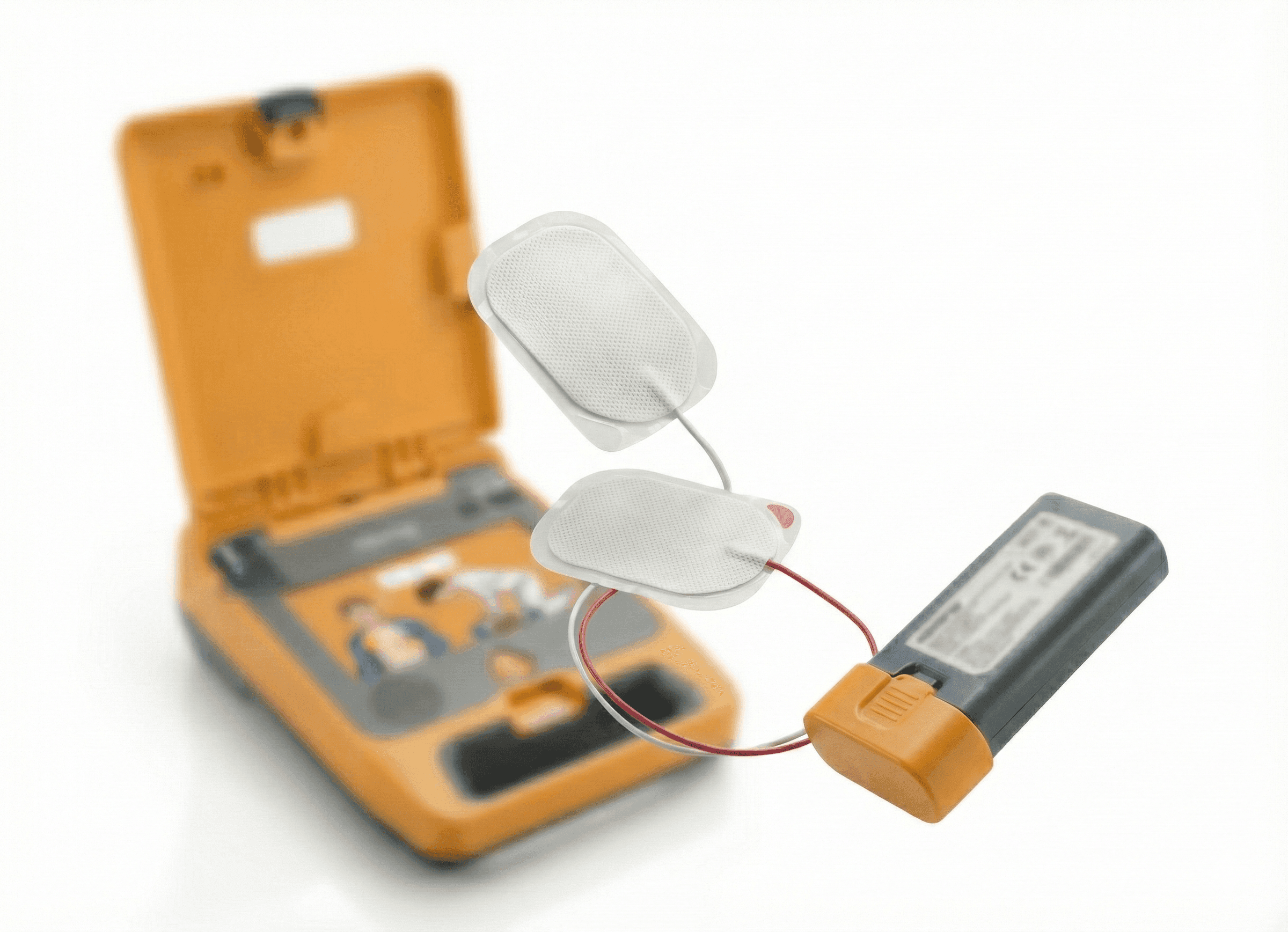
The operator must make sure the device is operational at all times. Electrode pads are replaced every 2 to 5 years, batteries every 3 to 5 years, and the AED itself lasts 8 to 10 years and more. Tracking self-tests and keeping a check log ensures nothing is missed.
For a site that prefers to delegate this follow-up, rental starts from €50 excl. VAT per month, maintenance included. When buying, the warranty is 5 years, delivery takes 2 to 5 working days and a quote is provided within 24 hours. France Défibrillateur can help you size the number of devices according to your site plan.
After any use, the device must be checked, the pads replaced and the intervention recorded. Plan these steps so the site is not left without an operational defibrillator during the treatment season, when attendance is highest.
Frequently asked questions
Must a thermal establishment have a defibrillator?
It depends on its ERP category. Categories 1 to 4 are subject to the obligation, as are some category 5 ERP. A large thermal site is usually covered. Confirm the category with the safety commission, and equip the site even without a strict obligation.
How many defibrillators does a treatment centre need?
The regulations set the obligation to equip, not a precise number. The right number follows from the floor plan: every zone must be reachable within a few minutes. A large site with pools, cabins and a hotel often needs several devices rather than a single one at reception.
Does the defibrillator withstand heat and humidity?
Each model has its own temperature and humidity ranges, given in the manufacturer's instructions. In a thermal area, favour a suitable cabinet and a location away from water splashes and direct steam, then check the device's condition regularly.
Who should be trained in a thermal establishment?
Anyone can use an AED, but it is recommended to train care staff, reception and pool supervision staff in chest compressions and defibrillator use, with regular refreshers and at least one simulation exercise a year.
Who is responsible for maintaining the defibrillator?
Maintenance is the operator's responsibility under article R. 5212-25 of the Code de la santé publique. The operator monitors self-tests, replaces pads and battery when due and keeps a log. A rental contract with maintenance included lets you delegate this follow-up.
Planning an AED project?
Purchase, rental from 50 EUR excl. VAT per month, installation with GéoDAE registration, servicing and training: our team replies within 24 hours.