Defibrillator in a coworking space: obligations and organisation
Written by Cyrille GAGNAIRE, France Défibrillateur. Published on 8 October 2026.
In a coworking space, freelancers, start-ups and seconded employees cross paths without belonging to the same company. Hours are flexible, visitors are many, and nobody quite feels responsible for the emergency equipment. Yet a cardiac arrest ignores these subtleties. Here is how to decide whether the space must be equipped, where to place the device and who should look after it day to day.
Status of the space: it all depends on public access
A coworking space reserved for badge-holding residents often falls under the rules for workplaces. As soon as it welcomes the public, for example for events, training open to all or a registered-address service with appointments, it may be classified as an ERP (établissement recevant du public, a French public-access building).
The obligation to install an automated external defibrillator (AED, called DAE in France) stems from loi 2018-527 (law no. 2018-527) and décret 2018-1186 (decree no. 2018-1186). It has applied to ERP of categories 1 to 3 since 1 January 2020, to category 4 since 2021 and to certain category 5 ERP since 2022. The exact classification should be checked with the building manager and, if needed, the safety commission.
If the space is not an ERP, the operator is still responsible for the safety of those present. Around 50,000 cardiac arrests occur in France each year, and every minute without defibrillation reduces the chance of survival by about 10%. Equipment is therefore justified in both cases.
A shared place, so a responsibility to name
The coworking pitfall is diluted responsibility. The lease is signed by the operator, residents change every month, and everyone assumes someone else has checked the device. Yet maintenance is the operator's duty, under article R. 5212-25 du Code de la santé publique (French Public Health Code).
In practice, the operator is usually the company running the space. It appoints a contact person, such as the site manager or community manager, who checks the self-test indicator, tracks expiry dates and keeps the log. A second contact prevents the device from being forgotten during holidays.
The house rules or welcome pack should state where the AED is and which number to call in an emergency. It takes two lines and makes a big difference to a newcomer.
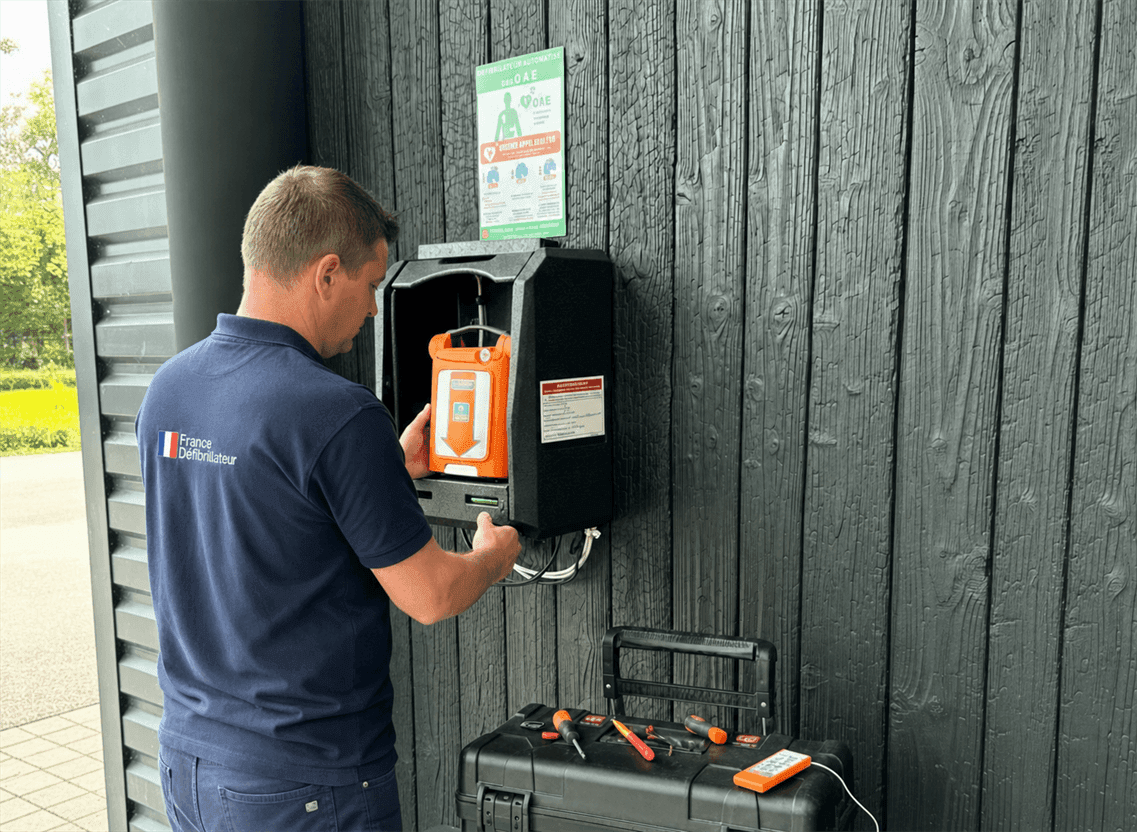
Where to place the device in premises with several access levels
A coworking space combines open areas, private offices locked by key, meeting rooms and sometimes a kitchen or terrace. The defibrillator must be in a common area, reachable by anyone present without an extra key or badge.
The reception, the central corridor or the break area are sensible choices, provided the device is visible and signposted according to the arrêté du 29 novembre 2018 (order of 29 November 2018). If the premises span several floors, a single device is not always enough: access time from the farthest points must stay short.
If the building already has a device in its common areas, make sure it is accessible during the coworking space's real opening hours, especially evenings and weekends, before considering the need covered.
The most common configurations
Depending on the size of the space, how it is run and whether it welcomes the public, the answers differ. The table below summarises the cases encountered.
| Configuration | Point to watch | What to do |
|---|---|---|
| Small space reserved for residents | Not always an ERP, safety still owed | One device in a common area |
| Space with events open to the public | Possible ERP classification | Check the category with the building manager |
| Several floors or open-plan levels | Access time from distant areas | Plan one device per level if needed |
| Space in an office building | Possible device in the common areas | Check access outside office hours |
| Open 24 hours by badge | Device reachable when no staff are present | Indoor cabinet, signposted, no key |
Training residents and organising follow-up
An automated defibrillator guides the user by voice, but fear of doing it wrong often holds bystanders back. A short awareness session, offered to new residents on arrival or during a community event, helps people act. It can also be combined with a simulation exercise.
For follow-up, plan regular checks of the indicator, an inventory of electrode and battery expiry dates, and entries in the log. Electrodes generally last 2 to 5 years, batteries 3 to 5 years and the device itself 8 to 10 years or more.
After any use, consumables must be replaced without delay. The contact person then knows whom to call, and the defibrillator is operational again.
Buying or renting for a space that changes
A coworking space may move, expand or close a floor. Renting suits this uncertainty: it starts from 50 € excl. VAT per month, maintenance included, and spares the operator from tracking consumables.
Buying suits a stable site kept for a long time. The device then carries a 5-year warranty, and the operator plans electrode and battery replacements.
In both cases, France Défibrillateur provides a quote within 24 hours and delivers in 2 to 5 working days, so you can be equipped quickly once the location is settled.
Frequently asked questions
Is a coworking space always an ERP?
No. A space reserved for badge-holding residents often counts as a workplace. It can become an ERP once it receives the public, for example at events open to all. The classification should be checked with the building manager or the safety commission.
Who is responsible for maintaining the defibrillator?
Maintenance is the operator's responsibility, under article R. 5212-25 du Code de la santé publique. In a coworking space this is usually the company running it, which appoints a contact person in charge of checking the device and keeping the log.
Is one device enough for a space spread over several floors?
Not always. The deciding factor is access time from the farthest points. If a bystander must change floors or pass a locked door to reach the device, a second AED per level should be considered.
Can a defibrillator be rented for a coworking space?
Yes. Renting starts from 50 € excl. VAT per month, maintenance included. It suits spaces whose size or premises may change, because it avoids having to track consumable expiry dates yourself.
Planning an AED project?
Purchase, rental from 50 EUR excl. VAT per month, installation with GéoDAE registration, servicing and training: our team replies within 24 hours.