Defibrillator in a Music Conservatory or Dance School
Written by Cyrille GAGNAIRE, France Défibrillateur. Published on 16 October 2026.
A conservatory welcomes six-year-old children, teenagers, adult amateurs and teachers of every age on the same day. Lessons take place in soundproofed rooms, sometimes at the end of a corridor, and auditions bring in whole families. A cardiac arrest is not frequent there, but it can happen. Here is how to equip and organise your school so that the device arrives in time.
A varied audience in partitioned premises
Around 50,000 cardiac arrests occur in France every year, and each minute without defibrillation reduces the chances of survival by about 10%. A conservatory or dance school does not carry a particular risk, but it brings together very different profiles: students, parents, teachers, companions and visitors.
Dance classes add sustained physical effort, sometimes at the end of the day after school or work. Singing and music lessons are held in closed rooms whose sound insulation prevents anyone from hearing a call for help from the corridor.
Teachers often work alone with their group, and some teach at several sites. Everyone must therefore know where the device is, without depending on a receptionist being present.
What the regulations provide
The equipment obligation rests on loi 2018-527 (the 2018 French law) and décret 2018-1186 (its implementing decree). It targets public-access buildings, known in France as ERP (établissements recevant du public), according to their category: categories 1 to 3 since 1 January 2020, category 4 since 2021, and certain category 5 ERP since 2022.
A municipal conservatory, an association-run music school or a private dance studio falls under ERP types and categories that vary with the activity, the capacity and the presence of an audition hall. The safest course is to confirm the classification of your premises with the safety commission or your town hall.
Once installed, the device must be declared in GéoDAE (the national AED register), signposted according to the arrêté du 29 novembre 2018 (the ministerial order of 29 November 2018), and maintained by the operator under article R. 5212-25 of the Code de la santé publique (French Public Health Code). The operator is the manager of the site: local authority, association or company.
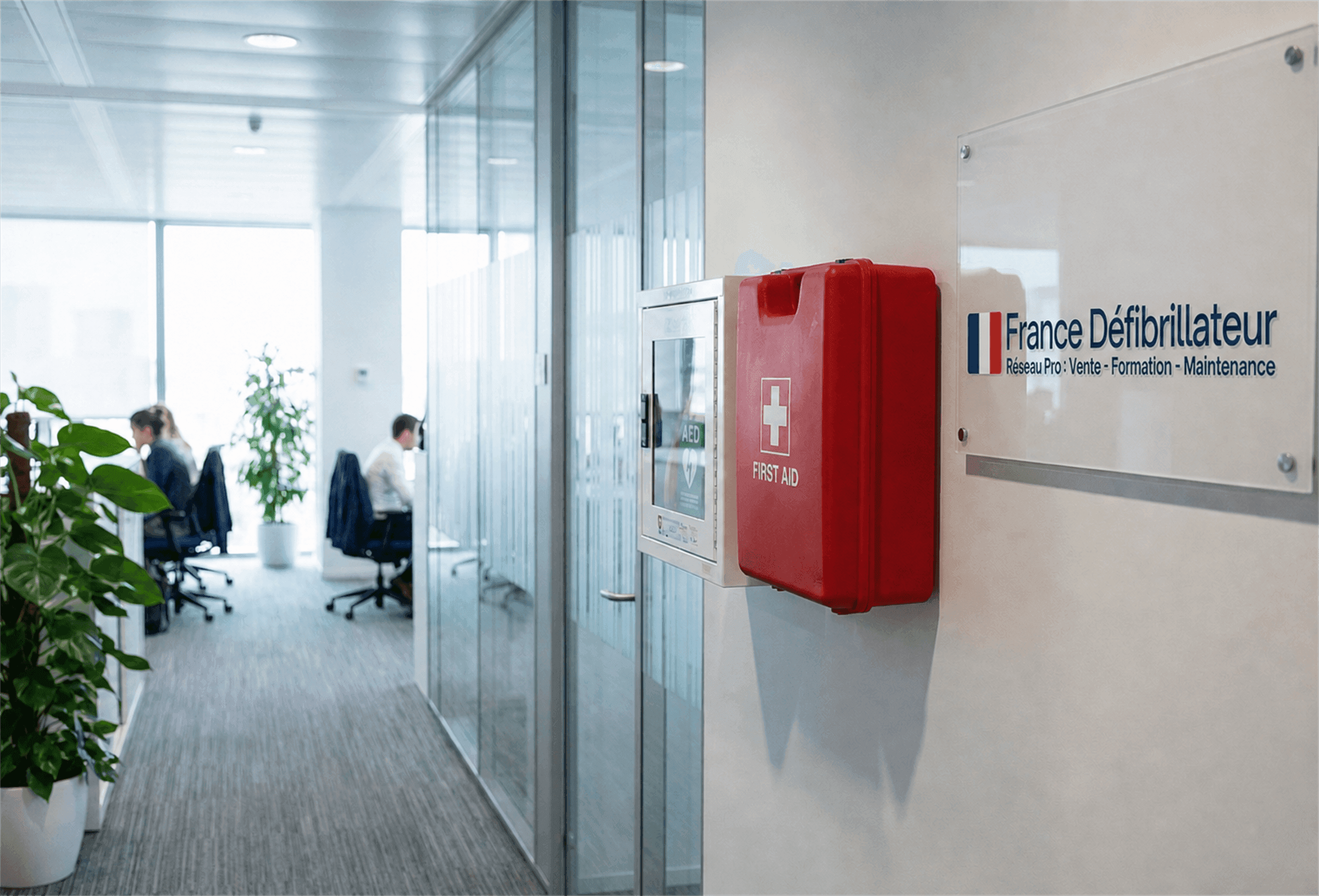
Where to place the device in the building
The right location is one you can reach in under two or three minutes from any room, without a key or a code. In a multi-storey building with soundproofed rooms, a single device on the ground floor may not be enough.
The following areas deserve priority.
| Area | Point to consider |
|---|---|
| Entrance hall and secretariat | Device visible, signposted and accessible during all class hours |
| Audition room or auditorium | High attendance on concert evenings, close to the stage and the exits |
| Corridor serving the dance studios | Area of physical effort, with an easily spotted cabinet |
| Floor with group practice rooms | Avoids crossing the whole building with an orchestra or a class on site |
Auditions, concerts and events
On concert or gala evenings, the school receives far more people than on a class day: families, grandparents, guests. Emotion, waiting backstage and standing for long periods can also weaken some people.
Make sure the device remains accessible throughout the event, even if the hall is closed or the reception is unattended. Tell volunteers and organisers where it is before the doors open.
If the conservatory rents its hall to third parties or stages shows off site, an extra device rented for the occasion can complete the arrangement. In that case, remember the GéoDAE declaration and temporary signage.
Training the team and organising the alert
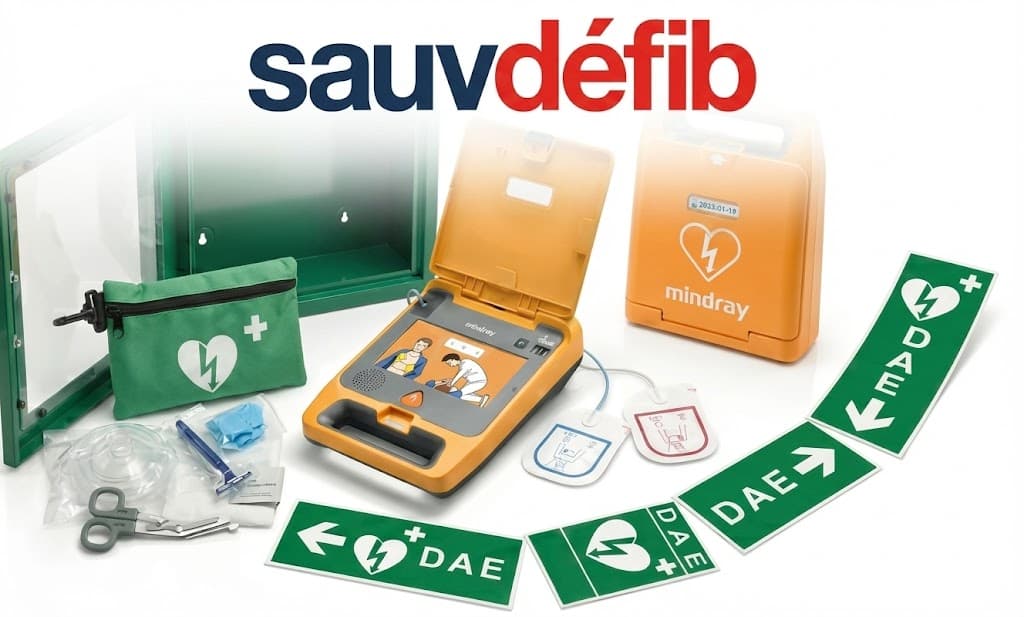
An automated external defibrillator (AED), known in France as a DAE, guides the user step by step by voice, and anyone can use it. It is still preferable for teachers, reception staff and room managers to be trained in chest compressions and in using the device, with regular refreshers.
Plan a short procedure: who calls 15 or 112, who brings the device, who meets the emergency services at the entrance and guides them to the right room. A plan displayed in the hall with room numbers speeds up the response. One simulation exercise per year, held outside class hours, lets you test this scenario.
Maintenance, rental and purchase
The operator must ensure the device is operational at all times. Electrodes are replaced every 2 to 5 years, batteries every 3 to 5 years, and the AED itself lasts 8 to 10 years and more. A check register, consulted at the start of each school year, avoids missing a deadline.
For associations without technical staff, rental starts from 50 € excl. VAT per month, maintenance included. When buying, the warranty is 5 years, delivery takes 2 to 5 working days and a quote is provided within 24 hours.
After any use, the device must be checked, the electrodes replaced and the intervention recorded, so that the site is never left without an operational defibrillator.
Frequently asked questions
Is a conservatory required to have a defibrillator?
It depends on the ERP category of its premises. Categories 1 to 4 are subject to the obligation, and some category 5 ERP too. Confirm the classification with the safety commission or the town hall, and equip yourself even without a strict obligation.
Who is the operator in an association-run music school?
The operator is the person or body that manages the site: the association, the owning local authority or the company running the studio. They are responsible for the GéoDAE declaration, the signage and the maintenance, even if the premises are lent or rented.
Is one device enough for a multi-storey building?
The law sets no number. Time the round trip from the furthest room. If the device cannot be reached within a few minutes, or if soundproofed rooms isolate the floors, add a second device rather than relying on a single location.
Is a device needed for end-of-year concerts?
A device already installed in the building may be enough if it stays accessible during the event and the organisers know where it is. For an off-site show or very high attendance, a temporary rental usefully completes the arrangement.
Must teachers be trained?
No training is required to use an AED, because it guides by voice. Training teachers and reception staff in chest compressions and in using the device is still strongly advised, with regular refreshers to keep the right reflexes.
Planning an AED project?
Purchase, rental from 50 EUR excl. VAT per month, installation with GéoDAE registration, servicing and training: our team replies within 24 hours.