Defibrillator at an Equestrian Centre: Duties and Good Practice
Written by Cyrille GAGNAIRE, France Défibrillateur. Published on 17 October 2026.
At an equestrian centre, a rider can fall, laugh it off, then collapse a few minutes later. The stables, the ring and the indoor arena are sometimes far apart, and emergency services take time to find the right entrance. Every minute without defibrillation reduces the chance of survival by about 10%. Here is how to equip and organise a riding club.
A large site and very varied visitors
About 50,000 cardiac arrests occur in France every year. An equestrian centre welcomes children on Wednesdays, leisure riders, competitors, relatives watching from the stands and employees who start work in the stables at dawn. Cardiac arrest does not only affect riders: a parent, a farrier or a visiting vet can be a victim too.
The difficulty lies in the layout. Between the clubhouse, the stalls, the covered arena, the outdoor rings and sometimes a cross-country course, distances run to hundreds of metres. An automated external defibrillator (AED, DAE in French) hanging in the office only helps those close to reception.
Holiday courses and weekend competitions raise attendance within a few hours. Families, companions and the volunteers who run the snack bar or the show office join the usual numbers, and the manager must be able to react for all of them.
What the regulations provide
The equipment duty rests on loi 2018-527 (the 2018 French law) and décret 2018-1186 (its implementing decree). It targets public-access buildings (ERP, établissements recevant du public) according to their category: categories 1 to 3 since 1 January 2020, category 4 since 2021, and some category 5 ERP since 2022. The clubhouse, the covered arena and the stands are concerned depending on their category, to be confirmed with the safety commission or the town hall.
Whatever the status of the site, operating rules are the same. The device must be registered in GéoDAE, signage follows the arrêté du 29 novembre 2018 (the order of 29 November 2018), and maintenance remains the operator's responsibility under article R. 5212-25 du Code de la santé publique (French Public Health Code). A manager who equips the centre without being obliged to takes on the same duties.
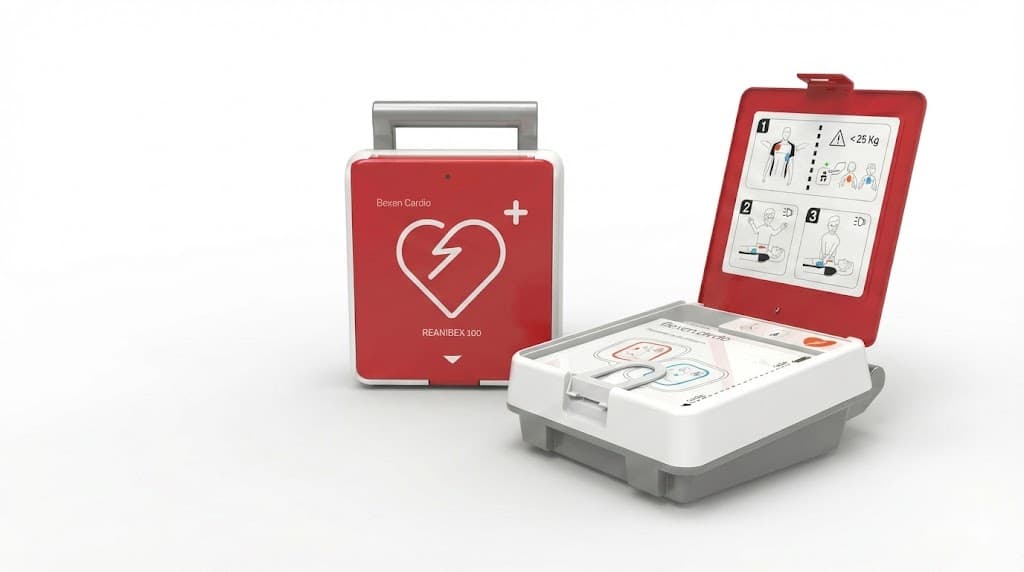
Where to place the device
The right location is chosen by real travel time, round trip included, not by distance on a map. Walk the centre with a stopwatch from the farthest points. The following zones deserve priority.
| Zone | Point to watch |
|---|---|
| Reception and clubhouse | Visible device, accessible during all opening hours |
| Covered arena | Where lessons are concentrated, with dust and temperature changes to expect |
| Stables and tack room | Workplace of employees, sometimes alone early in the morning or late in the evening |
| Outdoor ring and cross-country course | Far from the buildings, access to be marked out for emergency services |
Dust, cold and heat: protecting the equipment
An equestrian centre is a demanding environment for electronics. Sand and hay dust, stable humidity and temperature swings between winter and summer can damage a poorly protected AED. Check the manufacturer's instructions for operating and storage ranges.
A suitable cabinet protects the device and makes it visible. For an outdoor location, choose a model designed for that use, and avoid leaving the AED in a vehicle or an unheated room. Also think of the pads, whose expiry date must stay readable from outside the cabinet.
Finally, signpost the device so that everyone can spot it without searching: a sign compliant with the arrêté du 29 novembre 2018 at the entrance, arrows from the arena and the ring, and a mention on the site plan given to new members.
Training teams and organising the alert
An automated defibrillator guides the user step by step, and anyone can use it. It remains preferable for instructors, grooms and reception staff to be trained in chest compressions and AED use, with regular refreshers. Instructors who supervise children are on the front line.
Prepare a written procedure: who calls 15 or 112, who brings the device, who waits for the ambulance at the entrance to guide it to the right place. Locating the patient is the weak point of large sites. Display the exact address near the phone, specify the access route and always keep the main gate clear. One simulation exercise a year lets you test this scenario.
Maintenance, rental and purchase
The operator must make sure the device is operational at all times. Pads are replaced every 2 to 5 years, batteries every 3 to 5 years, and the AED itself lasts 8 to 10 years and more. A check register, with regular reading of the self-test indicator, avoids missing a deadline.
To delegate this follow-up, rental starts from €50 excl. VAT per month, maintenance included. When buying, the warranty is 5 years, delivery takes 2 to 5 working days and a quote is provided within 24 hours. After any use, the device must be checked, the pads replaced and the intervention recorded.
Frequently asked questions
Does an equestrian centre have to have a defibrillator?
It depends on the ERP category (public-access building) of its buildings, such as the clubhouse, the covered arena or the stands. Categories 1 to 4 are subject to the duty, and some category 5 ERP too. Confirm the category with the safety commission, and equip yourself even without a strict obligation.
Do I need one device at the arena and another at the stables?
The law sets no number. What matters is that a device can reach anyone within a few minutes, round trip included. If the trip from reception exceeds that time for the arena, the ring or the stalls, a second device is justified.
Can the AED cope with stable dust?
It depends on the model and its protection rating, given in the manufacturer's instructions. In any case, keep the device in a suitable cabinet, away from splashes and temperature swings, and check its self-test indicator regularly.
Who handles maintenance in a riding club?
Maintenance is the operator's responsibility under article R. 5212-25 du Code de la santé publique. It includes monitoring self-tests, replacing pads and batteries when due, and keeping a register. A rental contract can include this follow-up.
Planning an AED project?
Purchase, rental from 50 EUR excl. VAT per month, installation with GéoDAE registration, servicing and training: our team replies within 24 hours.