Defibrillators in Administrative Buildings: Obligations
Written by Cyrille GAGNAIRE, France Défibrillateur. Published on 14 October 2026.
A public service counter welcomes users of all ages every day, often stressed, sometimes fragile, waiting a long time in queues. Staff spend years in the same premises. This double audience makes equipping with an AED (automated external defibrillator) particularly relevant. Here is how to read the obligations, choose the location, organise maintenance and prepare staff to react. Each point is detailed below.
Is an administrative building subject to the obligation?
Most administrative buildings open to the public are ERP (établissements recevant du public, buildings open to the public). The obligation depends on the category, set by capacity. Law 2018-527 and decree 2018-1186 (French texts) require an AED in ERP of categories 1 to 3 since 1 January 2020, in category 4 since 2021, and in certain category 5 ERP since 2022.
A prefecture, a court or a large social security office often falls into the first categories. A small neighbourhood office or local branch may be category 5. In both cases, the operator should check its classification with the safety commission or the owner, then act without delay.
Specifics of a place that receives a constrained public
In an administrative building, users rarely come for pleasure. They wait for a decision, a document, an appointment. Long waits, the heat of a crowded room and the stress of an important procedure create conditions in which a medical emergency can occur. Staff on site are concerned too, with sedentary and sometimes tense days.
Controlled access is the other specificity. Turnstiles, security airlocks, badges and restricted areas slow movement. A device stored behind a badge-controlled door or in a locked office will not do its job. The location must remain accessible to everyone, including when the service is closed to the public but staff are present.
Choosing the location and the signage
The device must be in a high-traffic area, visible from reception, within three minutes of any point in the building. The entrance hall, near the receptionist or the security desk, is the most common choice. In a multi-storey building, one device per busy floor may be more realistic than a single one on the ground floor.
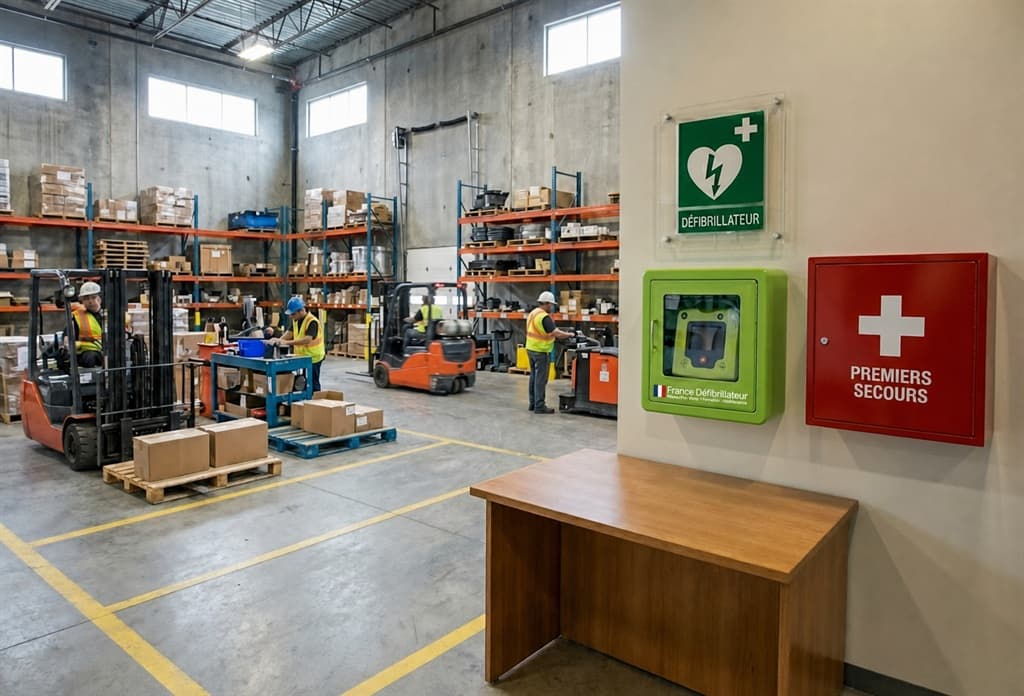
Signage follows the arrêté du 29 novembre 2018 (French order of 29 November 2018): a standard sign above the device, completed by directional signs from entrances and corridors. An indoor cabinet protects the equipment and makes its presence clear. The device must also be registered in GéoDAE, which is mandatory, so that emergency services can locate it.
Maintenance, register and operator responsibility
Maintenance of the defibrillator is the operator's responsibility, under article R. 5212-25 du Code de la santé publique (French Public Health Code). In practice, you must monitor the device self-test, replace the pads (2 to 5 years depending on the model) and the battery (3 to 5 years), then plan to replace the device itself after 8 to 10 years and more.
In an administration, the difficulty is often organisational: who follows the device when departments move or staff change assignment? Naming a referent and a deputy avoids a warning light being ignored for months. A simple dated register in which each check is noted completes the system.
Training staff and raising awareness at reception
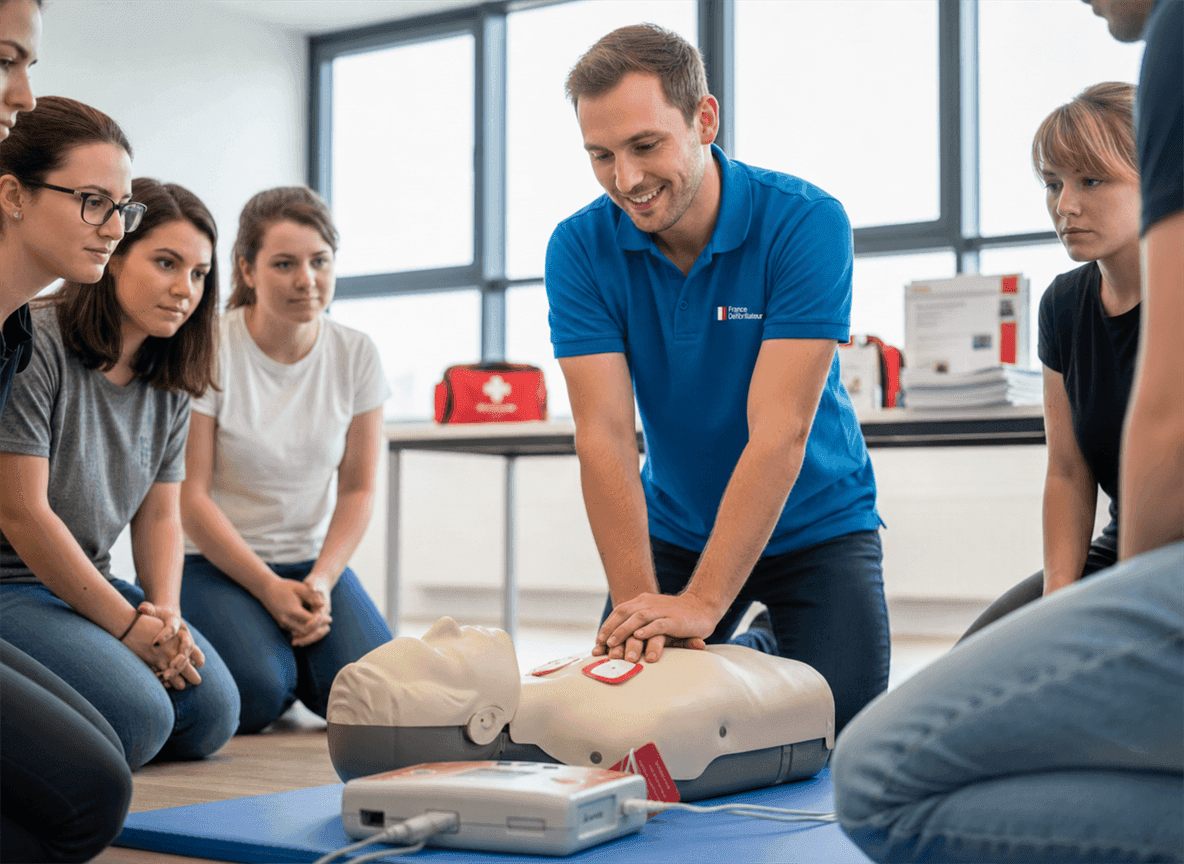
An automated defibrillator guides the user by voice, and anyone can use it. Short awareness training remains valuable, however: it removes the fear of doing it wrong and teaches how to chain the alert, chest compressions and pad placement. Reception and security staff, first on the scene, are the priority profiles to train.
A realistic approach is to train reception agents, security teams and first aiders already present first, then widen in waves. A periodic refresher is useful, as is mentioning the device location in the welcome booklet for newcomers.
Buying or renting for a public body
The choice between buying and renting depends on how the building is managed. Rental starts from €50 excl. VAT per month, maintenance included, which removes consumables tracking and simplifies the operating budget. Purchase suits a body that already has a technical team able to handle the follow-up.
In both cases, devices carry a 5-year warranty, delivery takes 2 to 5 working days and a quote is provided within 24 h. Any grants depend on each local authority or body: enquire locally before including them in the financing plan.
Frequently asked questions
Must an administrative building have a defibrillator?
If the building is an ERP of category 1 to 4, yes. Category 5 ERP are concerned for certain types of establishment since 2022. The safest course is to check the site's classification category, then equip even when the obligation is not clearly established.
Where should the defibrillator go in a prefecture or town hall annex?
In the hall, near reception or the security desk, visible and accessible without badge or key. A standard sign and directional signs from the entrances let everyone find it within three minutes, even on a busy day.
Who handles maintenance in an administration?
The operator, under article R. 5212-25 du Code de la santé publique. It can be outsourced or done in-house. A named referent and a check register limit the risk of missing a pad or battery expiry date.
Do all staff need to be trained?
No, the device can be used by anyone thanks to its voice instructions. Training reception, security and first aiders on site first gives better reactivity, however. Short, regular awareness sessions are enough to build confidence.
Rent or buy for a public service?
Rental, from €50 excl. VAT per month maintenance included, lightens follow-up and the investment budget. Purchase makes sense if a technical team already handles checks. A quote is provided within 24 h to compare both options.
Planning an AED project?
Purchase, rental from 50 EUR excl. VAT per month, installation with GéoDAE registration, servicing and training: our team replies within 24 hours.