AED in a non-profit association: who equips, who maintains
Written by Cyrille GAGNAIRE, France Défibrillateur. Published on 15 October 2026.
Associations welcome members of all ages every week in rooms that are lent, rented or managed by them. When a cardiac arrest happens, nobody asks who owns the defibrillator, but the question has to be settled beforehand: who buys it, who checks it, who is responsible? Here is how to share the roles clearly between the association, the owner of the premises and the volunteers.
Is an association required to have a defibrillator
The obligation does not depend on the legal status of the association but on where it operates. Law 2018-527 and decree 2018-1186 require an AED (automated external defibrillator, known in France as DAE) in certain ERP (établissements recevant du public, meaning buildings open to the public): categories 1 to 3 since 1 January 2020, category 4 since 2021 and some category 5 ERP since 2022.
An association that runs its activities in a municipal hall, a gym or a multipurpose room is therefore most often in an ERP already subject to the obligation. It falls on the operator of the building, not on each occasional user. If the association operates its own premises, it is the operator and the obligation is its own.
Who buys and who maintains depending on the situation
The starting point is to know who operates the venue. A loan agreement or a lease should say so, and it rarely mentions the defibrillator. It is better to put it in writing before installation rather than after an incident.
Maintenance remains the operator's responsibility, under article R. 5212-25 of the French Public Health Code (Code de la santé publique). The table below summarises the common cases.
| Situation | Likely operator | Point to write into the agreement |
|---|---|---|
| Municipal hall lent to the association | The municipality | Access to the defibrillator and instructions for use |
| Premises rented by the association | The association | Who funds purchase and maintenance |
| Premises owned by the association | The association | Taking out a maintenance contract |
| Outdoor or travelling activity | The organiser | Portable defibrillator and a designated contact person |
Buying or renting on a tight budget
Associations often think in terms of an annual budget, with little room for unplanned spending. Renting can then be suitable: it starts at 50 € excl. VAT per month, maintenance included, so you do not have to track replacement deadlines yourself.
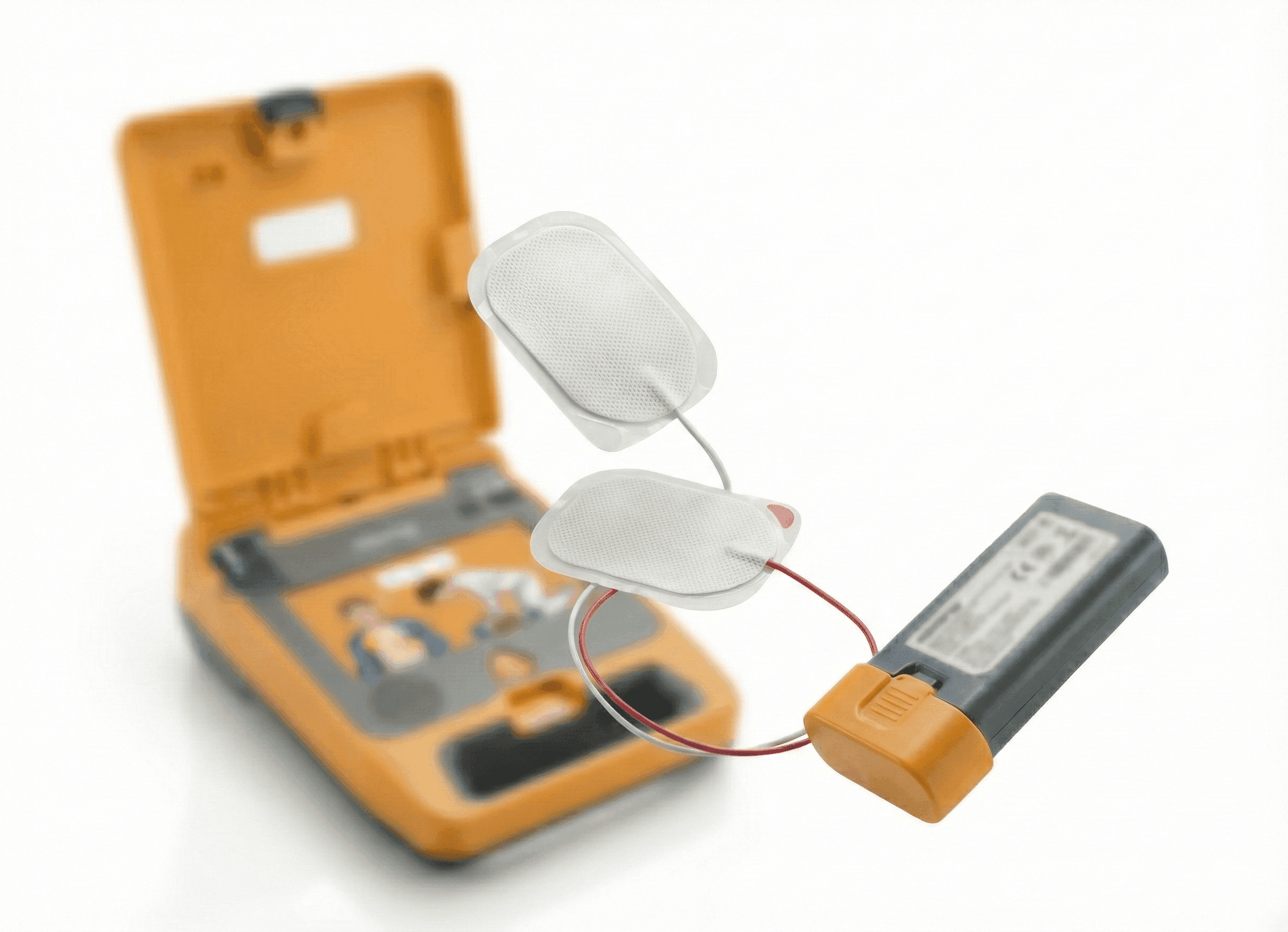
Buying remains relevant for a long-established organisation. You then need to plan for consumables: electrodes are replaced every 2 to 5 years, batteries every 3 to 5 years, and the device itself lasts 8 to 10 years and more. Equipment bought from France Défibrillateur comes with a 5-year warranty, is delivered within 2 to 5 working days, and a quote is provided within 24 hours.
We do not detail any specific grant here: funding options vary by local authority, so enquire locally before committing.
Place the device where members actually pass
A defibrillator locked in a cupboard whose key only the president holds is useless. It must be visible, accessible at all opening hours and signposted in line with the order of 29 November 2018 (arrêté du 29 novembre 2018). A wall cabinet at the entrance or near the activity room is a good compromise.
If the association shares a building with other users, one well-placed device known to everyone is better than two forgotten ones. The route from the farthest room must be quick to cover, because each minute without defibrillation reduces the chances of survival by about 10%.
The device must also be registered in GéoDAE, a mandatory declaration, so that emergency services can locate it.
Training volunteers and appointing a lead
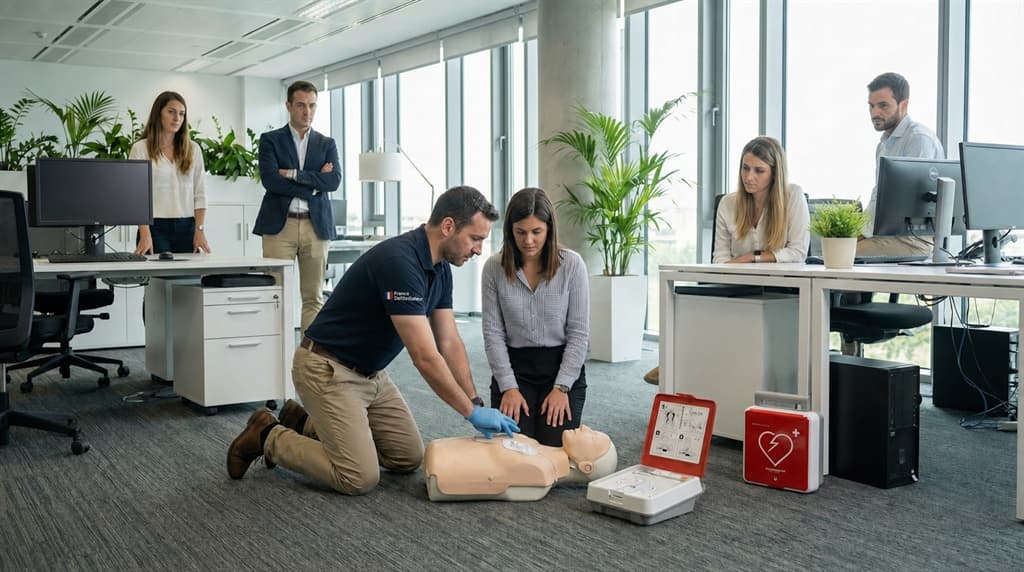
Each year, around 50,000 cardiac arrests occur in France. In an association, the person on site is rarely a healthcare professional. A defibrillator guides the user by voice, but experience shows that a volunteer who has already been briefed acts faster and with more confidence.
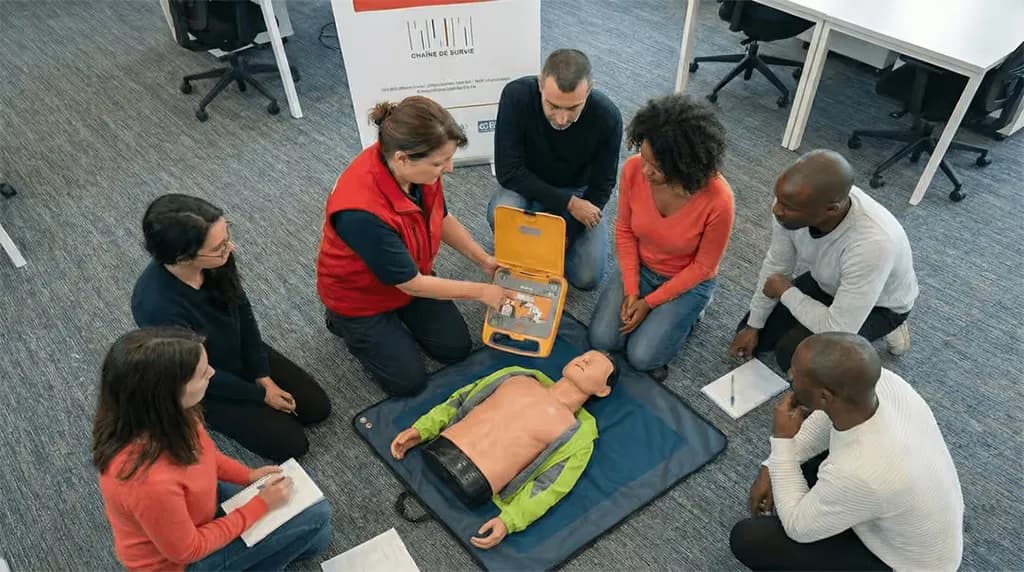
It is useful to offer lifesaving awareness training at the annual general meeting or at a start-of-season day, including new coaches and supervisors. The board can also appoint a lead to check the self-test indicator, record expiry dates in a register and alert the board in case of a fault.
This role is handed over when the board is renewed. Without a written handover, the monitoring is the first thing to disappear when the volunteer concerned leaves the association.
Responsibility of officers and insurance
A volunteer officer may be held liable if they neglected a safety obligation. Equipping the premises, keeping a register and training supervisors are evidence of diligence.
It is wise to inform the association's insurer that a defibrillator is present and to check what the policy covers in case of damage linked to its use or its absence. A person who uses an AED in good faith to help someone acts within a protected framework, which also reassures hesitant volunteers.
Frequently asked questions
My association uses a municipal hall, do I need to buy a defibrillator?
Not necessarily. If the hall is an ERP (a building open to the public) that is already equipped, the obligation lies with the municipality, which operates it. It is still useful to confirm in writing where the device is, who has access and who maintains it, and to consider a device of the association's own for activities outside the hall.
Who is responsible for maintenance in an association?
Maintenance falls to the operator, under article R. 5212-25 of the French Public Health Code. If the association operates the premises, it is responsible: checking the self-test, replacing electrodes and battery, and keeping a register. A maintenance contract or an all-inclusive rental can delegate these tasks.
Must an association's defibrillator be registered in GéoDAE?
Yes, registration in GéoDAE is mandatory. It lets emergency services locate the nearest device during a call. Remember to update the entry if the association moves, if the device is relocated or if the equipment is replaced.
Can an untrained volunteer use the defibrillator?
Yes, an AED is designed for use by the general public thanks to its voice instructions. Prior awareness training does help people react faster. First call the emergency services, start chest compressions, then follow the device's instructions without waiting.
Planning an AED project?
Purchase, rental from 50 EUR excl. VAT per month, installation with GéoDAE registration, servicing and training: our team replies within 24 hours.