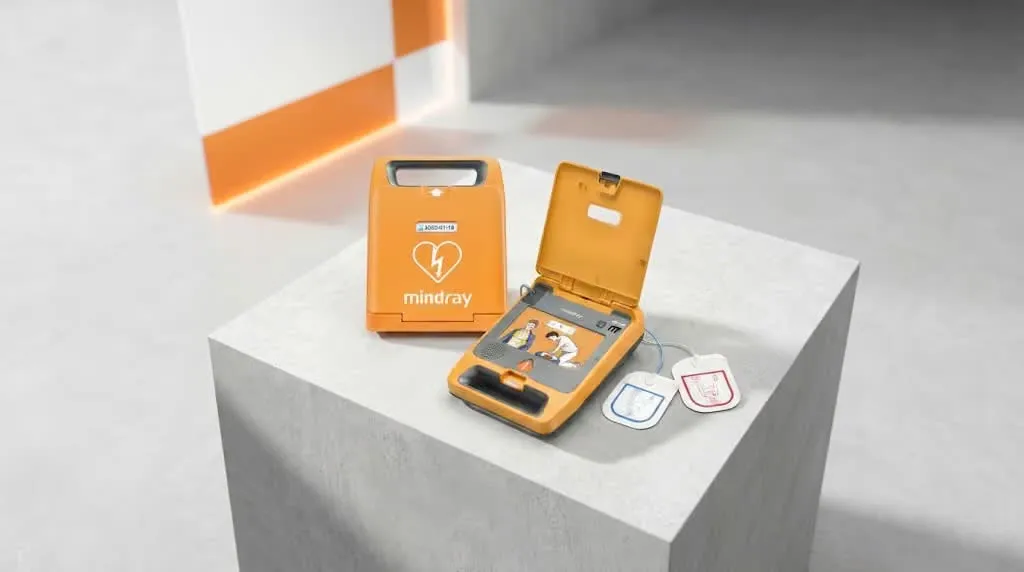
Defibrillator in a bank or insurance branch: obligations and organisation
Written by Cyrille GAGNAIRE, France Défibrillateur. Published on 7 October 2026.
A bank or insurance branch welcomes the public all day: elderly customers, appointments that run long, queues at the counters. Staff are always on site, but rarely trained for emergencies. The questions are whether the branch must be equipped, where to place the device behind airlocks and secured areas, and who looks after it. Here are the points to check before deciding.
A branch is an ERP: the obligation depends on its category
A bank or insurance branch that receives the public is an établissement recevant du public, or ERP (a building open to the public under French safety rules). The obligation to install an automated external defibrillator (AED, known in France as DAE) stems from loi 2018-527 and décret 2018-1186 (French law and decree), and it varies with the category of the establishment.
ERP of categories 1 to 3 have been subject to the obligation since 1 January 2020, category 4 since 2021, and certain category 5 ERP since 2022. Most neighbourhood branches fall into category 5, so you need to check whether yours is among the establishments concerned, depending on its activity and the number of people it receives.
Even where nothing requires it, equipping the branch remains worthwhile. Around 50,000 cardiac arrests occur in France every year, and each minute without defibrillation reduces the chances of survival by about 10%.
Placing the device despite airlocks and secured areas
Branches have a specific constraint: closed spaces, entrance airlocks, restricted-access areas. An AED kept in an office or behind a counter is useless if a bystander has to look for a key or ask for permission.
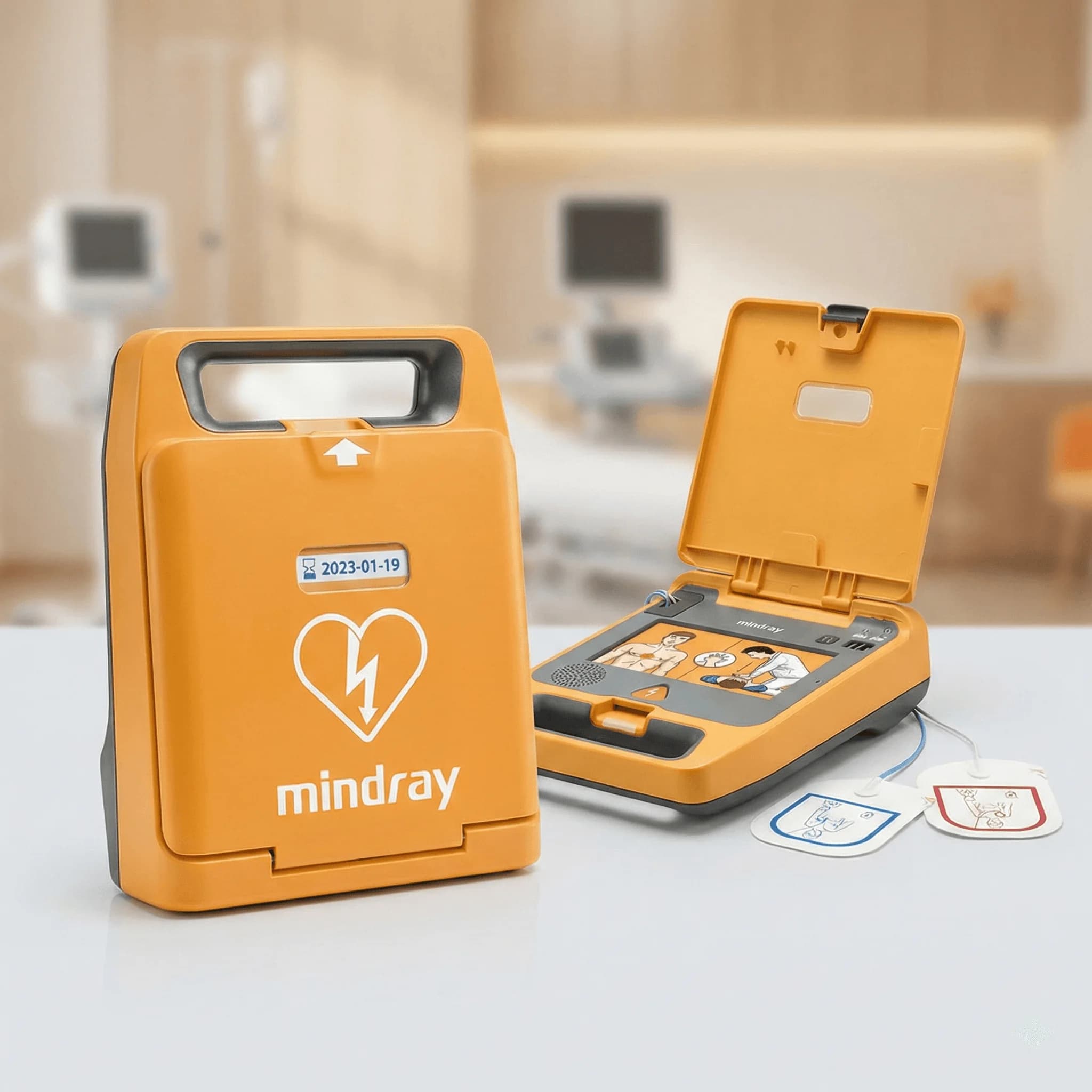
The right location is visible from the reception area, accessible without a key during all opening hours, and signposted according to the arrêté du 29 novembre 2018 (French ministerial order). If the branch has an airlock or a waiting area separate from the counter zone, it is better to position the device on the side where the public circulates.
Also consider consistency with the evacuation plan: the route from the furthest point of the branch to the AED must be quick, without passing through a locked door.
Points to check depending on the layout
Depending on whether the branch is on the ground floor of a busy street, in a shopping centre or on an upper floor of an office building, the answers change. The table below summarises the most common situations.
| Layout | Point of attention | What to do |
|---|---|---|
| Street-front neighbourhood branch | Device accessible during opening hours | Indoor cabinet near reception |
| Branch in a shopping centre | Possible shared equipment | Check with the centre's manager |
| Branch in an office building | Access through common areas | Agree the position with the owner |
| Head office or administrative floor | Large workforce across several levels | One device per level depending on distances |
Maintenance: a responsibility that falls on the operator
Maintenance of the defibrillator is the operator's responsibility, under article R. 5212-25 du Code de la santé publique (French Public Health Code). For a branch, the operator is generally the establishment or entity managing the site, and it must appoint a person in charge of follow-up.
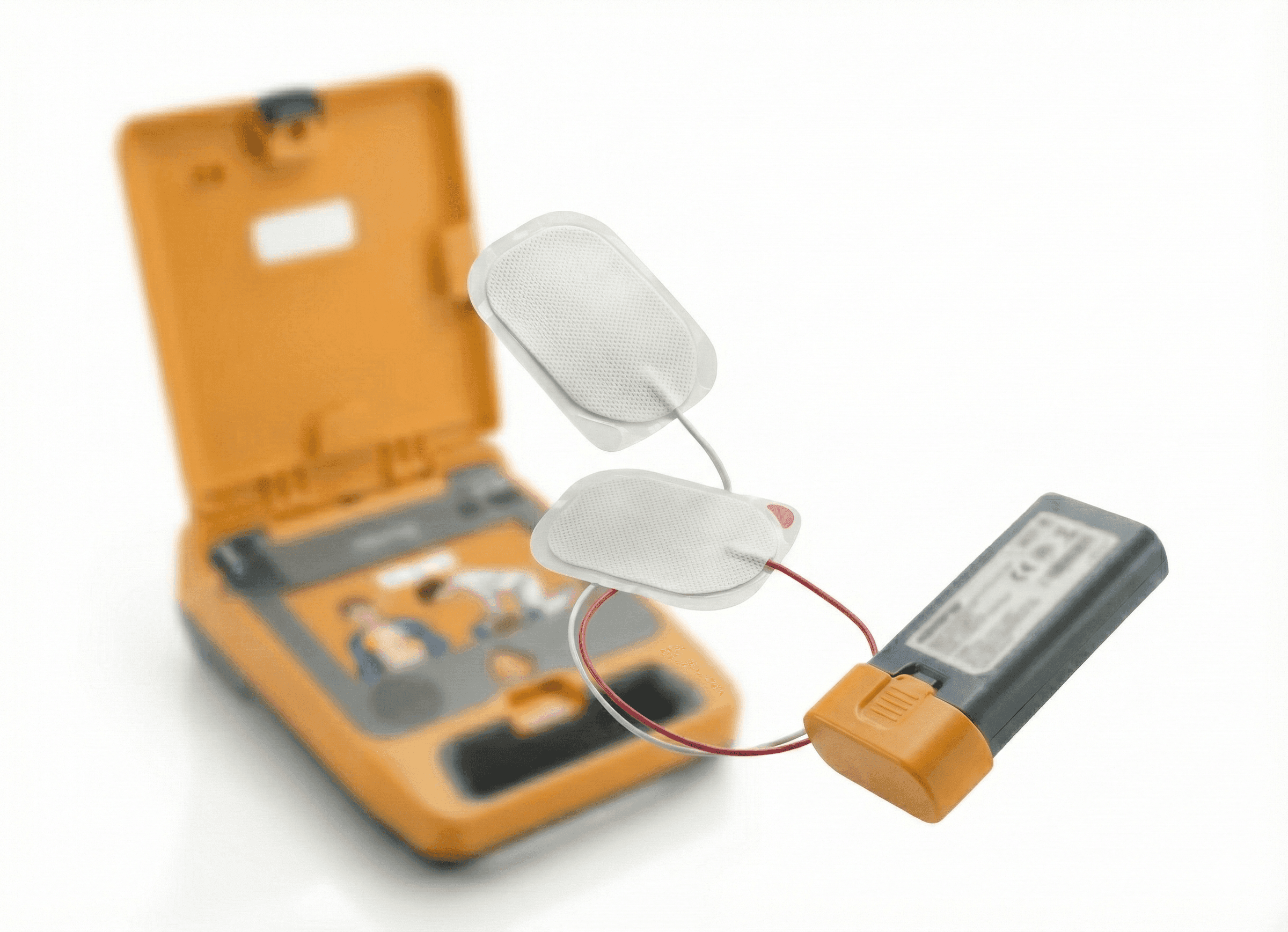
In practice, this means monitoring the device's self-test, checking the expiry dates of the electrodes (2 to 5 years) and the battery (3 to 5 years), then planning the replacement of the AED itself, whose lifespan ranges from 8 to 10 years and more. A register in which each check is recorded makes inspections easier.
Do not forget the declaration in GéoDAE, which is mandatory: it allows emergency services to locate your device.
Training the team, including advisers in meetings
An automated defibrillator guides the user by voice, but the speed of the response depends on how well the teams are prepared. A short awareness session on life-saving gestures lets every employee know how to raise the alarm, perform compressions and fetch the device.
In a branch, think about rotations: advisers, reception staff, the manager, replacements. It is better to train several people per team so that at least one of them is present at every opening.
Buying or renting for a network of branches
For a network of several branches, renting simplifies management: it starts from €50 excl. VAT per month, maintenance included. Buying suits a single site whose management wants to control the replacement schedule.
In both cases, the device comes with a 5-year warranty, delivery takes 2 to 5 working days and a quote is provided within 24 hours. France Défibrillateur can price a solution suited to the layout of each branch.
Frequently asked questions
Is a bank branch required to have a defibrillator?
It depends on the ERP category. Categories 1 to 3 have been subject to the obligation since 2020, category 4 since 2021, and certain category 5 ERP since 2022. A neighbourhood branch often falls into category 5, so check whether your activity is concerned before deciding.
Where should the defibrillator go in a branch with an entrance airlock?
On the public side, visible from reception, accessible without a key during opening hours and signposted according to the arrêté du 29 novembre 2018. Avoid a closed office or a staff-only area: a bystander must be able to reach it within seconds.
Who is responsible for maintaining the defibrillator?
Maintenance is the operator's responsibility, under article R. 5212-25 du Code de la santé publique. The operator appoints someone to follow the self-test, the expiry dates of the electrodes and battery, and to keep a register of checks.
Must a branch's defibrillator be declared?
Yes, declaration in GéoDAE is mandatory. It lets emergency services know where the device is and guide a bystander to it during an emergency call.
Is renting suitable for a network of branches?
Yes, it avoids managing deadlines branch by branch: it starts from €50 excl. VAT per month, maintenance included. Buying remains relevant for a single site. A quote is provided within 24 hours so you can compare both options.
Planning an AED project?
Purchase, rental from 50 EUR excl. VAT per month, installation with GéoDAE registration, servicing and training: our team replies within 24 hours.