Defibrillators in airports: requirements and best practices
Written by Cyrille GAGNAIRE, France Défibrillateur. Published on 17 September 2026.
An airport brings together hurried passengers, long queues and staff working shifts across vast surfaces, all under one roof. Roughly 50,000 cardiac arrests occur every year in France, and every minute without defibrillation cuts survival odds by about 10 percent. In a terminal where two points can be hundreds of metres apart, deciding where to place defibrillators becomes a genuinely pressing question.
A public venue with very high footfall
An airport terminal is a public venue, generally classified in the highest French category because of the number of people it welcomes at once, passengers, visitors, airline staff and contractors. French law 2018-527 and its implementing decree 2018-1186 require public venues in categories 1 to 3 to carry an automated external defibrillator (AED) since 1 January 2020.
This obligation covers areas open to the public: check-in halls, security checkpoints, boarding lounges, shops and catering areas. It does not exempt the operator from also considering staff-only zones, runways, hangars, freight areas, where footfall is lower but distance from outside emergency services can be greater.
A sprawling site that calls for multiple access points
A single defibrillator is never enough in an airport, even a modest one. The distance between a collapse and the nearest device must stay short, roughly a few dozen seconds on foot, which means spreading AEDs across every functional zone of the terminal rather than clustering them near the main entrance.
Priority zones include check-in halls, security checkpoints where queues can linger, boarding lounges, catering areas and common spaces near baggage carousels. Terminals with several floors or satellite buildings need to repeat this coverage at every level, without relying on a lift or escalator to reach the device.
Equipment and installation in a demanding environment
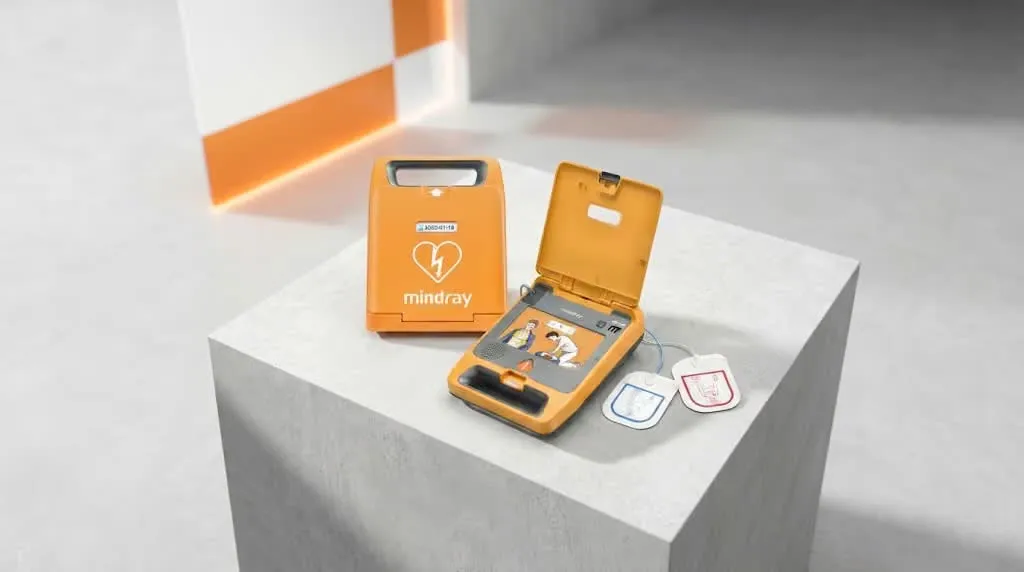
A wall-mounted cabinet, heated or ventilated depending on the site's exposure, protects the device from heavy foot traffic and constant visual checks typical of these locations. In areas exposed to weather, outdoor boarding gates, car parks, a weatherproof outdoor cabinet is preferable to a model designed for indoor use only.
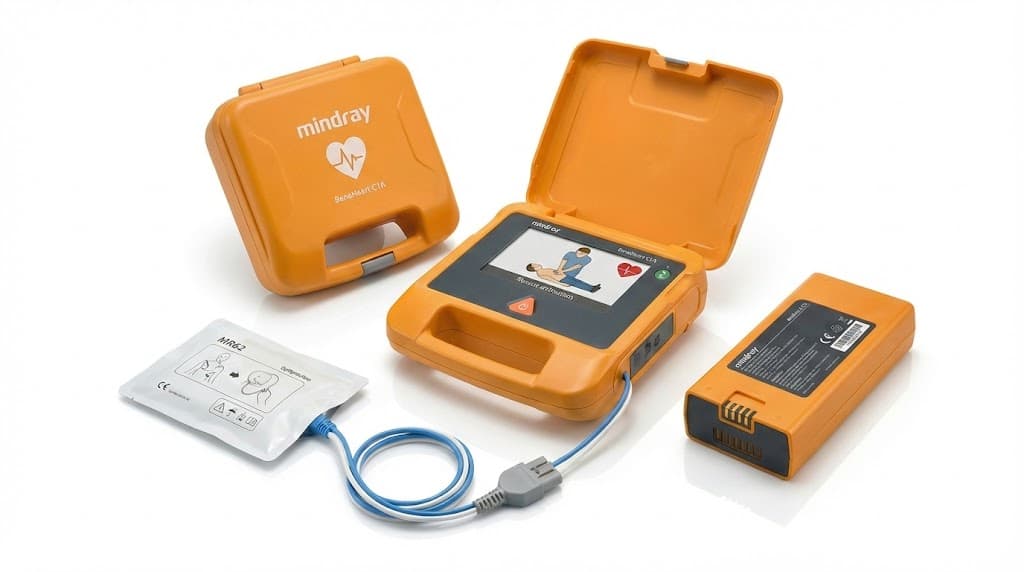
An airport regularly renewing its fleet or equipping a new terminal can choose between purchase, with a 5-year warranty and delivery within 2 to 5 working days after a quote issued within 24 hours, and rental, available from 50 euros excl. VAT per month with maintenance included, which simplifies tracking a fleet spread across several sites.
Signage and visibility in a multilingual environment
Signage must follow the models set by the French order (arrêté) of 29 November 2018, visible from the main circulation routes. In an airport, an international clientele makes the standardised pictogram particularly useful: it is understood without translation, unlike text that would need several language versions to stay effective.
Additional directional signs from the busiest areas, check-in desks, boarding gates, retail zones, help travellers and staff alike locate the nearest device without hesitation. Registering each device on GéoDAE, France's national AED directory, also lets emergency services know the exact layout of the site before they even arrive.
Trained staff and coordination with security services
In France, anyone can use an automated external defibrillator without prior training, the device guides the user through every step by voice. In an airport, staff who interact with the public, ground agents, security staff, catering and retail employees, still benefit from first-aid training so they can act without delay during the first, decisive minutes.
Coordination with the central security post is a key point: it is often the first to receive the alert and can guide a bystander to the nearest device by radio. A periodic drill involving security staff and airline personnel helps confirm that everyone knows where the defibrillator for their area is located.
Maintaining a fleet of devices spread across a large site
Maintenance of each defibrillator remains the operator's responsibility under article R. 5212-25 of the French public health code (code de la santé publique). At an airport, this obligation covers a large number of devices, which justifies a centralised tracking register recording each unit's location, date of last check and consumables status.
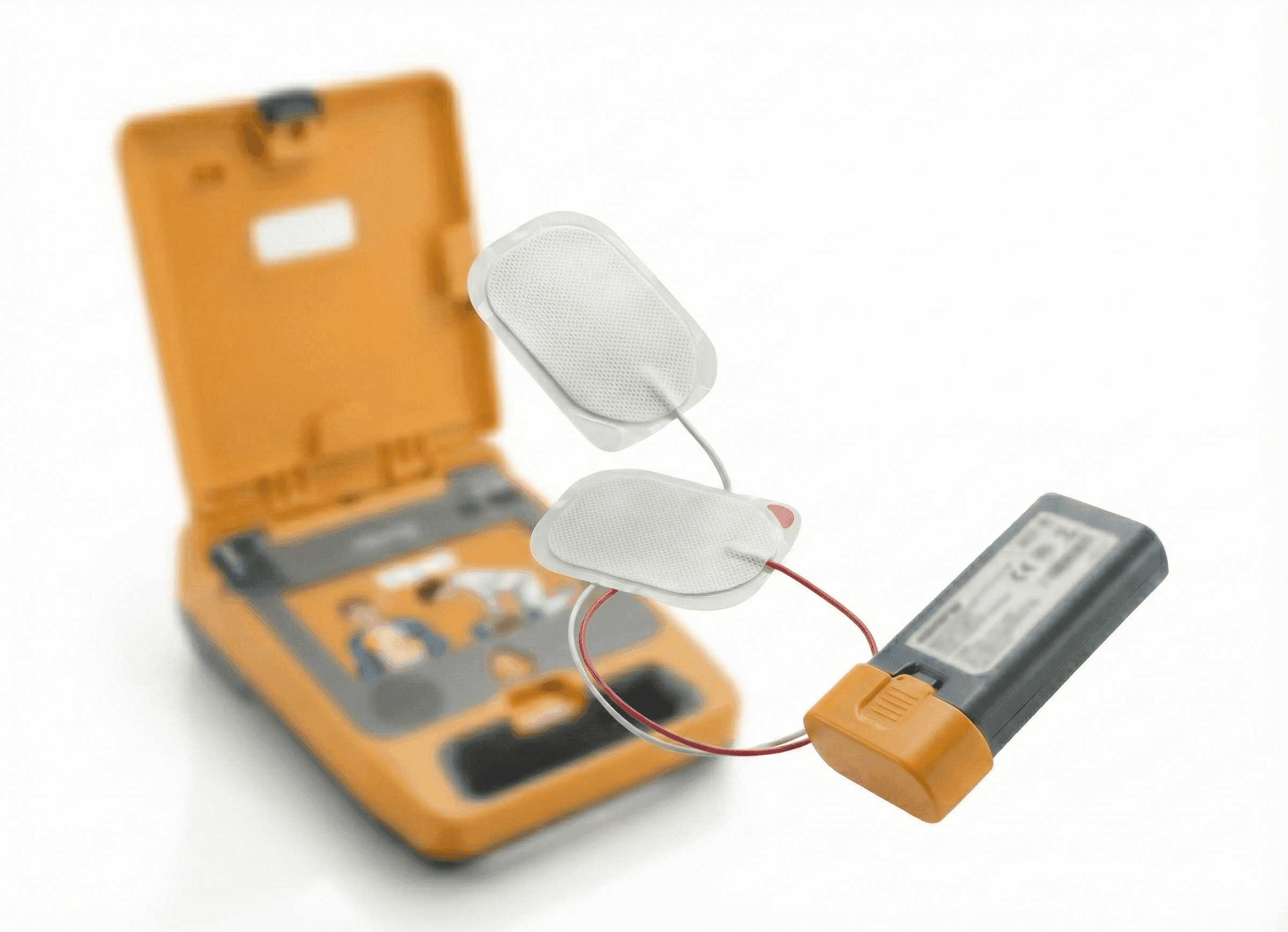
Electrode pads need replacing every 2 to 5 years and batteries every 3 to 5 years, with a regular self-test check on every device in the fleet. A single maintenance contract covering all AEDs on site simplifies this tracking and guarantees a fast response whenever a warning light flags a fault.
Frequently asked questions
Is an airport required to install several defibrillators?
Regulations set a minimum level of equipment based on the venue's category, but an airport terminal in the top category is often far too large for a single device to guarantee quick access from every zone. In practice, airport operators install multiple units to cover halls, checkpoints and boarding lounges.
Do staff-only zones such as runways or hangars need to be equipped too?
The legal requirement primarily covers areas open to the public. Technical zones, however, host teams who sometimes work far from fast outside help, which is a good reason to install defibrillators there as well as a precaution, even outside any strict obligation for these restricted spaces.
How can a traveller who does not speak French locate a defibrillator in an airport?
Signage compliant with the order of 29 November 2018 relies on a standardised pictogram, recognisable without translation. Combined with directional signs from the main circulation routes, this signage stays understandable for an international clientele that does not necessarily read French or English.
Who is responsible for maintaining defibrillators at an airport?
The site operator remains responsible for each device working properly, under article R. 5212-25 of the French public health code. At an airport, this responsibility covers a large fleet, which makes a centralised register and a maintenance contract covering every installed unit worthwhile.
Does airport staff need training to use the defibrillator?
No training is legally required to use an automated external defibrillator, the device guides the user by voice. First-aid training is nonetheless recommended for staff who interact with the public, so they can react without delay and start chest compressions while waiting for the device.
Planning an AED project?
Purchase, rental from 50 EUR excl. VAT per month, installation with GéoDAE registration, servicing and training: our team replies within 24 hours.