Defibrillator locked away at night: staying accessible
Written by Cyrille GAGNAIRE, France Défibrillateur. Published on 4 November 2026.
A defibrillator kept in a locked lobby, behind a counter or in a building that is empty at night is of no use when an emergency strikes. Yet cardiac arrest does not follow opening hours. Each minute without defibrillation reduces the chances of survival by about 10%. Here is how to assess the real availability of the device, which solutions exist outside opening hours, what to display and declare, and how to check access over time.
A device is only useful if it can be reached
People readily check the state of the pads and the battery, far less often the path leading to the device. Yet an AED (automated external defibrillator) in perfect working order but locked away produces the same result as no device at all: the person in cardiac arrest is not defibrillated in time.
The reasoning is simple. With about 50,000 cardiac arrests a year in France, some happen in the evening, at night, on Sundays or during an annual closure. If the device is accessible only from 9 a.m. to 6 p.m., it covers only a fraction of the time during which people pass near the building.
Situations where access closes off
The problem rarely appears dramatically. It sets in through habit: the device is put away for safety, the room is locked, the gate is closed. The table below lists the most common cases.
Each of these cases can be solved, provided it is identified before an incident and not after.
| Situation | What blocks access | Option to consider |
|---|---|---|
| AED in a reception hall | Door closed outside opening hours | Cabinet reachable from outside |
| AED behind a counter | Only staff can take it | Visible location on the public side |
| Building with a keypad | Code unknown to passers-by | Cabinet on the façade, outside the closed area |
| Site closed in the evening | Locked gate or fence | Device placed at the property boundary |
| Premises shared between occupants | Everyone assumes the other has the key | Appoint a lead person and duplicate access |
Outdoor cabinet or controlled access
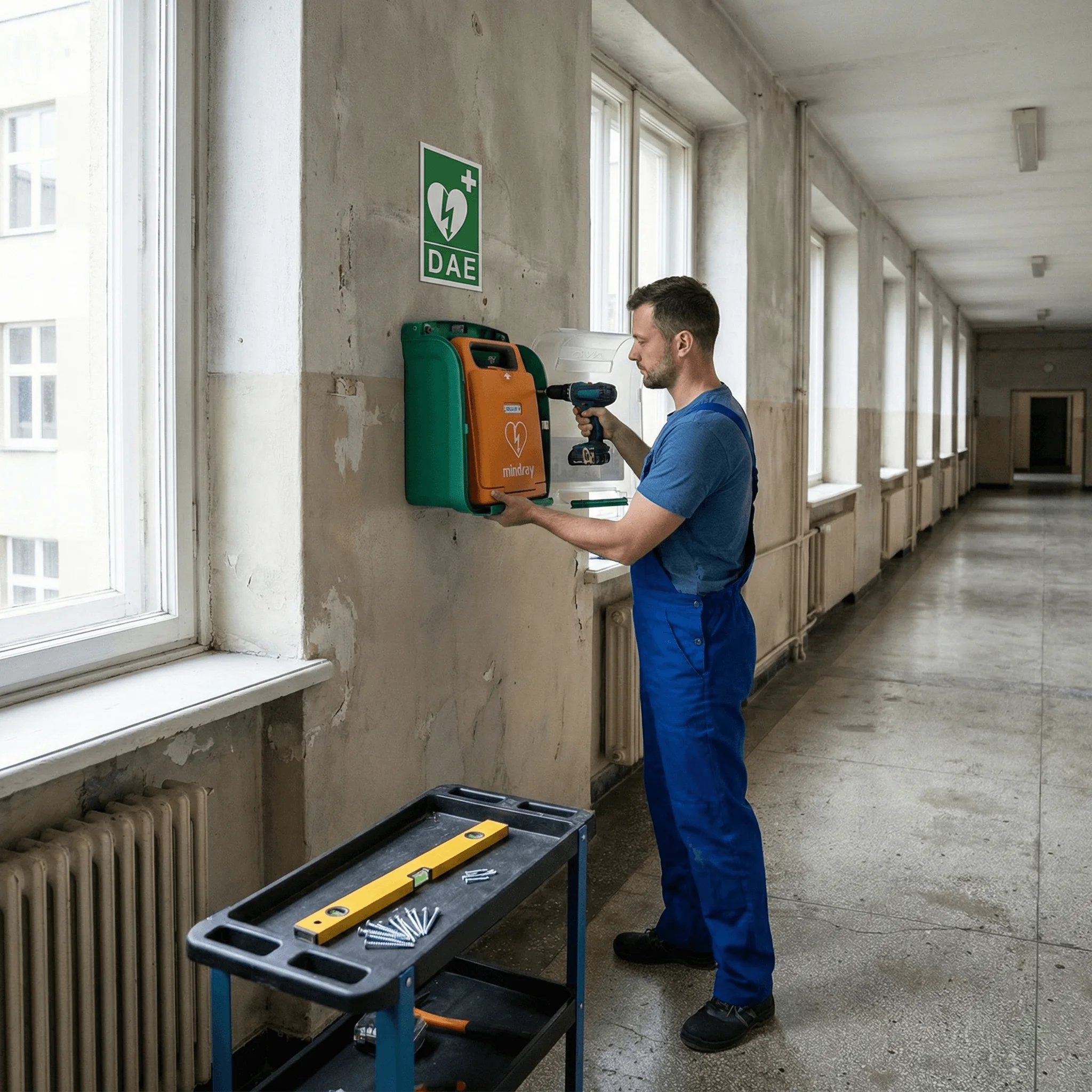
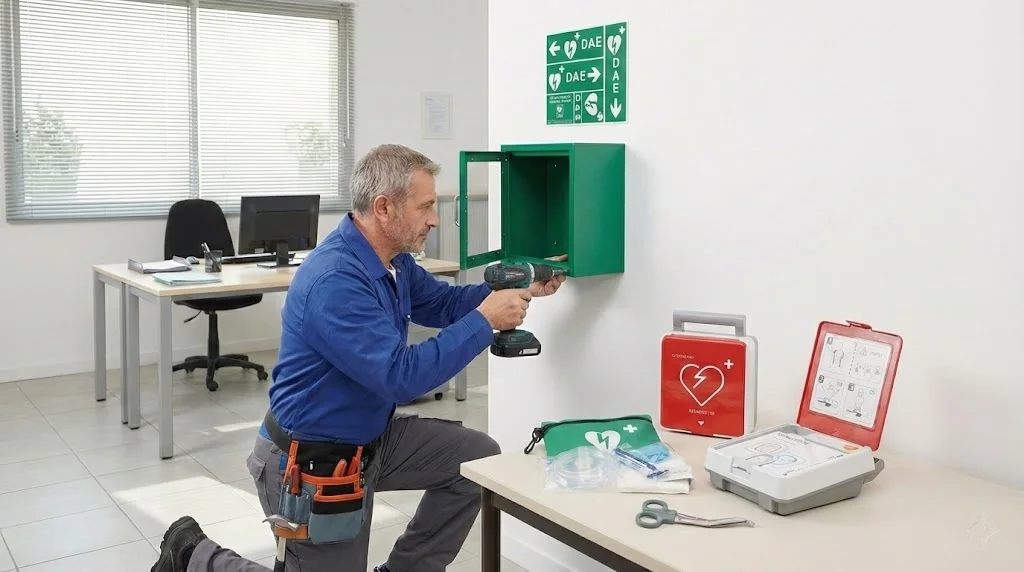
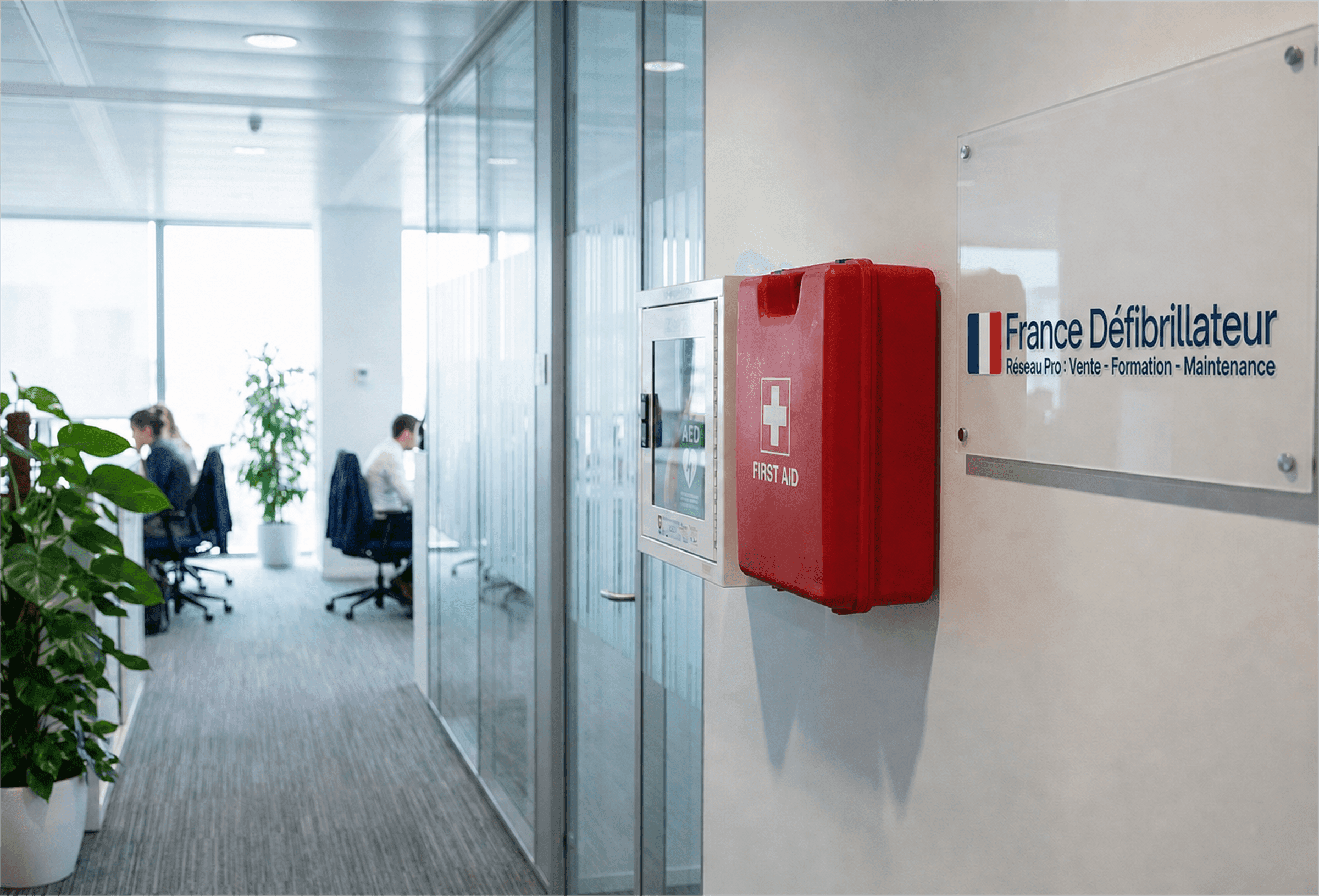
The most direct solution is to install the AED in an outdoor cabinet, fixed to the façade or at the edge of the public road. It stays reachable at any hour, with no key and no staff. Choosing a model suited to the climate and fitted with an alarm deserves careful thought: our article on indoor and outdoor cabinets details the criteria.
When the operator prefers to limit access, for fear of theft or vandalism, a controlled-opening cabinet may do. It is released by a code, by breaking glass or by a number given by the emergency services. This choice costs time: the longer the opening procedure, the less it suits an emergency. A mechanism that any bystander understands within a few seconds is preferable.
Some premises cannot move the device outside. In that case, the most honest approach is to acknowledge that the AED is available only during opening hours and to say so clearly, rather than suggest round-the-clock coverage.
Informing on site and online
Signage follows the arrêté du 29 novembre 2018 (the French order of 29 November 2018): it guides people to the device from the main routes, with consistent arrows. If access changes with the time of day, a legible note on the sign or the cabinet saves a bystander from wasting time in front of a closed door.
The GéoDAE declaration, which is mandatory, must reflect the real situation. A device listed as available around the clock when it is locked at night sends the emergency services and volunteers to a point that does not respond. Update the record as soon as hours, location or access method change.
Emergency operators rely on this information to direct a caller. Accurate data is worth more than optimistic data.
Checking access over time
Maintenance is the operator's responsibility under article R. 5212-25 du Code de la santé publique (French Public Health Code). Nothing prevents adding a check specific to accessibility: is the device still in place, is the path clear, does the door or gate unlock as planned?
A simple exercise is enough: once a quarter, someone who does not know the premises starts from the street and looks for the device using only the signs. The time taken and the hesitation encountered say more than a register filled in at a desk.
Record the result in the safety register, with the date and the name of the person checking. After any change of organisation, works or new occupant, repeat the test without waiting for the next quarter.
Frequently asked questions
Must a defibrillator be accessible 24 hours a day?
The regulations require certain ERP (establishments open to the public) to be equipped, the device to be declared in GéoDAE and signposted, but continuous accessibility is not always required. It remains strongly recommended, since cardiac arrest can strike at any hour. If access is limited, say so clearly in the declaration and on site.
Can the defibrillator be kept in a locked room?
It is possible, but the AED can then be used only if someone with a key is present. This solution suits a place used outside working hours poorly. In that case, it is better to move the device to an accessible area or to place it in an outdoor cabinet.
How do I report limited access in GéoDAE?
Fill in your device's accessibility information accurately when declaring it, then update the record whenever hours or location change. Accurate information allows the emergency services to direct a bystander to another device if yours cannot be reached.
Does an outdoor cabinet expose the device to theft?
The risk exists, but it is reduced with a securely fixed cabinet, fitted with an alarm and placed in a visible spot. It must be weighed against the risk of being unable to use the device. Regular checks of the cabinet help detect a problem quickly.
Planning an AED project?
Purchase, rental from 50 EUR excl. VAT per month, installation with GéoDAE registration, servicing and training: our team replies within 24 hours.