Defibrillator Insurance: What Is Covered, and What Isn't
Written by Cyrille GAGNAIRE, France Défibrillateur. Published on 30 August 2026.
Many organisations assume their defibrillator is protected by its warranty or by their maintenance contract. Neither covers theft, deliberate damage, or weather exposure on an outdoor cabinet. Only a dedicated insurance policy or an extension to a professional multi-risk contract covers that risk. Understanding the difference between warranty, maintenance and insurance avoids an unpleasant surprise the day the device is needed and missing.
Manufacturer warranty and insurance are two different protections
The manufacturer warranty, usually five years on a new defibrillator (DAE, AED), covers manufacturing defects and failures that do not result from abnormal use. It does not cover theft, accidental breakage, or damage from an impact, water ingress or vandalism. An AED stolen from its cabinet or destroyed by water infiltration will not be replaced under warranty, even if it still had several years of service life left.
This distinction often surprises organisations that discover, after an incident, that their manufacturer or maintenance provider has no obligation to replace the device free of charge outside of an actual equipment defect. Only an insurance policy, taken out separately, covers these situations.
What a professional multi-risk policy covers
Most professional or building multi-risk contracts can include the defibrillator alongside any other fixed or mobile equipment on site. Depending on the cover chosen, insurance can pay out for burglary, fire, water damage, accidental breakage and, in some cases, vandalism. The amount reimbursed depends on the declared value of the device and its age, which is why it is worth keeping the purchase invoice and maintenance records.
The defibrillator still needs to be explicitly listed in the contract, or covered by a general clause on professional equipment, for a claim to succeed. A device forgotten at the time of taking out the policy risks not being reimbursed, even if the contract otherwise looks comprehensive. Housing associations and local authorities managing several sites should check that every equipped location appears on the list of insured assets, rather than relying on a generic clause.
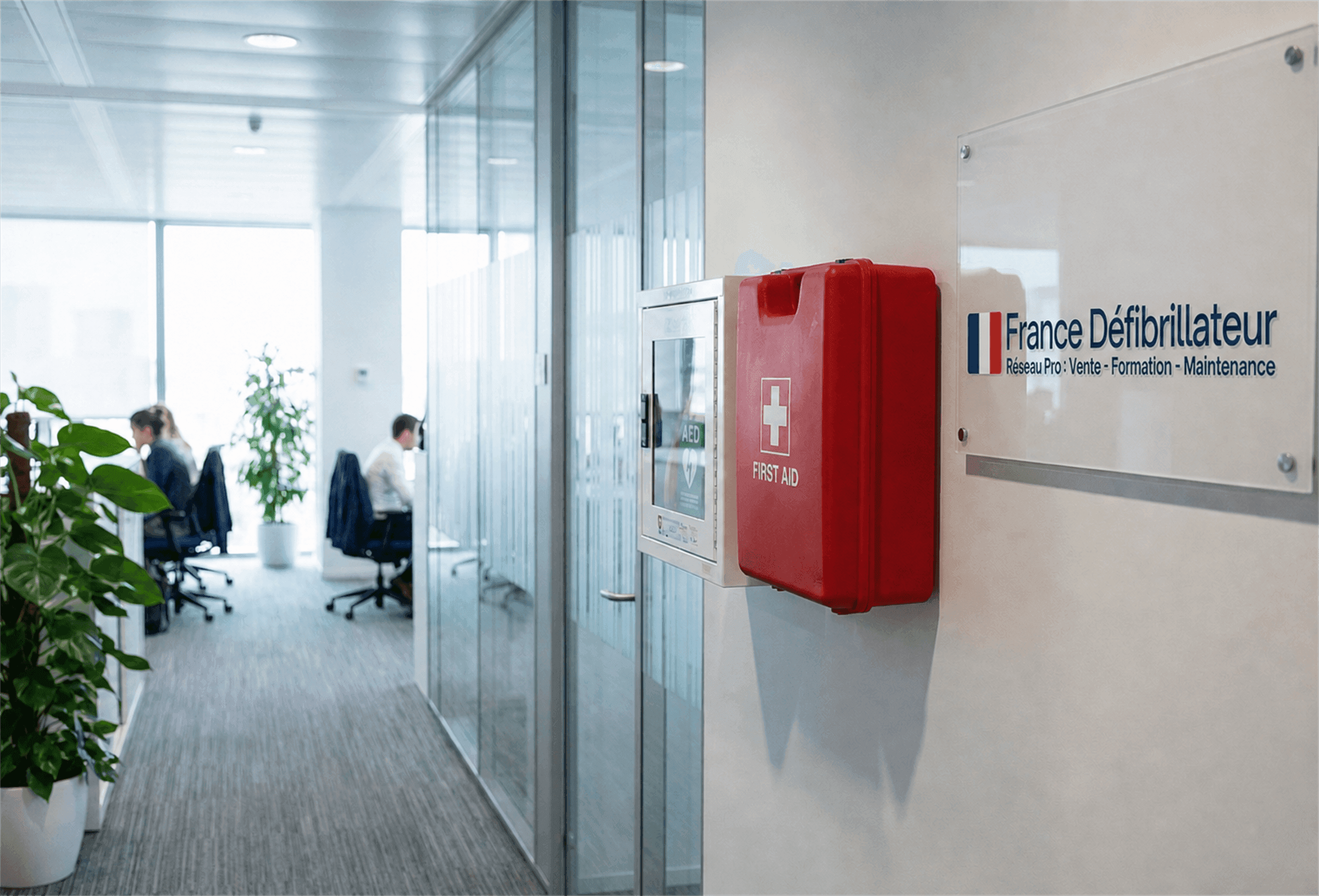
Theft and vandalism, a real risk for outdoor cabinets
Defibrillators installed for open access, in a heated outdoor cabinet near a building entrance, are more exposed than those kept indoors behind a reception desk. Theft, vandalism, forced entry attempts and simple damage to the cabinet are among the most frequently reported incidents. Some cabinets include an audible alarm and remote notification that deter part of this risk, without removing the financial exposure if the device disappears.
Checking that the theft clause of a policy explicitly covers equipment installed on the exterior of a building, outside the main premises, avoids a disappointment when filing a claim.
The operator's civil liability, what is really at stake
Article R. 5212-25 of the French Public Health Code (Code de la santé publique) places responsibility for defibrillator maintenance on the operator of the premises. If a cardiac arrest occurs on site and the device fails because it was not maintained, the operator's civil, or even criminal, liability can be engaged where negligence is established. Taking out insurance does not remove the need for regular self-tests, timely replacement of pads and battery, and an up to date safety log.
That log, beyond being a regulatory requirement, is useful evidence of due diligence if a claim is filed or liability is questioned after an incident. An operator able to show a rigorous follow-up significantly reduces its exposure, regardless of what the insurance policy reimburses.
Warranty, maintenance and insurance, three contracts not to confuse
These three arrangements meet different needs and complement each other rather than replacing one another. The table below summarises what each one covers in the most common situations.
| Situation | Manufacturer warranty | Maintenance contract | Insurance |
|---|---|---|---|
| Breakdown or manufacturing defect | Yes | Depends on contract | No |
| Pads or battery at end of life | No | Yes if included | No |
| Theft of the device | No | No | Yes if taken out |
| Water damage or fire | No | No | Yes if taken out |
| Vandalism of the outdoor cabinet | No | Rarely | Yes if taken out |
Good practice for insuring a defibrillator correctly
Declaring the defibrillator by name to the insurer, with its purchase value and serial number, makes claims much easier to settle. Keeping the invoice, the warranty certificate and the self-test history in the safety log makes it possible to put together a file quickly. For an outdoor cabinet, it is worth checking that the policy explicitly mentions equipment installed outside the main building.
Where there is any doubt about the exact scope of cover, discussing it with the insurer before installing the AED, rather than after an incident, makes it possible to adjust the contract if needed. The same conversation is a good opportunity to check the excess and the replacement timeframe offered, two details that matter as much as the amount reimbursed when a site is left, even temporarily, without a working defibrillator.
Frequently asked questions
Does my professional insurance automatically cover my defibrillator?
Not automatically. Most professional multi-risk contracts require the defibrillator to be declared as equipment, with its purchase value, to be covered for theft, fire or water damage. Without that declaration, the device may be treated as not covered by the contract and a claim refused. Checking with the insurer confirms the exact situation.
What happens if the defibrillator is stolen from its outdoor cabinet?
Without insurance explicitly covering theft of equipment installed outside a building, replacement remains the operator's responsibility, since the manufacturer warranty does not apply to theft. Some cabinets fitted with an audible alarm or remote notification reduce the risk but do not guarantee against the device disappearing. A police report is still required for any claim.
Does the manufacturer warranty replace insurance?
No. The warranty, usually five years, covers only manufacturing defects and failures that do not result from abnormal use. It does not cover theft, vandalism, or accidental or weather related damage. Only a dedicated insurance policy or an extension to a professional multi-risk contract covers these situations, alongside the warranty.
Am I liable if the defibrillator fails to work during a cardiac arrest?
The operator of the premises is responsible for defibrillator maintenance under article R. 5212-25 of the French Public Health Code. A failure linked to established negligence, such as expired pads or a battery that was not replaced, can engage liability. Regular self-tests and an up to date safety log offer far better protection than an insurance policy alone.
Should the defibrillator be declared to the insurer when it is installed?
It is strongly recommended. Declaring the device with its purchase value, serial number and type of installation, indoors or in an outdoor cabinet, makes it possible to adjust cover and avoid a refused claim. This can be done at installation or when the site's multi-risk contract is renewed each year.
Planning an AED project?
Purchase, rental from 50 EUR excl. VAT per month, installation with GéoDAE registration, servicing and training: our team replies within 24 hours.