Indoor or outdoor AED cabinet: how to choose
Written by Cyrille GAGNAIRE, France Défibrillateur. Published on 3 August 2026.
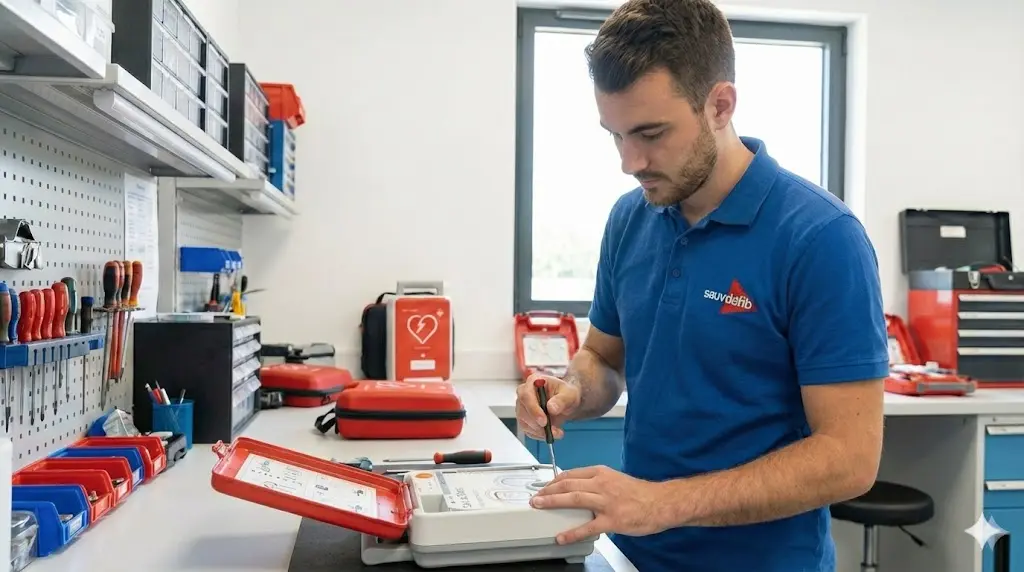
An unprotected defibrillator wears out quickly and becomes an easy target for theft or vandalism. A cabinet solves both problems, but the right choice depends on where the AED (automated external defibrillator, DAE in French) is placed. A unit sitting in a heated lobby faces different constraints than a cabinet fixed to a wall exposed to frost and rain. This guide compares indoor and outdoor models, their real prices and the criteria that should guide the decision.
Why a cabinet is not just an accessory
An automated external defibrillator must remain available at all times, including at night and on public holidays. A wall cabinet protects it from dust, impacts and attempts to open it by unauthorised people. Many recent models include a sound alarm that triggers on opening, which deters theft while alerting staff present in the building.
The choice of cabinet directly affects the lifespan of the equipment it houses. An electrode or a battery exposed to large temperature swings can wear out before the 2 to 5 years and 3 to 5 years announced by manufacturers. The AED itself, built to last 8 to 10 years or more, only keeps that promise if it stays within its operating temperature range.
Indoor cabinet: simplicity and a controlled budget
Indoors, in a reception hall, a corridor or a heated room, a simple cabinet is enough. It mainly protects against impacts and accidental handling, since ambient temperature stays stable all year. The plainest models suit most offices, shops and town hall reception areas that close their doors in the evening.
For a neater look or better visibility from the entrance, some cabinets add built-in signage or a sturdier finish, without changing the basic principle: protecting the device without having to manage frost or rain.
| Cabinet | Use | Price incl. VAT |
|---|---|---|
| Wall cabinet with alarm and key | Indoor | €94.99 |
| ARKY metal indoor cabinet | Indoor | €99 |
| Latest-generation indoor case | Indoor | €115 |
| Universal wall box | Indoor | €129 |
| Rotaid Solid Plus | Outdoor | €249 |
| ARKY outdoor cabinet with alarm | Outdoor | €359 |
| AIVIA 210 with alarm, heating, pin lock | Outdoor | €619.99 |
Outdoor cabinet: what really changes
A cabinet installed on a facade, a boundary wall or a car park must withstand frost, heat and bad weather. Built-in heating keeps the internal temperature within the range tolerated by the battery and electrodes, even in severe cold. This is the case for several models fitted with an alarm and a heating system, priced from €249 to over €600 including VAT depending on the level of protection.
Ventilated, heated versions with alarms also exist for highly exposed sites, and a solar wall version allows equipping a location without easy access to a power socket. The budget for an outdoor cabinet is therefore higher than for an indoor model, but it avoids premature replacement of the battery or electrodes.
Signage and accessibility, an obligation tied to the cabinet
Whichever model is chosen, the cabinet must remain visible from the building entrance, or from the public road for an outdoor AED. The signage required by the French order of 29 November 2018 (arrêté du 29 novembre 2018) indicates the exact location of the defibrillator and must be visible from a distance. Many cabinets come with a compliant sticker or panel, but this point deserves checking before purchase.
The location of the defibrillator, whether installed indoors or outdoors, must also appear in the GéoDAE registration. This step remains mandatory regardless of the type of cabinet chosen, and it allows emergency services to direct a bystander to the nearest device in the event of a cardiac arrest.
How to choose between indoor and outdoor?
The central question is accessibility outside opening hours. A shop or office that closes in the evening can settle for an indoor cabinet, provided the intended public is staff or customers present during opening hours. Conversely, a town hall, a sports club with outdoor facilities, or a venue open to the public in the evening benefit from installing the AED outdoors, accessible at all times.
For public-facing establishments, the building category also matters. In France, categories 1 to 3 (ERP, establishments open to the public) have been required to have a defibrillator since 1 January 2020, category 4 since 2021 and some category 5 sites since 2022, under law 2018-527 and its implementing decree 2018-1186. A venue open over long hours has an interest in choosing a heated outdoor cabinet, so the defibrillator stays usable even when no staff are present.
Maintaining the cabinet just like the defibrillator
Maintenance of the defibrillator remains the responsibility of the operator, as specified in article R. 5212-25 of the French public health code (article R. 5212-25 du Code de la santé publique). This responsibility also covers the cabinet: a door that closes poorly, an alarm that no longer triggers, or broken heating undermine the availability of the device just as much as a flat battery.
A regular visual check of the cabinet, carried out alongside the AED's self-tests, avoids this kind of unpleasant surprise. This simple check, a few seconds each month, usefully complements the maintenance log already kept for the defibrillator itself.
Frequently asked questions
Is a heated cabinet mandatory outdoors?
No specific text requires heating, but a defibrillator exposed to frost sees its battery and electrodes wear out faster. For a lasting outdoor installation, a heated cabinet is strongly recommended, especially in regions with harsh winters. The extra purchase cost is often offset by less frequent consumable replacements.
Does the defibrillator cabinet need an alarm?
An alarm is not a legal requirement either, but it deters theft and immediately signals an opening, whether linked to an emergency or an intrusion attempt. On an outdoor location accessible to the public, it remains the best guarantee that the device will still be there the day it is needed.
How much does a defibrillator cabinet cost?
Simple indoor models start around €95 including VAT and rarely exceed €160. Outdoor cabinets, sturdier and often fitted with an alarm or heating, generally range between €250 and €1,000 including VAT depending on the equipment level and the weather resistance sought.
Does the cabinet replace the GéoDAE registration?
No, these are two separate steps. The cabinet physically protects the device, while the GéoDAE registration references it in a national database consulted by emergency services. A well-protected but unregistered defibrillator stays invisible to a bystander searching for the nearest device through that database.
Can an indoor cabinet be installed outdoors?
This is not recommended. A cabinet designed for indoor use resists neither water infiltration nor the temperature swings of an exposed facade, which speeds up wear on the defibrillator and its consumables. For an outdoor location, it is better to choose a model designed and tested for that use from the start.
Planning an AED project?
Purchase, rental from 50 EUR excl. VAT per month, installation with GéoDAE registration, servicing and training: our team replies within 24 hours.