Relaying the chest compressor to prevent exhaustion
Written by Cyrille GAGNAIRE, France Défibrillateur. Published on 16 November 2026.
Effective chest compressions are intense physical effort, and fatigue sets in much faster than most people expect. When compressions lose depth and regularity, blood flow suffers. As soon as several people are present, taking turns becomes a lifesaving act in its own right. Here is how to organise it, when to hand over and how to limit interruptions during the swap.
Why fatigue arrives faster than you think
Compressing an adult's chest takes strength in the arms, shoulders and back, at a steady pace and with enough depth. Even a fit person feels the muscles burn after a few minutes. The rescuer, often running on adrenaline, does not notice their own tiredness.
The danger is subtle: compressions become shallower, the chest no longer recoils fully between pushes, the pace slows. Every minute without effective circulation counts, since survival chances fall by about 10% for each minute without defibrillation. A tired compression is worth less than a fresh one.
Trained rescuers get tired too. Professionals themselves take turns during a prolonged resuscitation, precisely because physical effort degrades the quality of the gesture. There is no shame in asking for help, or in offering to replace someone who is starting to flag.
When to hand over
The most natural moment to swap is when the defibrillator (AED) analyses the rhythm. The device asks you to stop compressions during analysis: it is an imposed pause that can be used to exchange places without any extra interruption.
If the rescuer feels their arms weakening before the analysis, they can ask for the handover earlier. It is better to say out loud that you are tired than to keep compressing badly. A person waiting beside you, ready to take over, saves precious time.
Organising the handover without losing compressions
The principle is simple: the replacement kneels on the other side of the victim, hands ready, while the first rescuer carries on. On the agreed signal, the first one lifts their hands and the second places theirs at the same spot, in the centre of the chest, without delay.
A few habits keep the swap smooth: the rescuer announces they are about to change, the replacement answers that they are ready, the exchange takes a few seconds without discussion, and the one who just stepped aside stays available for what comes next.
Sharing the other roles around the compressions
When several bystanders are present, the handover is part of a wider split of tasks: one person compresses, another has called the emergency services and stays on the line, a third brings and attaches the defibrillator, a fourth clears space and meets the responders.
Whoever stops compressing can take another useful role: guiding new arrivals, keeping the rhythm or watching the defibrillator. Nobody should be left without a task, and nobody should wear themselves out alone.
What to do when you are alone
With no other bystander, a handover is impossible. In that case keep compressing as regularly as you can, use the defibrillator as soon as it is available and stop only on the device's instructions or when the emergency services arrive.
If fatigue becomes so great that effectiveness collapses, the priority is still to maintain a continuous effort. Do not stop for fear of doing it wrong: imperfect compressions are always better than none. The emergency dispatcher on the phone can also guide the rhythm and reassure you.
As soon as a bystander arrives to help, even untrained, the rescuer can ask them to take over by showing the hand position and the rhythm. A few clear words are enough, and a helper on site quickly becomes valuable support.
Preparing your premises for this handover
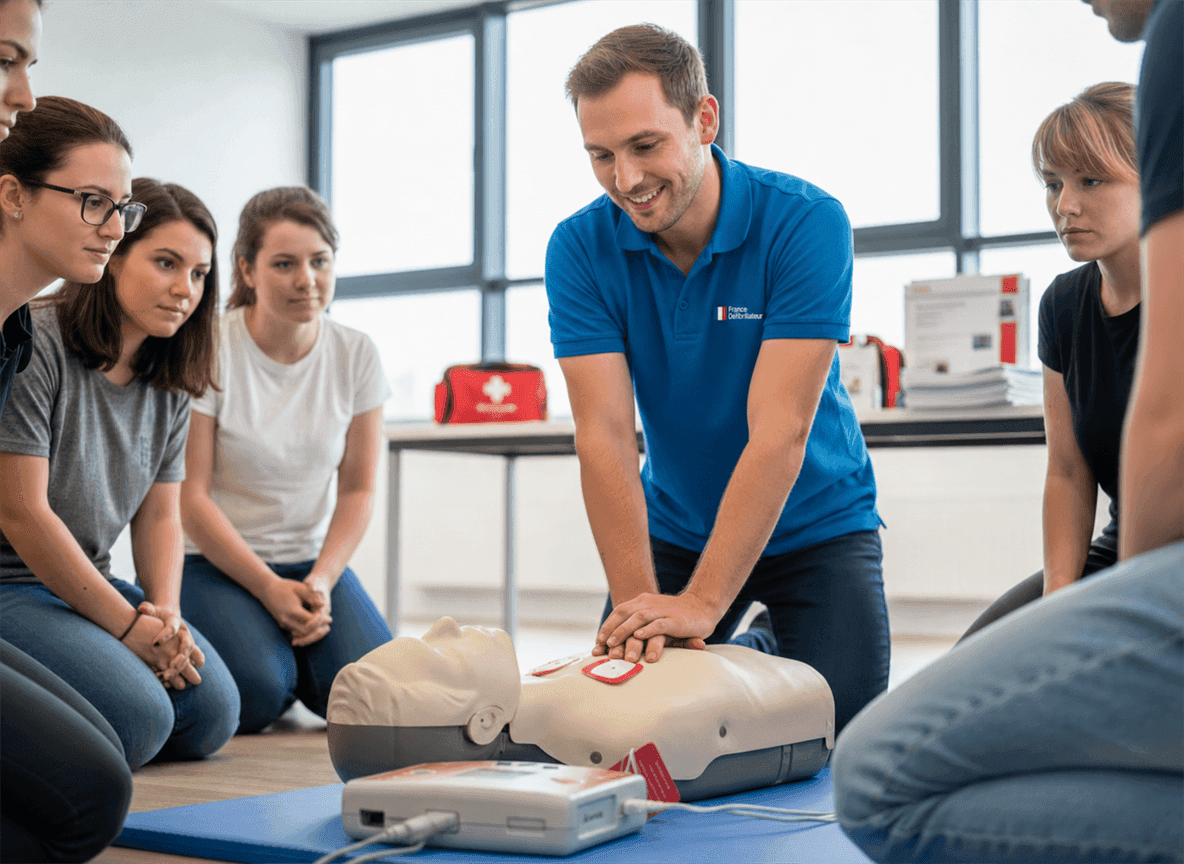
In a company, a club or a public venue (ERP), the handover is prepared before the emergency. Training that has people practise swapping on a manikin builds the reflex far better than a theoretical explanation.
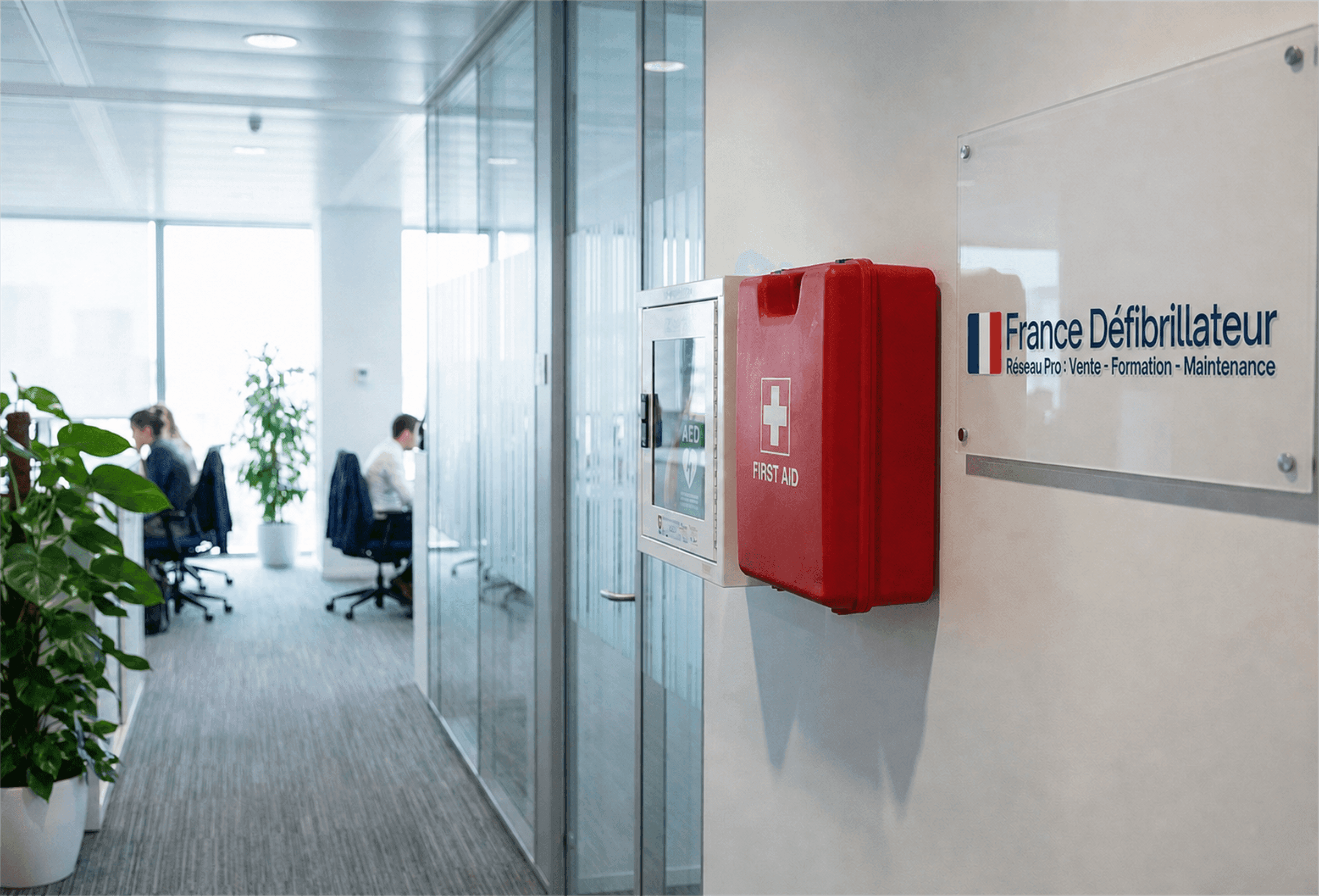
A simulation exercise also tests the organisation: who compresses, who takes over, who brings the device. Thinking about fatigue when designing your set-up also means placing a visible defibrillator close to where people work, so that the time saved reaching it is not lost to the first rescuer's exhaustion. France Défibrillateur offers life-saving training and a quote within 24 hours to equip and train your teams.
Frequently asked questions
How often should the person doing compressions be swapped?
The most practical approach is to use the defibrillator's analysis to swap places, since compressions already stop. If the rescuer feels their arms weakening sooner, they should ask for the handover without waiting. Quality of compressions matters more than any fixed rule.
How can you tell the rescuer is tired?
Signs include a slowing pace, shallower compressions, a chest that no longer recoils between pushes and heavy breathing. An attentive bystander can point it out and offer to take over before effectiveness drops.
Can you swap without stopping compressions?
There is always a short pause, but it must stay minimal. The replacement positions themselves on the other side beforehand, hands ready, and resumes at the same spot as soon as the first removes theirs. A well prepared swap lasts a few seconds.
What if nobody can replace me?
Keep compressing as regularly as possible, attach the defibrillator as soon as it arrives and follow its instructions. The emergency dispatcher reached by phone can guide you. Imperfect compressions are far better than stopping altogether.
Should teams be trained to swap compressors?
Yes, because this gesture can be learned and rehearsed. Hands-on training on a manikin lets people practise changing places and announcing the handover. It makes the team more effective on the day a real emergency happens.
Planning an AED project?
Purchase, rental from 50 EUR excl. VAT per month, installation with GéoDAE registration, servicing and training: our team replies within 24 hours.