2025 resuscitation guidelines: what changes for your DAE (AED)
Written by Cyrille GAGNAIRE, France Défibrillateur. Published on 28 July 2026.
October 2025 saw the back to back release of the international ILCOR CoSTR consensus and the ERC Guidelines 2025, launched at the Resuscitation congress in Rotterdam. These documents are not French regulations, but they shape lifesaving skills training and the way a defibrillation scheme is organised. Here is what they mean in practical terms for a site operator and for trained staff.
Two documents published in October 2025, two levels of reading
Every five years, the International Liaison Committee on Resuscitation publishes its CoSTR, the Consensus on Science with Treatment Recommendations. The 2025 edition appeared in Circulation in October 2025. It is the global synthesis of the scientific evidence on resuscitation, the basis on which continental learned societies then build their own guidelines.
The European Resuscitation Council followed with the ERC Guidelines 2025, officially launched in Rotterdam in October 2025 during the Resuscitation congress. Their scope covers adult BLS, meaning basic life support, ALS or advanced life support, special circumstances such as pregnancy, hypothermia, drowning or trauma, post resuscitation care, and finally education and the organisation of systems of care.
For an operator, the distinction matters. The CoSTR is a scientific reference, not a French regulatory text. Your equipment obligations remain the ones you already know: French public-access buildings (ERP) in categories 1 to 3 have been equipped since 1 January 2020, category 4 since 2021, and some category 5 ERP since 2022. These guidelines create no new purchasing obligation.
The core message has not moved
The CoSTR 2025 states it plainly: the quality of chest compressions and rapid access to a defibrillator determine survival. The ERC reaches the same conclusion. On the intervention itself, the principles remain stable: recognise, call for help, compress, defibrillate. What is changing is the ecosystem around the intervention, that is training, digital support and the organisation of the chain of survival.
In other words, no operator needs to question their equipment because the guidelines have been updated. The question these texts raise is not which defibrillator, but how long it takes for someone to have it in hand and know how to use it. On equipment selection, our buying guide and our comparison of DAE, DEA and DSA devices remain the starting point.
The first three to five minutes become the centre of gravity
In 2025 the ERC stresses the first three to five minutes: compression quality and access to the DAE. This is consistent with what has long been known in France, where around 50,000 cardiac arrests occur each year and where every minute without defibrillation cuts the chances of survival by roughly 10 per cent.
Translated into concrete action, this means timing your own premises. Start from the furthest point in the building, walk to the cabinet, come back. If the round trip takes considerably more than three minutes, the problem is not your device but its location, or the fact that a single unit covers too large a site. Also check that the route stays usable outside office hours: a locked door cancels out the whole benefit of the investment.
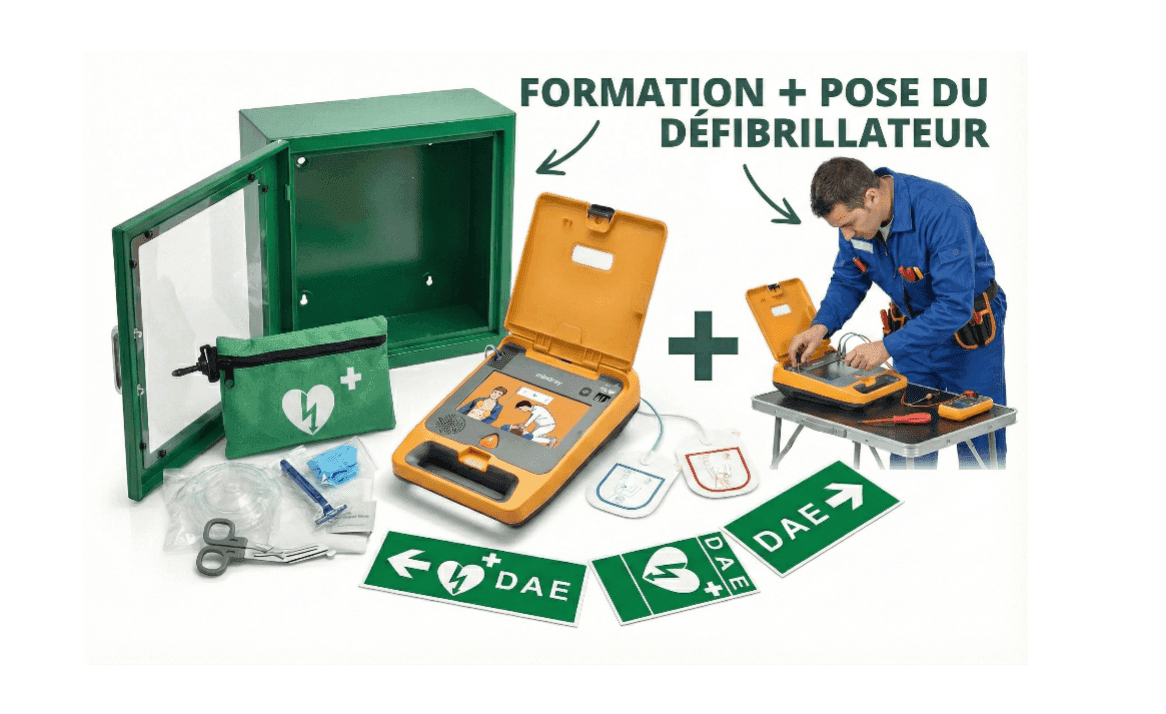
A second practical point is signage. A DAE that nobody spots is a DAE that does not exist. Display the pictogram along circulation routes and point out the cabinet during evacuation drills.
| Development highlighted in 2025 | What the operator can do right now |
|---|---|
| Priority given to the first three to five minutes | Time the actual walk to the cabinet from the most remote areas |
| Quality of chest compressions | Schedule short practical refreshers between two full training courses |
| Rapid access to the defibrillator | Check signage, cabinet height and accessibility outside working hours |
| Central role of the bystander | Identify trained staff by name, floor by floor or team by team |
| Early CPR education | Open awareness sessions to apprentices and young employees |
The bystander is once again the decisive link
The CoSTR 2025 confirms that learning cardiopulmonary resuscitation can begin as early as age 4, with the aim of raising the alarm: recognising that something is wrong and calling the emergency services. From around 12 to 15 years old, teenagers can learn effective compressions and how to use a DAE. The consensus speaks of a paradigm shift, with lifesaving skills training embedded in schools.
This direction is of interest to employers. It is a reminder that the useful action is within reach of a bystander with no clinical background, which should dispel any hesitation among your teams.
On the ground, the most cost effective measure is to map your trained staff: how many per department, per floor, per shift, including night teams and weekends. A properly equipped site whose first aiders all work mornings remains vulnerable in the afternoon.
Training is evolving faster than the technique
Both documents converge on teaching methods. The CoSTR 2025 highlights the integration of augmented reality, virtual reality and gamification into resuscitation training, along with a systems approach and equity of access to resuscitation care, including adapting guidelines to low resource settings.
The ERC Guidelines 2025 point the same way, with a renewed teaching approach built around digital tools, the first mentions of artificial intelligence in the chain of survival for early detection and dispatching, and the role of social media and health advocacy in spreading lifesaving skills.
For a business, the consequence is simple: do not reduce training to a box ticking exercise. Alternate a full classroom session with short refreshers, on site, in front of the cabinet actually installed.
The French timetable remains that of the AFGSU
In France, AFGSU training (the national emergency care certificate) has historically been based on ERC guidelines, transposed by ANCESU. The techniques officially taught in AFGSU 1 and 2 therefore change only once they are incorporated into the national framework. That transposition is expected within 12 to 24 months, most likely after the national congress in Angers in December 2026.
In practice, a team trained in 2025 or 2026 remains trained under a valid framework. Nothing needs to be redone urgently. Good practice is to keep to the planned refresher cycle, then fold the new material into the following refresher once the framework has been revised.
What this means for maintaining your fleet
A defibrillator is only useful if it works on the day it is opened. The 2025 guidelines insist on rapid access to the equipment, which presupposes a device that is ready. Pads are generally replaced every 2 to 5 years, batteries every 3 to 5 years, and the unit itself commonly lasts 8 to 10 years, sometimes longer. These deadlines deserve a line in your maintenance schedule, just like fire extinguishers.
Introduce a monthly visual check of the self test indicator and record the date in your safety register. Keep a spare set of pads on site. If you would rather outsource the monitoring, rental from 50 euros excl. VAT per month includes maintenance and removes the need to track expiry dates yourself. We set out these trade offs in our articles on the lifespan of a defibrillator and on choosing between renting and buying.
For a new site or an additional unit, allow 24 hours for a quotation, 2 to 5 working days for delivery and a 5 year warranty on the device.
Frequently asked questions
Do the 2025 guidelines require me to replace my defibrillator
No. Neither the ILCOR CoSTR 2025 nor the ERC Guidelines 2025 are French regulatory texts, and neither calls installed equipment into question. They deal with training, the organisation of the chain of survival and speed of access. A compliant, well maintained and clearly signposted device remains perfectly suitable.
Do employees who have already been trained need retraining
Not immediately. The techniques taught in AFGSU 1 and 2 change only once ANCESU transposes them into the national framework, which is expected within 12 to 24 months and most likely after the Angers congress in December 2026. Keep to your usual refresher cycle and add the new material at the next session.
What should I take away from the emphasis on the first three to five minutes
That the limiting factor is time, not technology. Every minute without defibrillation cuts the chances of survival by roughly 10 per cent. Measure the actual walk between the most remote areas of your site and the cabinet, check that the route stays open outside office hours, and consider a second unit if the site is large.
Is early CPR education relevant to a business
Indirectly, yes. The CoSTR 2025 places raising the alarm from age 4 and compressions with DAE use at around 12 to 15 years old. New entrants to the labour market will therefore be better and better prepared. Open your awareness sessions to apprentices and trainees, as they are the most receptive audience.
How can I adopt the new teaching tools without extra cost
The CoSTR 2025 cites augmented reality, virtual reality and gamification, and the ERC describes teaching built around digital tools. Without investing in those resources, you can already apply the principle: short, frequent refreshers held on site in front of the device actually installed, rather than a single widely spaced theory session.
Planning an AED project?
Purchase, rental from 50 EUR excl. VAT per month, installation with GéoDAE registration, servicing and training: our team replies within 24 hours.