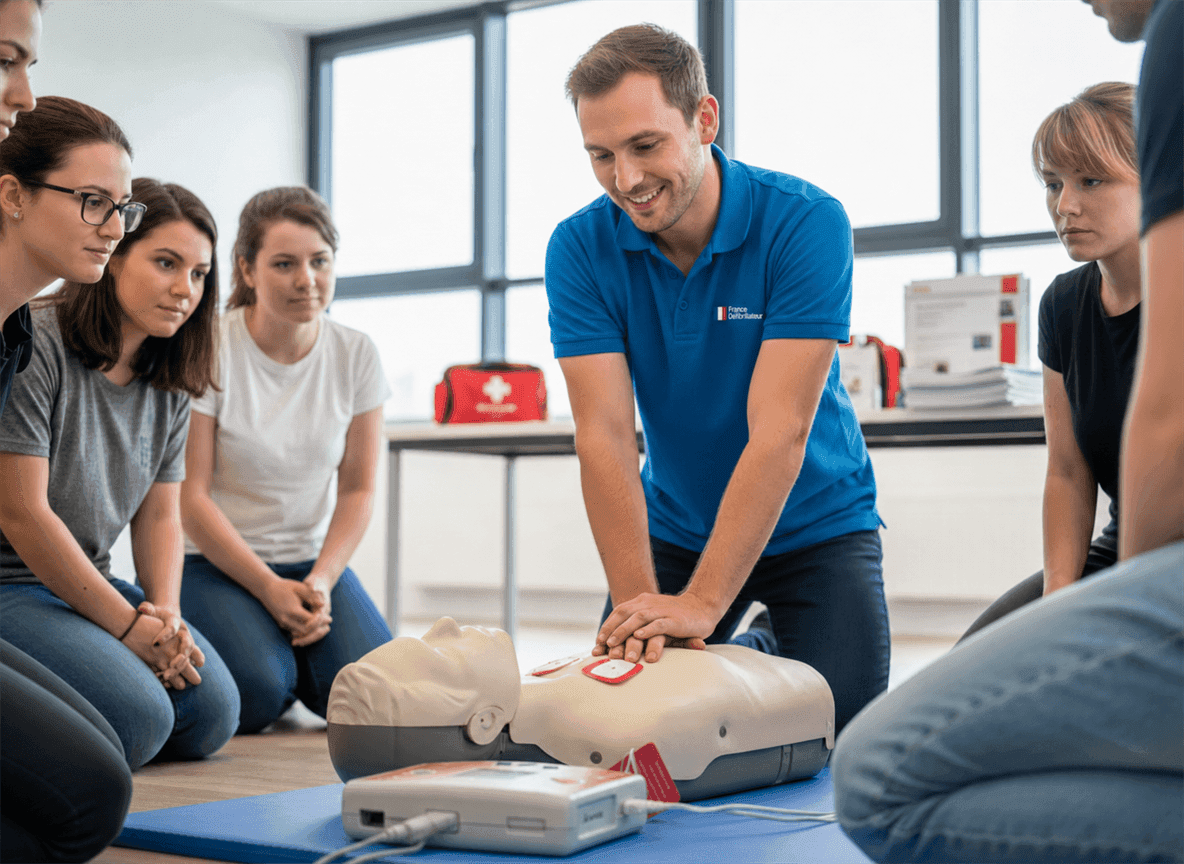
When rescuers arrive: handing over without losing time
Written by Cyrille GAGNAIRE, France Défibrillateur. Published on 12 November 2026.
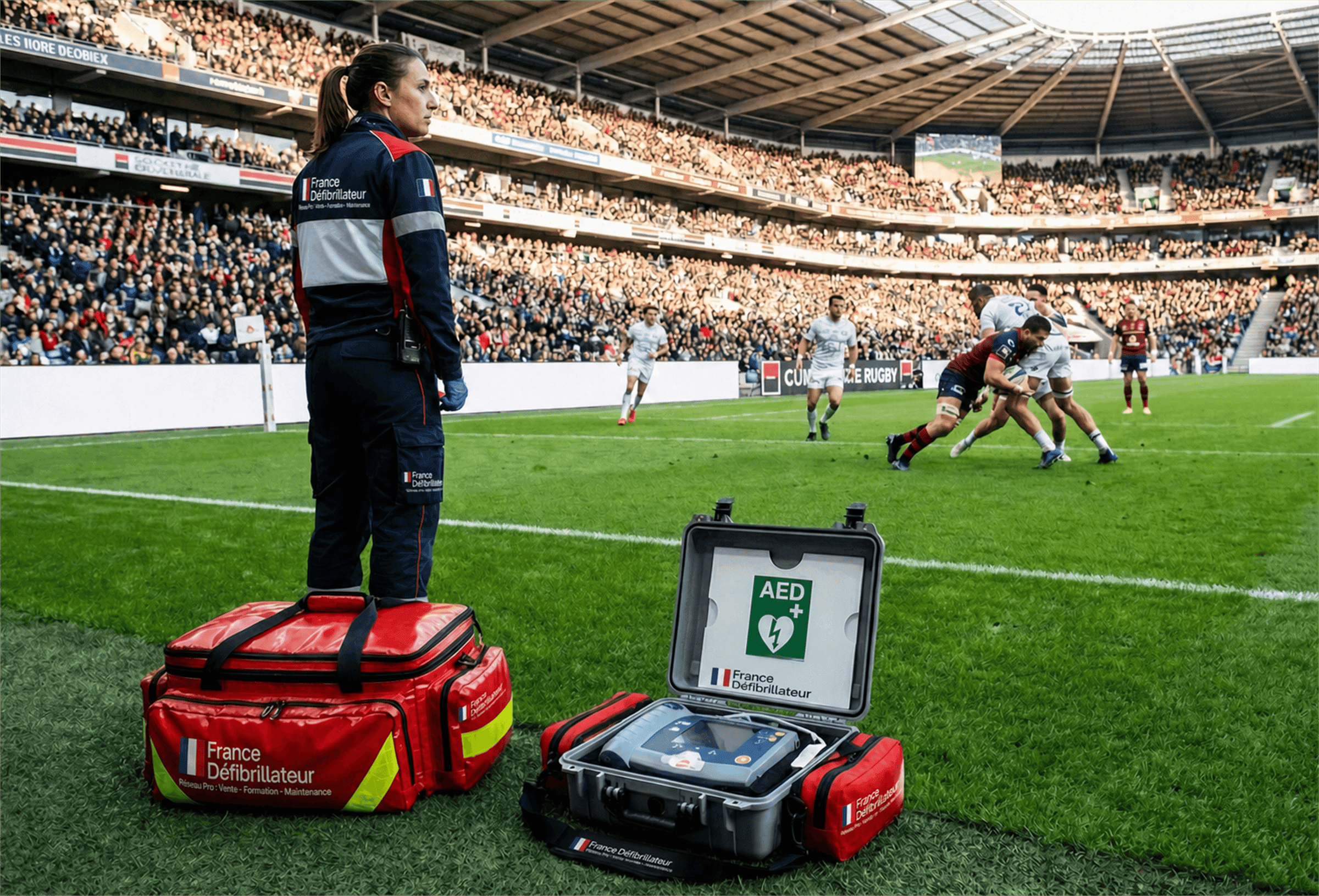
The arrival of the emergency services is a relief, but it is a fragile moment. Compressions are under way, the defibrillator is stuck to the chest and the bystanders are exhausted. A poorly prepared handover can interrupt compressions longer than necessary or lose useful information. Here is how to welcome the team, what to tell them in a few sentences, what stays in place and what to do with the device afterwards.
Do not stop anything until you are asked to
The most common reflex is to stop as soon as uniforms appear in the room. That is the mistake to avoid. Unless a rescuer explicitly asks you to stop, compressions continue and the defibrillator stays connected, whatever its voice prompts say.
Each minute without defibrillation reduces the chances of survival by about 10%. A handover pause that drags on, even in good faith, eats into that margin. The team on site takes over at its own pace: often a rescuer kneels beside you and places their hands on the sternum in your place while you lift yours, leaving no gap between two compressions.
What to tell them in a few sentences
The team has no time for a long story. It expects short facts in a simple order. One person should take care of this, preferably the one who saw the collapse or followed events most closely.
Rescuers want to know: the approximate time of the collapse, when compressions started, the number of shocks delivered if the device indicated it, and whether the person showed any sign of recovery. Add what you know about the victim: approximate age, discomfort before falling, known illness, treatment, presence of a pacemaker. If you do not know, say so simply, without guessing.
What stays in place, what comes off
The pads stay on the chest unless told otherwise. The medical team has its own equipment and will decide whether to replace the establishment's device or keep using it for a few moments.
Do not unplug anything and do not switch the defibrillator off on your own initiative. Depending on the model, the recording of the intervention stops or freezes when it is switched off, so it is better to let the rescuers handle the device. Simply clear the space: move furniture, push back onlookers, open doors and guide the team to the victim.
Useful tasks to give other bystanders
While one person hands over, others can help without getting in the way. One waits for the rescuers at the entrance and leads them in, another keeps onlookers at a distance, a third gathers the victim's belongings and papers if they are within reach.
A relative who is present needs particular attention. It is better to seat them aside with someone than to let them watch the care, and to note their name and number so the team can reach them.
| Step | Who handles it | What is done |
|---|---|---|
| Team arrives | A designated bystander | Leads them to the victim, clears the way |
| Compression handover | The current rescuer | Continues until the rescuer asks them to stop |
| Passing on the facts | The best-informed bystander | Time, duration of compressions, shocks, known history |
| Managing those around | An available bystander | Keeps onlookers away, supports relatives |
Preparing the handover before it happens
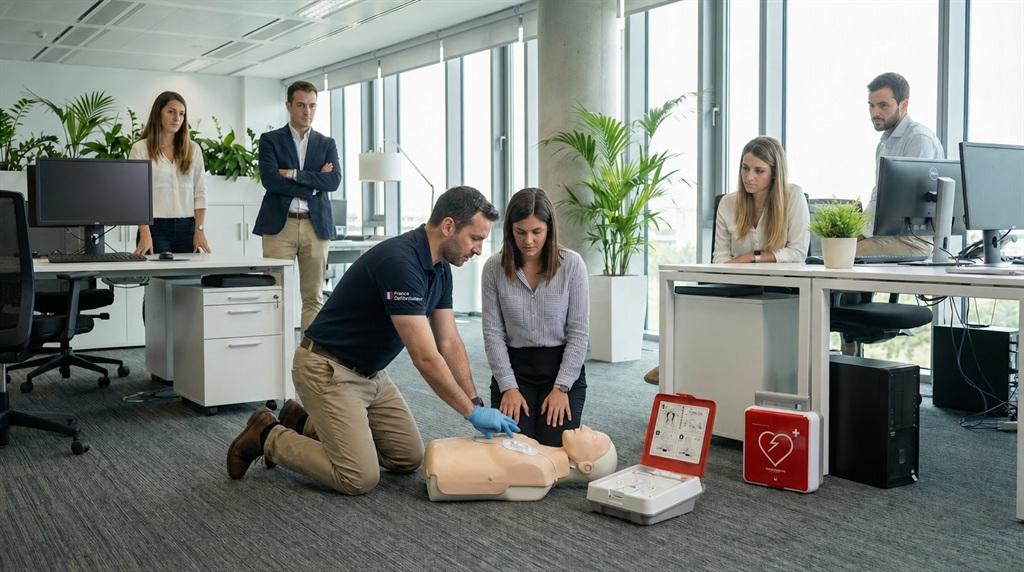
A site that has rehearsed the scene hands over much faster. An instruction posted near the device, recalling who welcomes the rescuers and who speaks, is enough to avoid improvisation. This split of roles can be practised during simulation exercises and training, where the team's arrival is also replayed.
Also plan clear access: unlocked door, available lift, precise address and a meeting point known to everyone. These details, trivial in normal times, save precious seconds when each one counts.
And the defibrillator after the rescuers leave
Once the victim has been taken care of, the device is no longer operational until it has been restored. Used pads must be replaced, the battery checked and the self-test run again. A device left in place without this gives a false sense of security.
The operator remains responsible for maintenance under article R. 5212-25 of the Code de la santé publique (French Public Health Code). Record the event in the register, keep the intervention data if the medical team or the manufacturer requests it, and have the consumables replaced before putting it back in open access. The risk of leaving a site without a device ready for use should be dealt with the same day, not the same week.
Frequently asked questions
Should I stop compressions when the rescuers walk in?
No. Keep going until a rescuer asks you to stop. They usually take over by placing their hands where yours are, with no break between two compressions. A pause that is too long reduces the victim's chances of survival.
Who should speak to the rescuers?
One person only, preferably the one who saw the collapse or followed events. They give short facts: time of the fall, start of compressions, shocks delivered, signs of recovery, known history. If they do not know, they say so without guessing.
Should the defibrillator be switched off when the rescuers arrive?
No, let the rescuers decide. The pads stay on and the device remains connected unless told otherwise. Depending on the model, switching off can affect the recording of the intervention. Let the team handle the device.
What should be done with the defibrillator after the intervention?
It must be restored before any new use: replace the used pads, check the battery, run the self-test. The operator remains responsible. Record the event in the register and restore access to a ready device as soon as possible.
Planning an AED project?
Purchase, rental from 50 EUR excl. VAT per month, installation with GéoDAE registration, servicing and training: our team replies within 24 hours.