Should You Move a Cardiac Arrest Victim?
Written by Cyrille GAGNAIRE, France Défibrillateur. Published on 17 November 2026.
When someone collapses in a corridor, a staircase or a shop aisle, the first instinct is often to move them to make them comfortable or shield them from onlookers. Yet in a cardiac arrest, every minute without defibrillation reduces the chances of survival by about 10%. Here is when moving the victim is truly justified, and how to limit the damage when it has to be done.
The principle: do not move the victim
Effective chest compressions require a flat, hard surface. The floor is perfectly suitable, whether tiles, wood or asphalt. The victim is therefore already in the best possible position, lying on their back.
Every move means stopping compressions, sometimes for long seconds. These interruptions deprive the brain and heart of blood flow that is already very low. The comfort reflex of placing the person on a sofa or in a nearby room should be avoided.
The same reasoning applies to onlookers. It is better to ask a bystander to form a perimeter and keep the crowd back than to move the victim out of sight.
First aid recommendations go in this direction: compressions start where the victim fell, as long as nothing directly threatens the rescuers. The priority is to restore blood circulation, even an imperfect one, then to defibrillate as early as possible.
The rare cases where moving is necessary
There are only a few situations where the safety of the rescuer or the victim takes precedence over continuous compressions. The danger must be real, immediate and impossible to remove otherwise.
Examples include a fire or spreading smoke, a risk of collapse, road traffic that nobody can stop, a gas leak or a live electrical area. In such cases, make the area safe first if possible, and move the victim only the strictly necessary distance.
A victim lying on a soft mattress, in a bed for instance, also justifies a move: compressions lose their effectiveness there. Slide them onto the floor or, failing that, place a rigid board under their back.
In every case, the decision is made within seconds and justified by a specific danger. Mere discomfort, a busy passage or a cold floor are never enough.
Moving without losing time
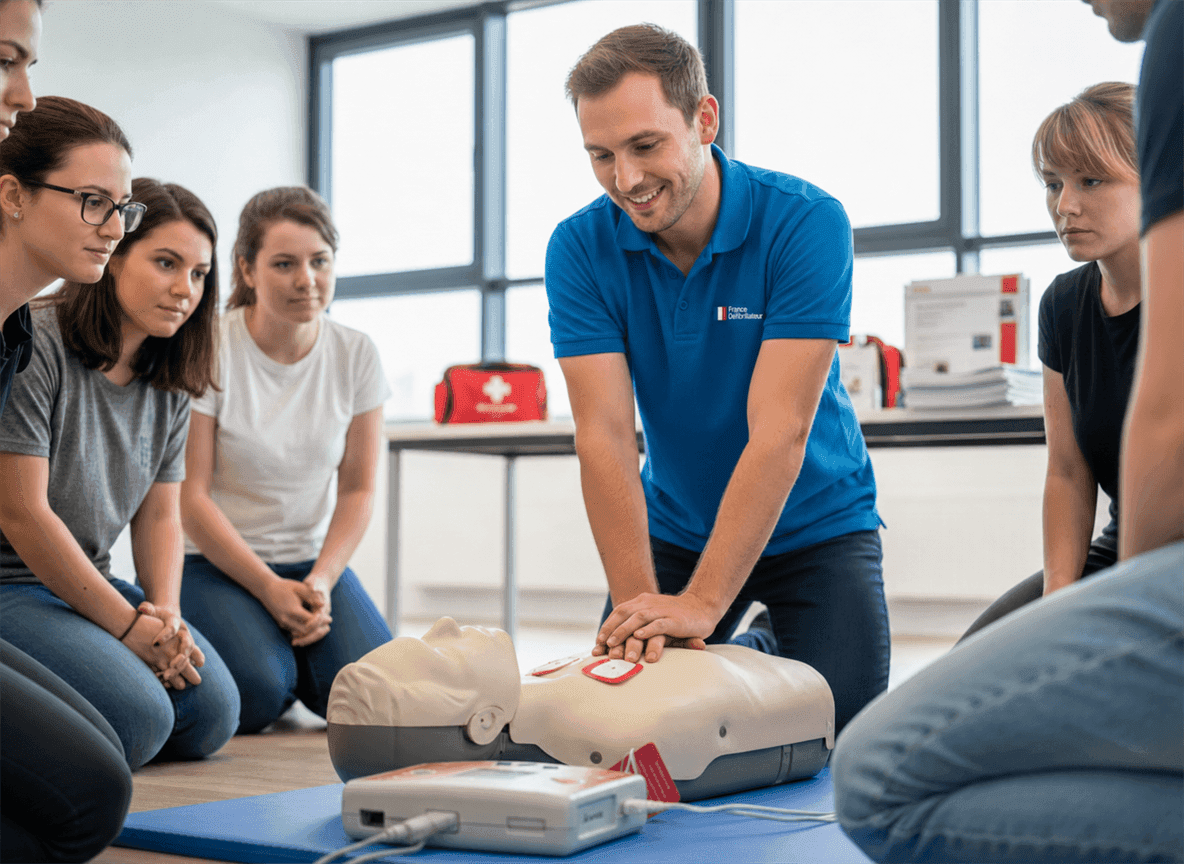
When moving cannot be avoided, prepare it before stopping compressions: identify the destination, clear the way and assign roles out loud. The route is as short as possible, pulling the victim by the wrists or by clothing at the shoulders, without lifting them.
As soon as the safe area is reached, compressions resume immediately. If there are several bystanders, one continues to alert emergency services and another brings the defibrillator directly to where the victim has been placed.
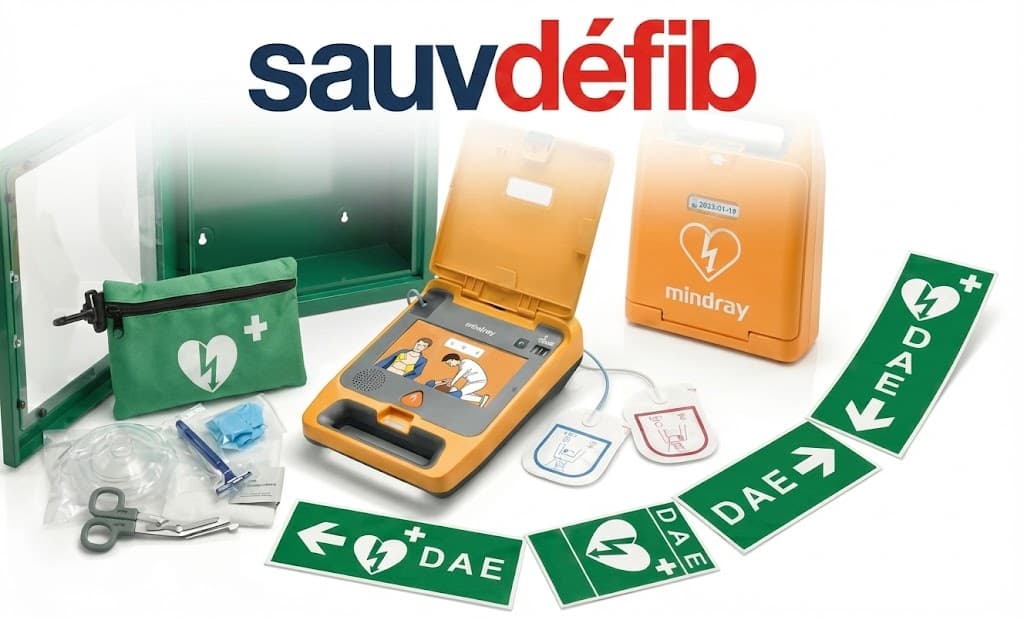
The defibrillator itself moves easily: an AED (automated external defibrillator, DAE in French) can be carried by hand. It is almost always the device that is brought to the victim, not the reverse.
Moving as a pair is faster and protects the rescuers' backs. If you are alone, do not seek perfection: a short, rough move is better than a careful manoeuvre that takes long.
Situations that cause hesitation
Some places raise real practical questions. The table below summarises what to do in the most common cases.
| Situation | What to do |
|---|---|
| Victim on a staircase | Move them down to the nearest landing if the slope prevents compressions, then resume at once |
| Victim in a bed | Slide them onto the floor, or slide a rigid board under their back |
| Victim on the road | Have traffic secured; move them only if nobody can do so |
| Victim in a crowded place | Do not move them; have bystanders clear a perimeter |
| Victim in a booth or tight corner | Take them out over the shortest distance that gives access to their chest |
Preparing the premises in advance
The operator of an establishment can anticipate these cases by planning circulation routes. A defibrillator placed on a clear path and signposted according to the arrêté du 29 novembre 2018 (the French order of 29 November 2018 on signage) saves bystanders from losing time searching for it, then crossing cluttered areas.
Internal drills are a good opportunity to address the subject: simulate a fall on a staircase or in a narrow corridor, and check that everyone knows where to make room. Staff training is the best protection against bad reflexes.
A well-placed AED remains the key: bring it to the victim, switch it on and follow the voice prompts, without interrupting compressions more than necessary.
Finally, an evacuation plan that is posted and known to staff helps tell a real danger from a mere nuisance. This distinction avoids unnecessary moves, and therefore lost minutes.
Frequently asked questions
Can you move a victim to shield them from the public?
No. Onlookers are not a danger to the victim. It is better to ask bystanders to form a perimeter around them, because every move interrupts compressions and delays defibrillation.
What should you do if the victim is in a bed?
A soft mattress makes compressions ineffective. Slide the victim onto the floor, or place a rigid board under their back, then resume compressions immediately after the transfer.
Should the defibrillator be brought to the victim, or the victim to the defibrillator?
Bring the defibrillator to the victim. An AED is light and portable, whereas moving a person in cardiac arrest stops compressions. One bystander fetches the device while the others stay with the victim.
What danger really justifies moving the victim?
A real, immediate danger that cannot be removed otherwise: fire, risk of collapse, traffic nobody can stop, a gas leak. The victim is then moved over the shortest possible distance.
Must compressions be stopped to move the victim?
Yes, moving requires it, but it should last as briefly as possible. Prepare the move before stopping compressions and resume as soon as the safe area is reached.
Planning an AED project?
Purchase, rental from 50 EUR excl. VAT per month, installation with GéoDAE registration, servicing and training: our team replies within 24 hours.