Moving or renovating: relocating a defibrillator without a gap
Written by Cyrille GAGNAIRE, France Défibrillateur. Published on 3 November 2026.
An office moves, a room goes under construction, a lobby is redesigned: the defibrillator is often the last item anyone thinks of, and sometimes the first to vanish into a cardboard box. Yet it must stay accessible and working throughout. Here is how to move it properly, who should handle it and what to update afterwards.
Why a poorly prepared move causes problems
A defibrillator is not ordinary furniture. It is declared at a precise address, marked by signs, mentioned in evacuation instructions and known to staff. As soon as it moves, all of this becomes wrong, sometimes without anyone noticing.
The risk is twofold. First, a device left in a storage room, out of reach the day someone collapses. Second, wrong information: a bystander or emergency service sent to an empty spot loses precious minutes, while every minute without defibrillation reduces the chances of survival by about 10%.
The problem is all the more insidious because it is invisible. On moving day everyone's mind is elsewhere: boxes, connections, keys, inventory. Nobody checks that the green sign with a white cross still points to a device actually behind the door.
Before departure: the inventory to draw up
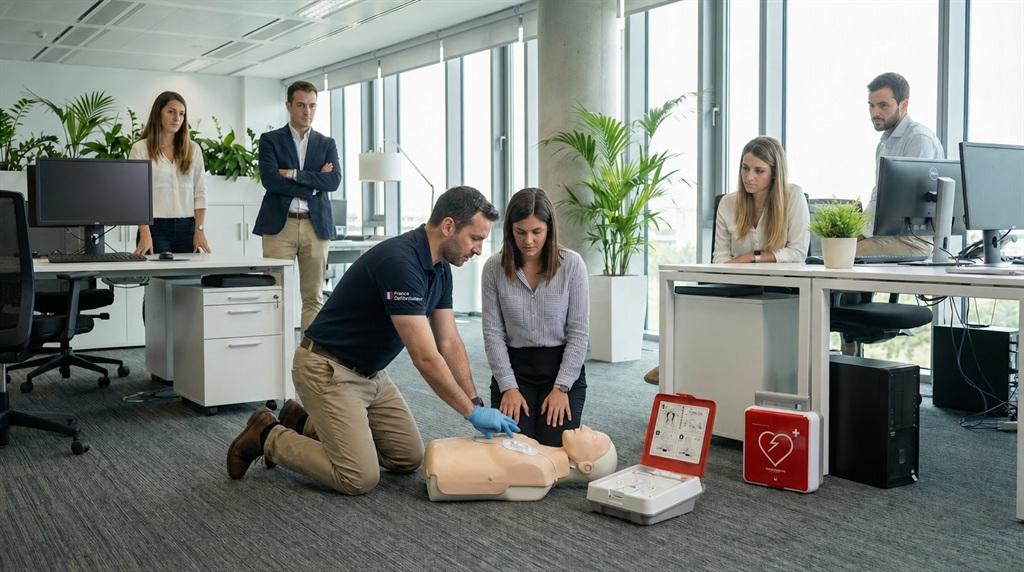
Start by listing what makes up the set: the device, its in-date electrodes and battery, the wall cabinet if there is one, the signs, the manual and the maintenance log. Note the expiry dates of consumables, because a move is a good moment to notice they are approaching.
Then appoint one person in charge of the operation. Without a name, everyone assumes someone else is handling it. If a defibrillator officer is already appointed, it is naturally them. Also warn your maintenance provider: they can advise on handling and adapt the contract to the new address.
Finally, take a few photos of the current location and think now about the future one: a visible spot, close to the entrance or a busy passage, accessible without a key and at a reasonable height. Choosing the location before arrival avoids dropping the device in a corner at random, then moving it again three months later.
Transporting the device without damaging it
A defibrillator tolerates shocks and extreme temperatures poorly. Carry it in its original case or bag, with electrodes and battery in place, rather than at the bottom of a box mixed with other equipment. Avoid leaving it for hours in a closed vehicle in full sun or in freezing weather.
On arrival, do not consider it ready before checking the status indicator. A device that has travelled must show its working indicator. If in doubt, if the indicator is abnormal or the casing shows a visible impact, contact the provider before putting it back into service.
If the device was left unattended for a few days, use common sense: check that the electrodes are still in their sealed package and that the battery is properly engaged. Never test the device on a healthy person and do not open the electrodes to try them.
What to update after the move
Moving triggers a series of updates, summarised in the table below. The GéoDAE declaration is mandatory: the address and exact location must therefore be corrected as soon as the device is installed, not a few weeks later.
Since maintenance remains the operator's responsibility (article R. 5212-25 du Code de la santé publique, the French Public Health Code), the operator must also check that the log follows the device and that the contract covers the new site.
| Item | Action | When |
|---|---|---|
| GéoDAE declaration | Correct the address and precise location | As soon as it is in place |
| Signage | Reinstall signs and directional arrows according to the arrêté du 29 novembre 2018 (French order of 29 November 2018) | Before reopening to the public |
| Maintenance log | Record the date of the move and the indicator check | The same day |
| Maintenance contract | Inform the provider of the new address | Before the move |
| Internal instructions | Tell staff the new location | On arrival |
During works: never leave a gap
When a worksite blocks the area where the device sits, you have two options. Either move it temporarily to a nearby, well-signed spot, free of dust and vibration. Or arrange a replacement device, for example rented, with plans starting from €50 excl. VAT per month, maintenance included.
In both cases, clearly indicate the temporary location to everyone using the site, including contractors. Remove old signs that would point to a demolished wall. If your building is an ERP (établissement recevant du public, a building open to the public), remember that the equipment obligation applies throughout opening hours, works included.
Also protect the cabinet and device from site dust. Electrodes and battery do not like moisture or splashes, and checking the indicator at the end of the works avoids unpleasant surprises.
Also record the works period and the temporary location used in the log: if questions arise later, this trace shows the operator ensured continuous coverage.
Frequently asked questions
Do I have to notify anyone when I move my defibrillator?
Yes. You must update the GéoDAE declaration with the new address and exact location. Also inform your maintenance provider, staff and, where relevant, the appointed officer. Outdated information can send responders to an empty spot.
Can I carry the device in my personal vehicle?
It is possible if you protect it from shocks, heat and frost. Keep it in its case with electrodes and battery, and do not leave it in a closed vehicle. On arrival, check the status indicator before considering it operational.
Should I replace electrodes and battery after a move?
Not systematically. Their lifespan depends on the expiry date: electrodes 2 to 5 years, batteries 3 to 5 years. Do use the move to check these dates and plan a replacement if the deadline is near.
What if the defibrillator is inaccessible during works?
Move it to a nearby, signed temporary spot, or install a replacement device, for example rented. Tell all occupants about the new point. The building must not be left without an accessible defibrillator while open to the public.
Does the maintenance contract follow the device to the new address?
It depends on the contract terms. Contact your provider before the move to confirm the new site is covered, checks will continue and the log will be updated. A simple amendment often avoids a break in follow-up.
Planning an AED project?
Purchase, rental from 50 EUR excl. VAT per month, installation with GéoDAE registration, servicing and training: our team replies within 24 hours.