Defibrillators in Warehouses and Logistics Sites
Written by Cyrille GAGNAIRE, France Défibrillateur. Published on 15 September 2026.
Warehouses and logistics platforms bring together several risk factors for cardiac health: repeated physical effort, handling equipment, shift work and long distances between workstations and help. Unlike a shop or an office open to the public, a warehouse is usually not a venue open to the public (ERP in French law), which removes the legal duty to install an automated external defibrillator (AED). That absence of a legal requirement does not exempt the operator from organising a fast response to sudden cardiac arrest.
A warehouse is not a public venue, but it remains a high-risk site
French law of 21 December 2018 and its implementing decree require a defibrillator in venues open to the public (ERP), from categories 1 to 3 since 1 January 2020 up to some category 5 venues since 2022. A warehouse closed to the public, used only by staff and carriers, generally falls outside this classification and is therefore not bound by the strict duty to register the device in Géo'DAE, France's national AED directory, which applies to equipped public venues.
This absence of a legal requirement should not be mistaken for an absence of risk. A site covering thousands of square metres, sometimes spread across several buildings, mechanically pushes help further away from the workstation where a collapse occurs. Every minute without defibrillation lowers the chances of survival by around 10 percent. Equipping the site therefore remains a prevention decision, even without a legal obligation.
Risk factors specific to logistics work
Warehouse work combines several factors that raise the likelihood of a cardiac event: carrying loads, order-picking pace, constant traffic of forklifts and pallet trucks, and temperature swings between ambient zones and cold rooms. Shift patterns common in logistics, such as two or three rotating shifts, add night-time exposure when fewer people are present on site.
Isolation at certain workstations, such as loading docks or high-level storage areas, also delays the detection of a collapse. A worker alone in a racking aisle can go unnoticed for several minutes, which strengthens the case for a network of visible rescue points covering several zones of the site.
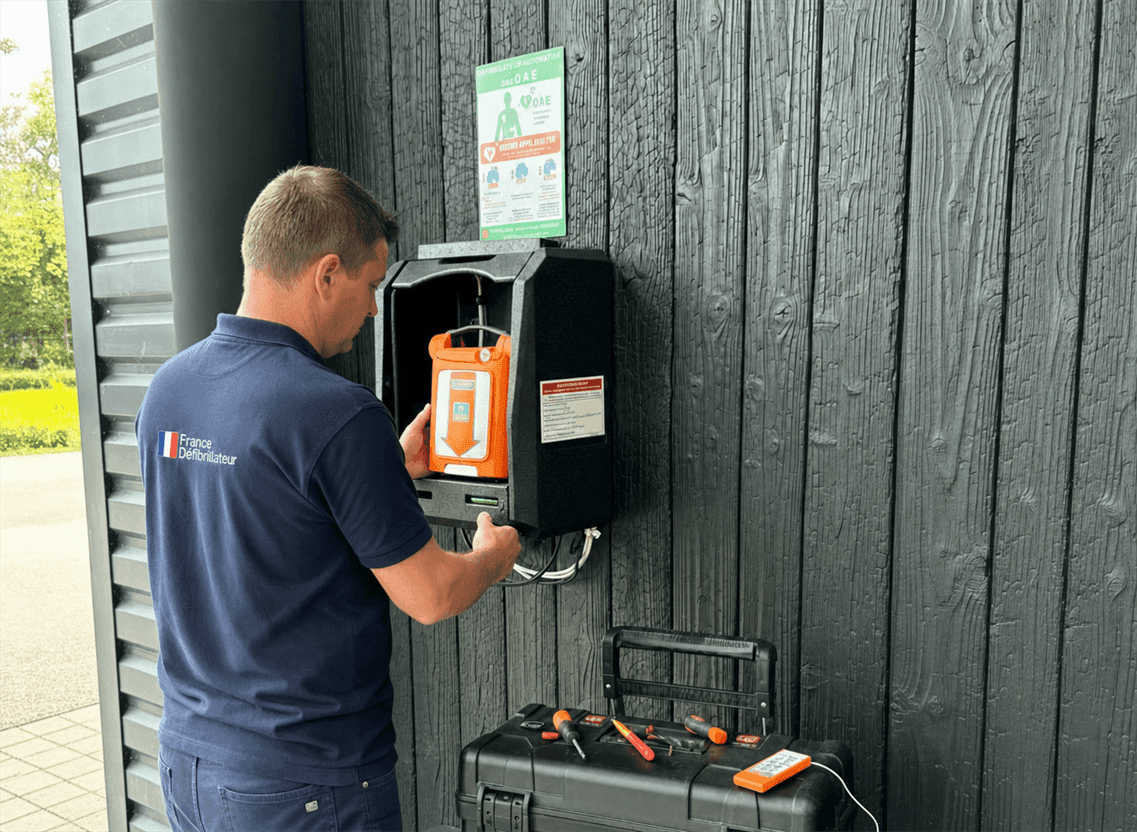
Which defibrillator for which site layout
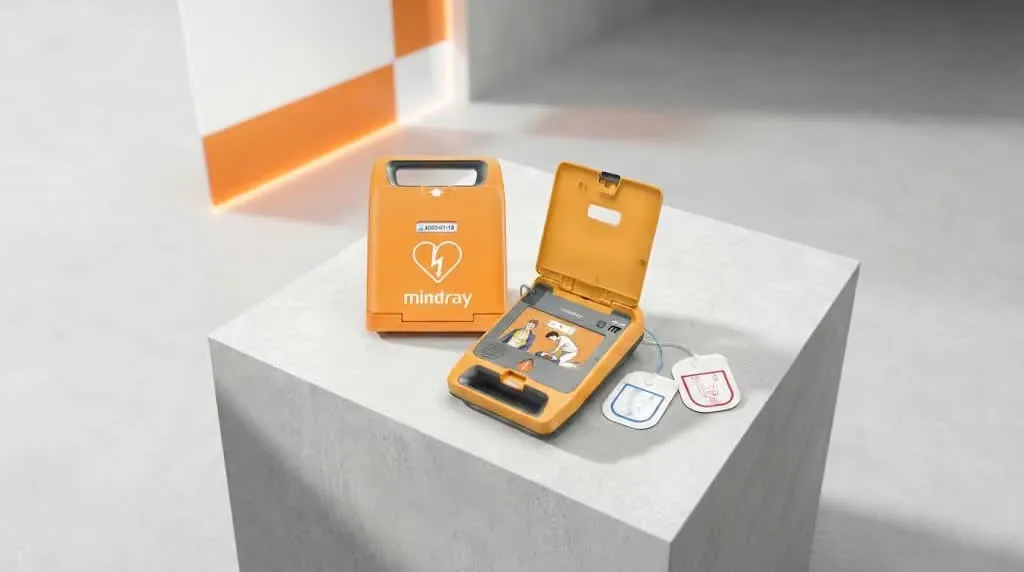
The choice of equipment depends less on the activity than on the layout of the site. A modest single-building warehouse can rely on one central wall cabinet, close to through-traffic areas. A multi-dock platform or a site spread across several halls needs several points, placed so that no workstation sits more than a three-minute walk from a device.
| Site layout | Recommendation |
|---|---|
| Single-building warehouse, under 3,000 sq m | One AED (automated external defibrillator) in an indoor cabinet, near reception or the security desk |
| Multi-dock platform or several halls | One device per building or per zone over 3,000 sq m, signposted from the main aisles |
| Continuous operation (two or three shifts) | A device accessible at all times, including at night, with a trained on-call responder |
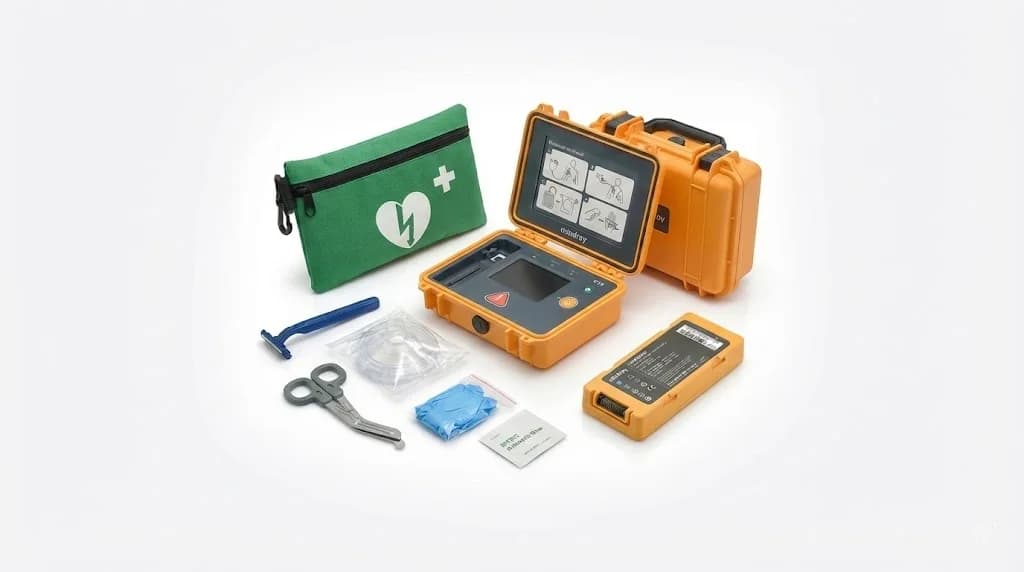
| Outdoor dock and storage area | A heated outdoor cabinet, resistant to weather and temperature swings |
Where to install it so it helps within five minutes
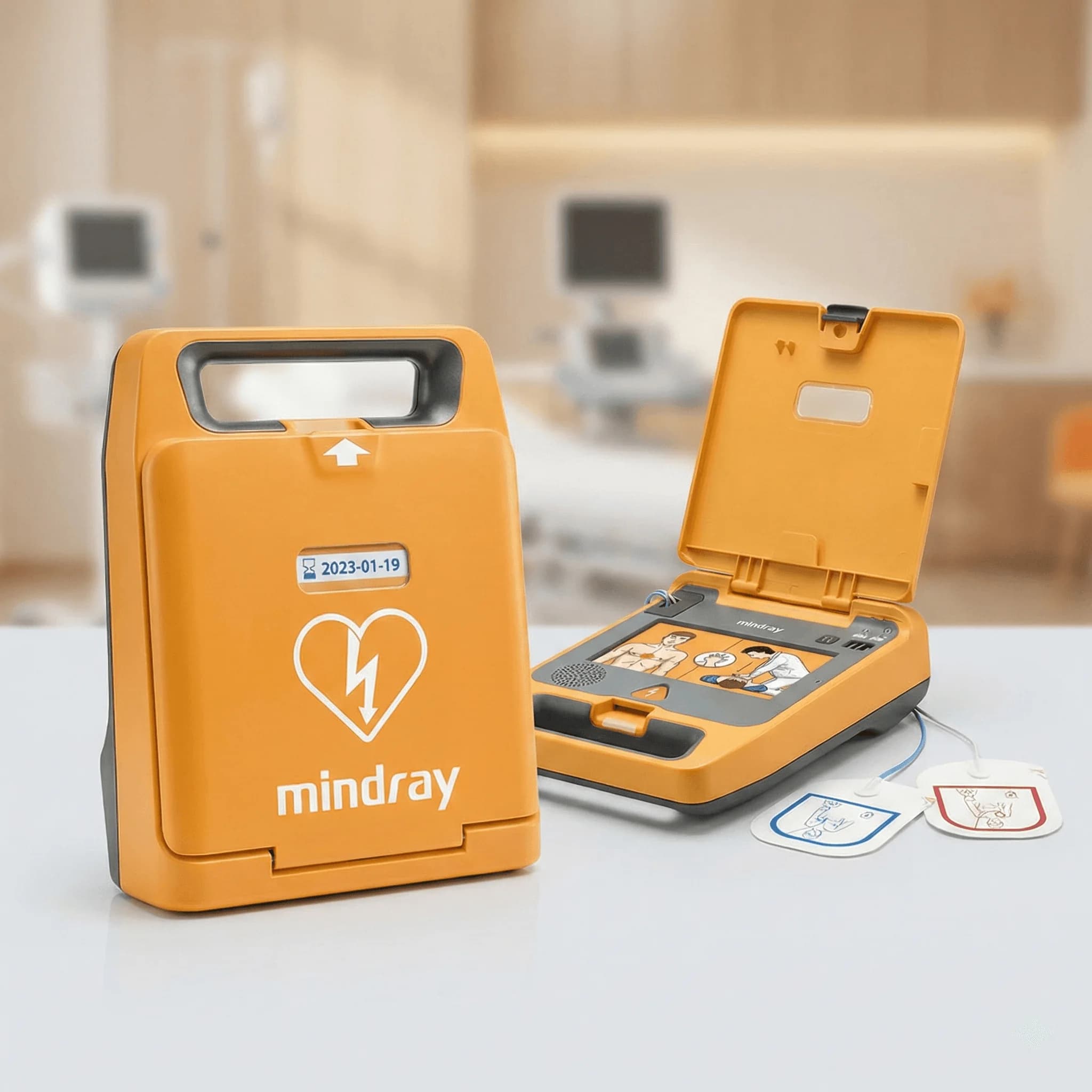
The device must stay visible and accessible without a code or a key, as with any defibrillator. In a warehouse, the strategic points are the security desk or reception, break areas where staff gather, the edges of loading docks where forklifts circulate, and the main aisles serving the whole storage area. Signage compliant with the French order of 29 November 2018 helps spot the device from dozens of metres away, an advantage in volumes as large as a warehouse.
Training rescuers on every shift
A defibrillator only helps if someone knows how to raise the alarm and start chest compressions while waiting for it. Training workplace first-aid responders on every shift, including night and weekend teams, ensures a trained responder is always nearby. Regular refresher training, combined with alert drills, keeps the actions from being forgotten between incidents.
The alert procedure should be displayed near every device and included in the induction of new employees and temporary agency workers, who make up a large share of this workforce. A site map showing defibrillator locations, shared with local emergency services, also helps them respond faster when called.
Maintenance: particular vigilance in warehouses
A warehouse environment puts more strain on equipment than an air-conditioned office: dust, temperature swings, vibration from passing vehicles. Checking the self-test indicators should be part of the security desk's routine, with more frequent visual checks than in an office building. Maintenance remains the operator's responsibility, as with any AED.
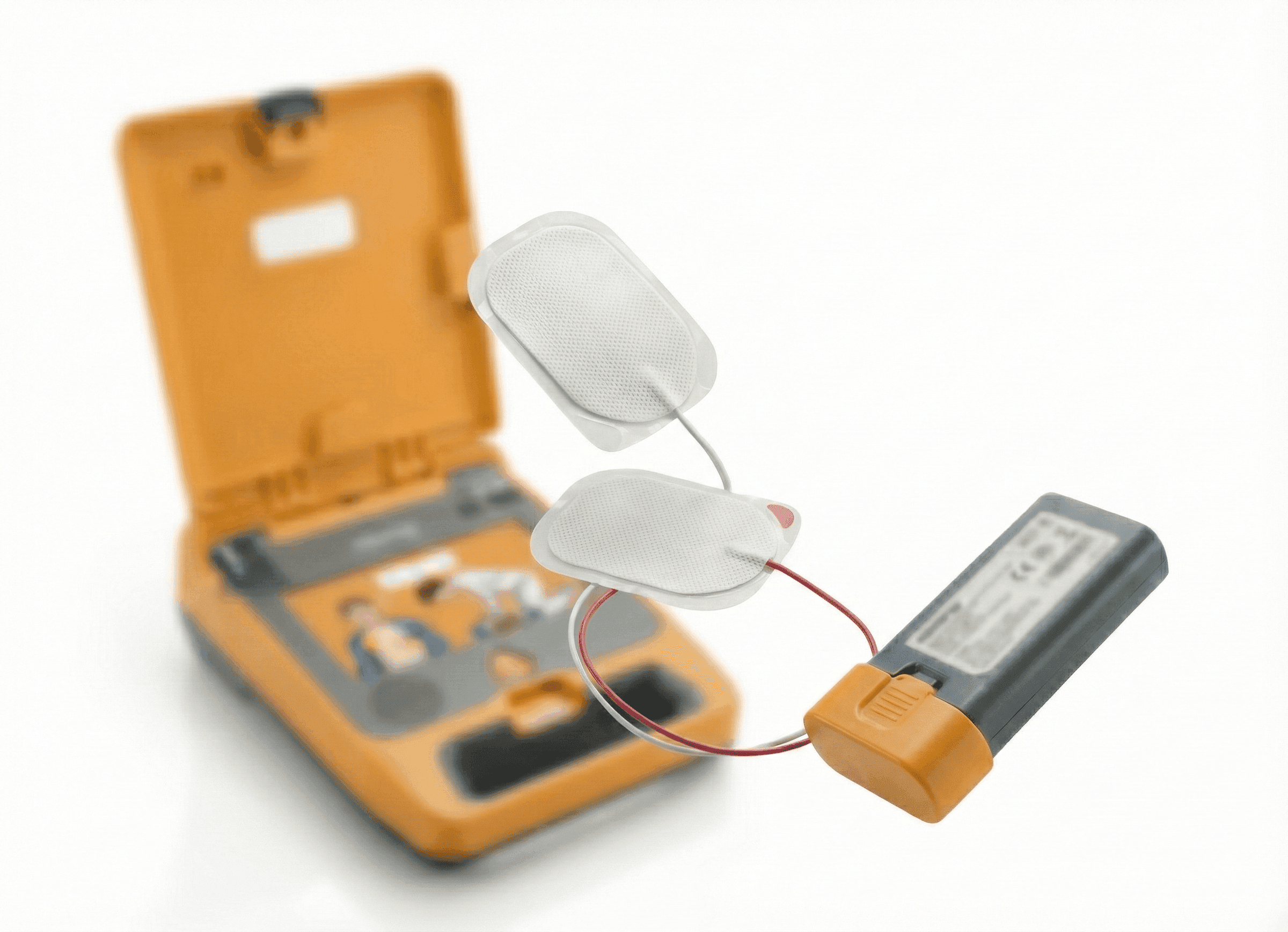
Pads need replacing every two to five years and batteries every three to five years, sooner if the device sits in an outdoor cabinet exposed to a dock's temperature swings. A maintenance log kept by the site's security or maintenance team helps track these deadlines and schedule replacements before an alert is needed.
Frequently asked questions
Is a warehouse required to install a defibrillator?
No, unless the site is open to the public and therefore falls under public-venue (ERP) rules. Most warehouses and logistics platforms, used only by staff and carriers, fall outside that category. Equipping the site is still advisable given the risks specific to the activity: physical strain, handling equipment, shift work and long distances to help across large surfaces.
How many defibrillators does a large logistics platform need?
There is no single fixed rule for a site not subject to public-venue regulations. Common practice is that no workstation should be more than a three-minute walk from a device, which often means installing one defibrillator per building or per zone over three thousand square metres on large platforms.
Does a warehouse defibrillator need to be registered in Géo'DAE?
Registration in Géo'DAE, the national AED directory, is mandatory for public venues equipped with a defibrillator. A warehouse that is not a public venue is not legally bound to register, but nothing prevents doing so voluntarily: it helps emergency services locate the device during an intervention, including outside public opening hours.
Does cold storage damage a defibrillator?
Batteries and pads tolerate large temperature swings poorly, which are common near docks or cold rooms. A heated outdoor cabinet or a temperature-controlled indoor spot extends their lifespan, between two and five years for pads and three to five years for batteries. Regularly checking the self-test indicators remains the best day-to-day marker.
Who trains temporary agency workers in life-saving actions on a logistics site?
The company using the site remains responsible for safety there, including for agency staff. A short induction briefing, combined with the alert procedure displayed near every defibrillator, lets everyone react even without full first-aid training. Agency workers present for longer periods can then follow dedicated training.
Planning an AED project?
Purchase, rental from 50 EUR excl. VAT per month, installation with GéoDAE registration, servicing and training: our team replies within 24 hours.