Defibrillators in Shops: Legal Duties and Best Practices
Written by Cyrille GAGNAIRE, France Défibrillateur. Published on 9 August 2026.

A city-centre boutique, a neighbourhood convenience store or a large supermarket welcome staff and customers every day in a place where sudden cardiac arrest can strike without warning. French regulation already requires a defibrillator in many public-facing establishments, and many shop owners wonder where they stand. Here are the duties to know, the criteria for choosing equipment, and good practices for equipping a store usefully.
Shops are busy places exposed to cardiac risk
A shopping centre, a neighbourhood convenience store or a city-centre boutique welcome anywhere from dozens to several thousand people every day, staff and customers combined. In France, around 50,000 cardiac arrests occur each year, most of them outside a hospital setting, in ordinary places such as a shop or a shopping arcade.
Every minute that passes without defibrillation reduces the chances of survival by roughly 10 percent, while emergency services take on average several minutes to arrive on site. Within that window, an accessible defibrillator and a bystander able to act often make the difference between life and death.
Legal duties depending on the size of the shop
The duty to install a defibrillator depends on the ERP category (établissement recevant du public, a public-facing establishment) the shop belongs to, calculated from the number of people it can accommodate. French law 2018-527 and its implementing decree 2018-1186 made an automated external defibrillator compulsory for ERP categories 1 to 3 from 1 January 2020, then for category 4 from 2021.
Some category 5 ERPs, including certain smaller shops, have been concerned since 2022, under thresholds set by ministerial order and specific to each type of activity. A shopping centre or a large supermarket generally falls into the more demanding categories, while a small boutique may stay in category 5 below the threshold that triggers the duty to equip. In every case, the operator remains responsible for checking the exact category and the date from which the duty applies to their activity.
Automatic or semi-automatic defibrillator: which one for a shop?
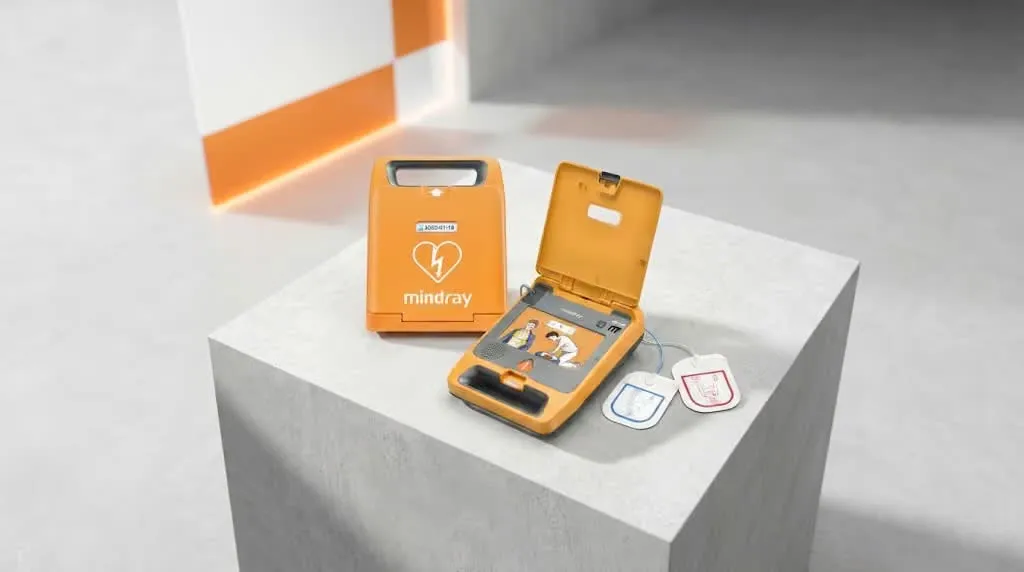
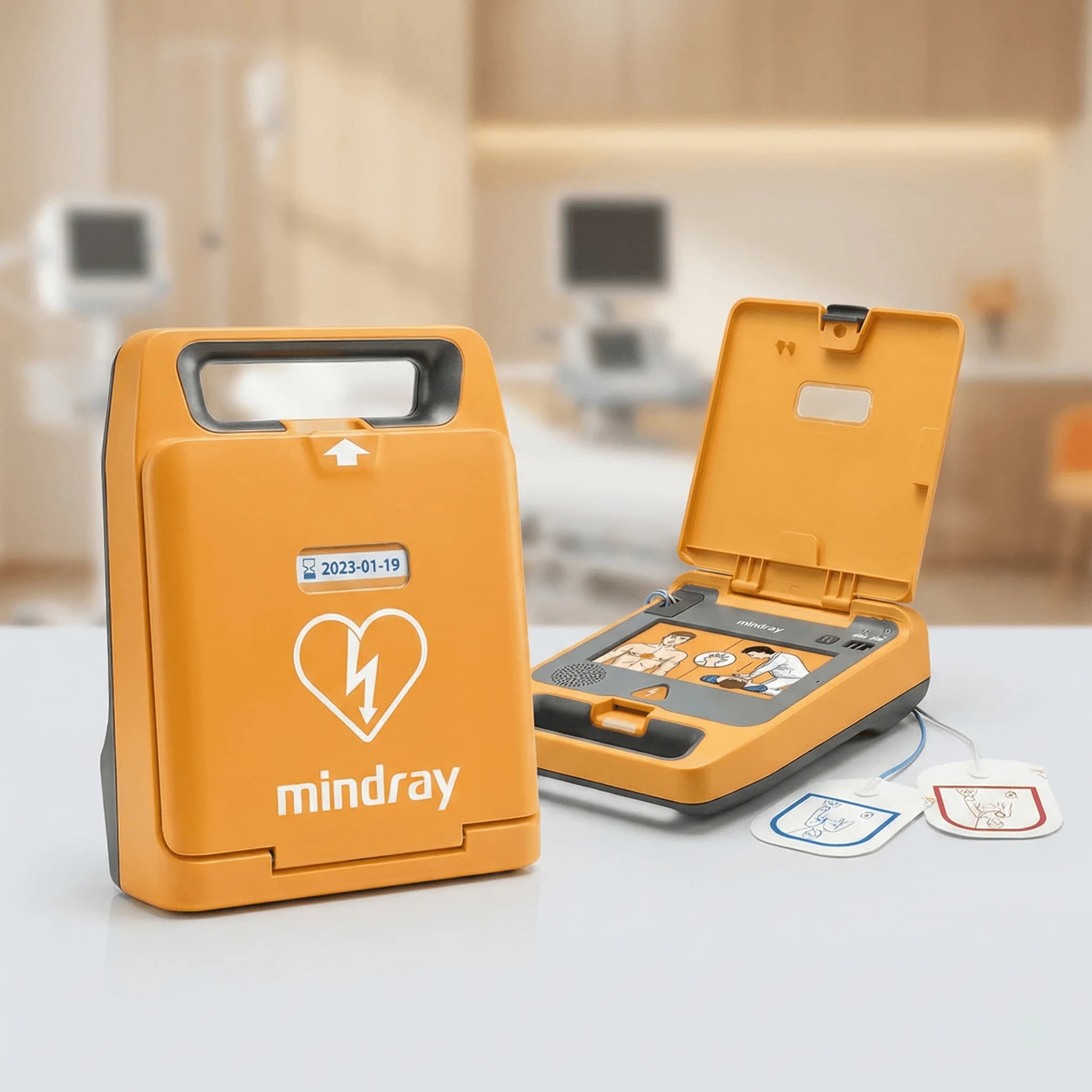
The choice between an automatic and a semi-automatic device mainly depends on how well trained the staff on site are. An automatic defibrillator (AED) analyses the heart rhythm and delivers the shock on its own if needed, which suits a shop where teams rotate often and are not all trained in first aid.
A semi-automatic model asks the user to confirm the shock after the voice prompt, an option suited to teams trained on a regular basis. Both types of device guide the user by voice from start to finish, and their use remains open to any bystander, trained or not, as provided for under French regulation.
Where to install the cabinet and how to signal the device
The defibrillator's location must stay visible and accessible at all times during opening hours, near the main entrance or a central passage rather than in a stockroom or a closed office. An outdoor wall-mounted cabinet suits a street-facing front, while an indoor cabinet is enough inside a heated shopping arcade.
Signage follows the ministerial order of 29 November 2018 (arrêté du 29 novembre 2018): the standard pictogram must be visible from the store's main circulation routes, complemented with directional signs if needed. Once installed, every defibrillator must be registered in the national GéoDAE database, which lets emergency services locate the nearest device when a call comes in to the emergency number.
Budget and maintenance: what a defibrillator costs a shop
A shop's budget depends on the choice between buying and renting. A complete automatic defibrillator pack, including wall cabinet and signage, starts at 350 euros in the catalogue, up to more than 2,000 euros for more complete models. Rental starts at 50 euros excl. VAT per month, maintenance included, a formula that avoids paying the device's full price upfront.
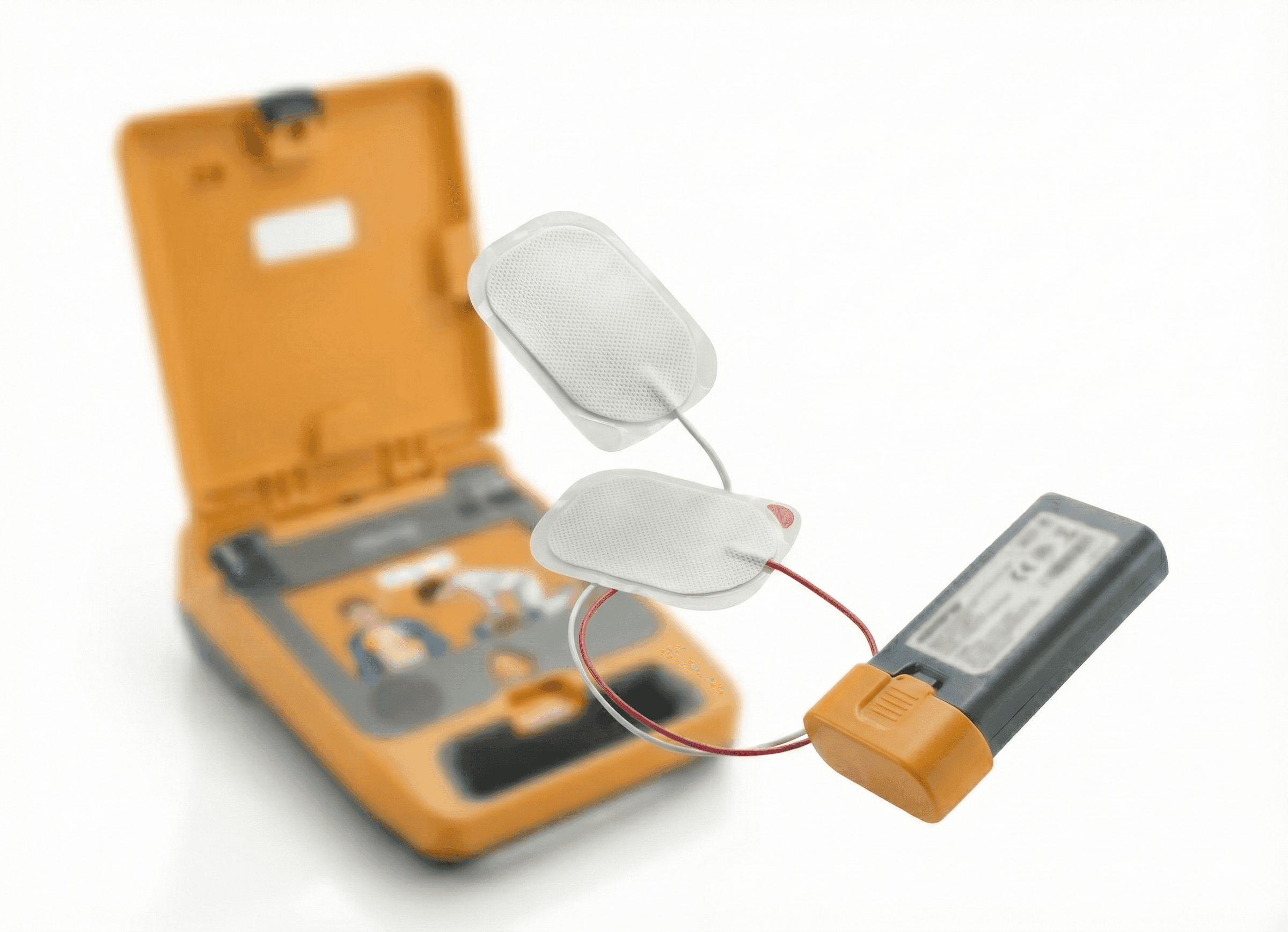
Electrode pads are replaced every 2 to 5 years depending on the model and cost between 14 and 240 euros a pair, batteries every 3 to 5 years for a price between 10 and 500 euros. A well-maintained device then lasts 8 to 10 years, sometimes longer.
| Item | Frequency | Indicative cost |
|---|---|---|
| Buying a complete AED pack | One-off | from 350 € incl. VAT |
| Rental with maintenance included | Monthly | from 50 € excl. VAT/month |
| Replacement electrode pads | Every 2 to 5 years | 14 € to 240 € a pair |
| Battery | Every 3 to 5 years | 10 € to 500 € |
Training staff: equipment alone is not enough
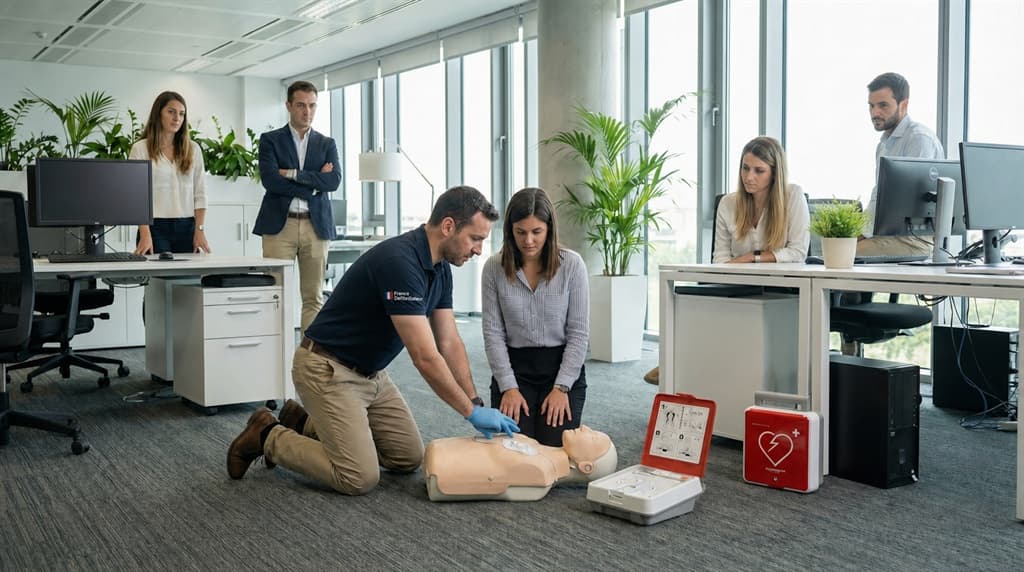
Installing a defibrillator is not enough if no one on the team knows how to react before emergency services arrive. A short first-aid awareness session, covering the emergency call, chest compressions and use of the defibrillator, lets a staff member gain the decisive minutes before professional help steps in.
In a shop where hours and teams rotate, it is better to train several staff members across different shifts rather than a single person, so that a bystander able to act is present during opening hours. This training should be renewed periodically to keep the reflexes sharp, in particular quickly recognising a cardiac arrest and the recovery position in case of loss of consciousness without a confirmed cardiac arrest.
Frequently asked questions
Is a small shop required to install a defibrillator?
It depends on its ERP category (établissement recevant du public) and the number of people it can accommodate. Shops classified in categories 1 to 4 have been concerned since 2020 and 2021, and some category 5 ERPs since 2022, under thresholds specific to each activity. A small boutique below these thresholds has no legal duty, but can equip voluntarily to protect staff and customers.
Who must maintain a shop's defibrillator?
Maintenance falls to the shop's operator, under article R. 5212-25 of the French public health code (Code de la santé publique). It includes monitoring the device's self-tests, replacing electrode pads and the battery before their expiry date, and keeping a record of the checks carried out on the equipment.
What should be done after a defibrillator has been used in the store?
The used electrode pads and battery must be checked and replaced if needed, and the device confirmed operational before it is put back into service. A report of the intervention is useful for the establishment's records, and depending on the model, the episode's data can be transmitted to the manufacturer.
Must a defibrillator installed in a shopping centre be registered?
Yes, every automated external defibrillator installed in a place accessible to the public must be registered in the national GéoDAE database. This registration lets emergency services locate the nearest device when an emergency call comes in and makes it easier for the operator to keep track of its condition.
Can a customer use a shop's defibrillator without training?
Yes, French regulation allows any person, trained or not, to use an automated external defibrillator in the event of a cardiac arrest. The device guides the user by voice at every step and only delivers a shock if the heart rhythm analysis justifies it, which makes its use safe for an untrained bystander.
Planning an AED project?
Purchase, rental from 50 EUR excl. VAT per month, installation with GéoDAE registration, servicing and training: our team replies within 24 hours.