Cardiac Arrest in Children: The Life-Saving Steps
Written by Cyrille GAGNAIRE, France Défibrillateur. Published on 22 September 2026.
Around 50,000 people suffer a cardiac arrest in France every year, and only a minority are children or infants. The causes often differ from those seen in adults, which changes how a rescuer should react and what equipment to use. Recognising the signs quickly, calling for help without delay, and adapting the technique to the child's size all shape the chances of recovery. An automated external defibrillator (AED) still applies, ideally with suitable pads.
A mechanism often different from that of adults
In adults, cardiac arrest most often starts in the heart itself, following cardiovascular disease. In children, and even more so in infants, the scenario is usually reversed. The heart tends to stop as a reaction to prolonged oxygen deprivation, caused by an airway obstruction, drowning, smoke inhalation, or severe respiratory distress. A cardiac arrest with a purely cardiac origin remains rare before adolescence, except when a heart condition is already known or during intense physical effort in a young athlete.
This difference in mechanism has an important practical consequence. Clearing the airway and ventilating the child matters as much as chest compressions, whereas in adults compressions take priority from the first minute. A choking, drowning, or inhaling child must be treated as a respiratory emergency first, before escalating, if the situation worsens, to full cardiac resuscitation.
Recognising cardiac arrest in a child or infant
The first step is to check whether the child responds. For an infant, gently stimulate the sole of the foot or call out while touching them; for an older child, speak to them while gently shaking their shoulders. A complete lack of response combined with abnormal or absent breathing signals cardiac arrest. Irregular, noisy, or widely spaced breathing movements in the first seconds should not be mistaken for effective breathing, they often accompany the very start of the arrest and must not delay the alert.
In infants, unusual skin colour, unusual limpness, and the absence of crying or spontaneous movement are signs to take seriously. When in doubt, it is better to call for help and start resuscitation than to wait for confirmation that will not come in time. First aid given in good faith does not expose the rescuer to liability.
What to do without waiting for help to arrive
When a child or infant does not respond and is not breathing normally, the alert must be given immediately, calling emergency services and putting the phone on speaker to follow their instructions while acting. If another person is present, they should go and fetch a defibrillator while the first rescuer starts resuscitation.
Resuscitation combines ventilation and chest compressions, with a technique adapted to the child's size: one hand for a child, two fingers or both hands encircling the chest for an infant. The pace stays steady, without prolonged interruption, until help or a defibrillator arrives. Emergency call handlers guide by phone a bystander who has never practised these gestures, which allows effective action even without prior training.
The defibrillator, usable from the youngest age
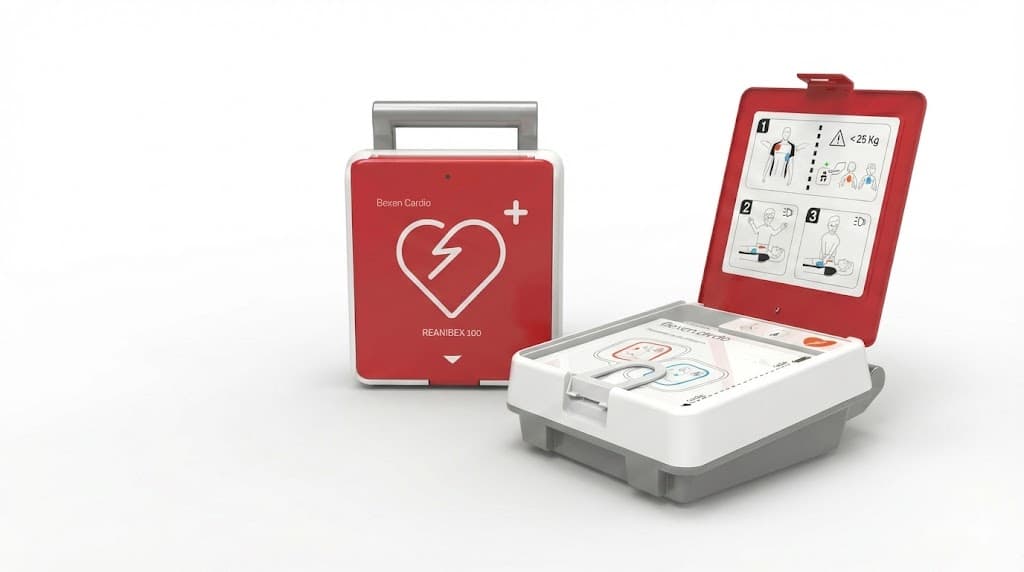
Contrary to a common belief, a child's age does not prevent the use of an automated external defibrillator. The device guides the rescuer by voice from start to finish and analyses the heart rhythm itself before proposing a shock, it never delivers an unnecessary shock. The only adaptation concerns the pads, whose size and delivered energy differ depending on the child's build.
Where available, paediatric pads reduce the shock energy and are placed differently on a small chest. Many nurseries, schools, and associations do not have them, since there is no general requirement to include them in the defibrillator kit. In their absence, adult pads should be used without hesitation rather than giving up on the shock, a victim in cardiac arrest has far more to lose from not being defibrillated than from receiving a shock sized for an adult.
| Age or build | Recommended pads | Point of care |
|---|---|---|
| Infant (under one year) | Paediatric pads if available | One pad on the chest, the other on the back to avoid contact between them |
| Child (about 1 to 8 years) | Paediatric pads if available, otherwise adult pads | Check that the pads do not overlap on a narrow chest |
| Child over 8 years or larger build | Adult pads | Same placement as for an adult |
Raising awareness among parents and childcare professionals
Nurseries, schools, leisure centres, and clubs that welcome children benefit from training their staff in life-saving gestures adapted to this age group, beyond general first aid courses. A short awareness session, focused on recognising the signs and knowing what to do for an infant or young child, strengthens a whole team's readiness for a situation that is rare but always feared.
Parents and grandparents can follow the same introductory courses, offered by approved civil safety associations. They do not replace an immediate call for help, but they give the confidence needed to act without delay on the day these gestures become necessary, which remains, statistically, the rarest situation a parent could face.
Frequently asked questions
From what age can a defibrillator be used on a child?
There is no minimum age for using an automated external defibrillator. The device analyses the heart rhythm before proposing a shock and never delivers one to a rhythm that does not need it. Paediatric pads, when available, adapt the delivered energy to the child's build, but their absence should never prevent using the device with adult pads instead.
What if the defibrillator has no paediatric pads?
Use the adult pads supplied with the device rather than giving up on defibrillation. Place them so they do not touch, one on the chest and the other on the back if the chest is too narrow to fit both at the front. A shock delivered with adult pads is still preferable to no defibrillation at all.
How should chest compressions be adapted for an infant?
For an infant, two fingers placed at the centre of the chest, or both of the rescuer's hands encircling the chest, replace the palm used on an adult. Compressions must stay suited to the infant's small chest, without interrupting the gesture longer than needed to let a defibrillator work once it is available.
Must nurseries and schools have a defibrillator?
The equipment requirement depends on the category and attendance of the establishment open to the public, following the timetable set by the 2018 law and its implementing decrees. Beyond the regulatory requirement, many establishments welcoming children choose to equip themselves and train their staff, as a precaution against a rare but serious emergency.
Why does ventilation matter more for children than adults?
A child's cardiac arrest most often results from prolonged oxygen deprivation rather than a failure of the heart itself. Restoring effective ventilation, alongside chest compressions, helps address the underlying cause of the collapse, which is why care differs slightly from that given to an adult in cardiac arrest of cardiac origin.
Planning an AED project?
Purchase, rental from 50 EUR excl. VAT per month, installation with GéoDAE registration, servicing and training: our team replies within 24 hours.