Safety register and defibrillator: what to record and how often
Written by Cyrille GAGNAIRE, France Défibrillateur. Published on 28 July 2026.
A defibrillator that is installed but never documented creates a twofold problem: nobody really knows whether it works, and nothing proves it has been maintained. Yet the paperwork is the cheapest part of the obligation. A few well kept sheets, one file per device and a single entry in the safety register are enough to show that the premises have done what was required. Here is what to record, where to file it and how often to check it.
What the regulations expect from the operator
Décret n° 2018-1186 du 19 décembre 2018 (the implementing decree), issued under articles L. 123-5 and L. 123-6 of the Code de la construction et de l'habitation (French construction and housing code) as created by loi n° 2018-527 du 28 juin 2018, requires French public-access buildings (ERP) to install an automated external defibrillator, or DAE (AED), in a place that is visible to the public and accessible at all times. The timetable was phased: 1 January 2020 for categories 1 to 3, 1 January 2021 for category 4, and 1 January 2022 for the category 5 premises concerned. The same text makes the owner of the DAE responsible for the maintenance and quality checks required for medical devices, whether they are entrusted to the manufacturer, to a third party acting under the owner's responsibility, or carried out in house.
Article L. 5212-1 of the Code de la santé publique (French public health code), as worded following ordonnance n° 2022-582 du 20 avril 2022, adds a general duty: the operator of a medical device covered by the text must ensure that its performance is maintained and that servicing takes place. The same article provides for penalties in the event of a breach. Maintaining the device and proving that you maintain it are not alternatives: on the day of an inspection or an incident, your records answer on your behalf.
The safety register, the starting point of any inspection
The ERP safety register is the first document a fire and safety commission opens. The defibrillator deserves its own entry from the moment it is installed: commissioning date, brand and serial number, exact location described in plain language, name of the maintenance provider and contact details of the internal officer. If the device is shared between several ERP on the same site or under common management, which décret n° 2018-1186 allows, list the premises covered.
From then on, the register records events only: maintenance visit, replacement of electrodes or battery, relocation of the device, actual use, first aid training session. Each line points to the device file, which holds the supporting document. This split keeps the register readable.
The device file, filed by serial number
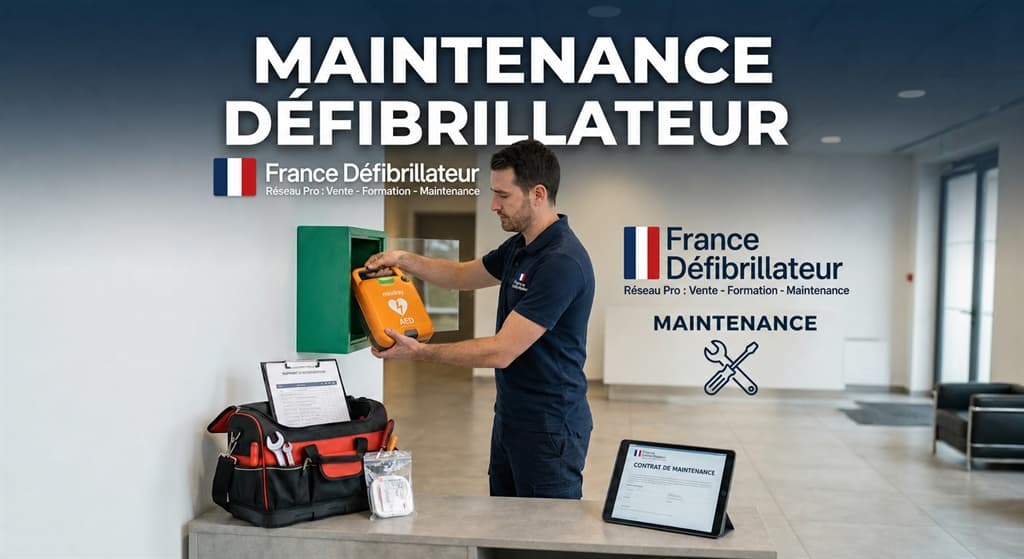
The device file brings together everything relating to one specific DAE, from the delivery note to its disposal. One divider per device, identified by serial number rather than by building, avoids confusion. A digital copy shared with the technical team is useful, provided the paper instructions stay next to the wall cabinet.
The table below sets out what you should be able to produce in under five minutes, and how often each item needs checking.
| Item to keep | Where to file it | Checking frequency |
|---|---|---|
| Purchase invoice or rental agreement, declaration of conformity | Device file | At commissioning, then whenever the device is changed |
| Manufacturer's instructions and installation sheet | Device file, copy near the cabinet | Annual check that they are present and legible |
| Visual reading of the self-test | Patrol sheet, entered in the safety register | Weekly, monthly at the very least |
| Electrode expiry date | Device file and label on the cabinet | Monthly check, replacement every 2 to 5 years |
| Battery end-of-life date | Device file | Monthly check, replacement every 3 to 5 years |
| Maintenance intervention reports | Device file, noted in the register | At every visit, at least once a year |
| Geo'DAE registration and updates | Device file | At installation, then after every change |
| Staff training certificates | Safety register | Annually, tracking refresher courses |
| Report following actual use | Device file | Every time the device is deployed |
Reading the self-test, the best value check of all
A DAE runs regular self-tests on its own and reports its status through an indicator light or an audible signal. This check costs nothing: you simply look and write it down. Build the walk past the cabinet into an existing patrol, using a dated and initialled sheet that records three things: indicator light normal or not, accessories present in the carry bag, cabinet unobstructed and signage visible. A printed monthly sheet slipped into the file is worth more than a daily check that leaves no trace.
If the light turns red or the device sounds an alert, the response must be written down before the incident happens: who calls the provider, within what time frame, and what temporary notice goes on the cabinet. Record the fault, the time of the call and the date the device returns to service. Every minute without defibrillation cuts the chances of survival by around 10 per cent, and an out-of-service device that is not flagged wastes exactly that time.
Managing consumable deadlines
Electrodes are generally replaced every 2 to 5 years, batteries every 3 to 5 years, and the device itself lasts 8 to 10 years or more. Enter every expiry date in a single table and set a reminder in the shared calendar three months ahead, which is long enough to obtain a quotation, approve the spend and take delivery of the part. Our article on the lifespan of a defibrillator sets out these intervals in detail.
Rental from 50 euros excl. VAT per month, maintenance included, passes this tracking to the provider while leaving the operator responsible for keeping the reports. If you buy, a 5-year warranty, a quotation within 24 hours and delivery in 2 to 5 working days keep the device from sitting unavailable for weeks. Either way, the file must contain proof of the replacement, not just the order.
Keeping the Geo'DAE record up to date
The national Geo'DAE database lists accessible defibrillators and feeds the tools used by emergency services and citizen responders. A device missing from the database, or listed at an old address, stays invisible to anyone searching for it in an emergency. Register the device as soon as it is commissioned and keep a copy of the registration in the file.
The record needs updating whenever something changes that matters to an outsider: the cabinet is moved, access hours change, the site closes, or the device is replaced or removed. Write this check into the annual review of the safety register. Around 50,000 cardiac arrests occur every year in France, and the exact location of a DAE is one of those pieces of information that saves minutes.
After the device has been used on a person
Article L. 5212-2 of the Code de la santé publique, also amended by ordonnance n° 2022-582 du 20 avril 2022, provides that any healthcare professional or professional user who becomes aware of a serious incident involving a medical device must report it without delay to the Agence nationale de sécurité du médicament et des produits de santé (the French medicines and health products safety agency). So if the defibrillator malfunctioned during an intervention, the report goes out immediately. Keep the procedure and the serial number in the file so that nobody has to hunt for them in an emergency.
A DAE that has been used is never ready for reuse as it stands. The electrodes are single use and must be replaced at once, the battery level checked, and the device returned to its cabinet only once the self-test is showing green again. Retrieve the event data recorded by the device, then note the date, the place and the consumables replaced. Finally, keep an eye on the safety alerts and recalls published by the ANSM for your model: they may call for a software update or a return to the workshop, which is recorded like any other intervention.
Frequently asked questions
How long should defibrillator records be kept?
None of the texts applying to a DAE sets a single retention period. Sensible practice is to keep the file for the whole life of the device, that is 8 to 10 years or more, and then for a few years after it is scrapped. Maintenance reports and records of actual use are the documents to keep longest, because they are the ones that demonstrate how seriously the device has been followed up.
Who is responsible for the follow-up, the owner or the site operator?
Décret n° 2018-1186 places responsibility for maintenance and quality checks on the owner of the DAE. Article L. 5212-1 of the Code de la santé publique refers to the operator of the medical device, who must ensure that its performance is maintained. Where the two roles are separate, for example between a landlord and a tenant, set out the split in the lease or the contract and attach it to the file.
Is a maintenance contract enough to cover the premises?
Décret n° 2018-1186 allows maintenance to be carried out by the manufacturer or by a third-party provider, but under the owner's responsibility. The contract organises the work, it does not transfer liability. Always ask for a written report after each visit, check that it states the expiry dates observed, and file it in the device file with a cross-reference in the safety register.
Can self-test readings replace a maintenance visit?
No. The self-test checks the internal functions of the device, not the condition of the electrodes, the presence of the accessories or access to the cabinet. It is the first-level check, to be logged weekly or monthly. The maintenance visit validates the whole set-up and produces a document you can rely on. The two are complementary and both belong in the documentary trail held by the premises.
What should you do if a check reveals a defibrillator out of service?
Flag the unavailability straight away with a notice on the cabinet, tell reception and the trained staff, then contact the provider the same day. Record the fault, the time it was reported and the date of return to service in the safety register. If the fault prevented or disrupted treatment of a person, the serious incident report to the ANSM required by article L. 5212-2 must be sent without delay.
Planning an AED project?
Purchase, rental from 50 EUR excl. VAT per month, installation with GéoDAE registration, servicing and training: our team replies within 24 hours.