Who is allowed to use a defibrillator in France, and with what legal protection
Written by Cyrille GAGNAIRE, France Défibrillateur. Published on 28 July 2026.
Faced with an unconscious person who has stopped breathing, most people hesitate before opening the cabinet. Am I allowed to do this? Will I make things worse if it goes badly? Those two questions cost precious seconds, when every minute without defibrillation cuts the chances of survival by around 10 %. French law answered them long ago: in 2007 by opening the device up to everyone, then in 2020 by protecting whoever uses it.
Since 2007, no qualification has been required
Décret n° 2007-705 du 4 mai 2007 (the decree of 4 May 2007), published in the French official gazette on 5 May 2007, amended the Code de la santé publique (French public health code) to allow any person, including non-doctors, to use an automated external defibrillator meeting the specifications set out in article R. 6311-14. Before that text, use of the device was reserved for doctors and certain authorised professionals. The decree lifted that restriction and provides the legal basis for rolling out publicly accessible DAE (AED) units across public spaces.
Article R. 6311-15 of the Code de la santé publique, introduced by that decree, remains the legal basis for use of defibrillators by the general public. In practical terms for a site operator: no approval, no card and no certificate has to be produced before acting. An agency worker who arrived that very morning has exactly the same right as a trained workplace first aider. The first practical consequence: the device must never be locked away in an office to which only one person holds the key.
The text also provides for an assessment by the ministry responsible for health, based on data supplied by emergency services: the geographical distribution of devices and statistics on the people treated. In other words, the exact location of your cabinet matters as much as the fact that you have one. Check that a visitor could find it unaided, without going through reception.
Citizen rescuer status protects the person who steps in
Loi n° 2020-840 du 3 juillet 2020 (the act of 3 July 2020) created the status of citoyen sauveteur, or citizen rescuer: anyone who voluntarily assists a person in serious and imminent danger becomes an occasional collaborator of the public service and is exempt from civil liability for any harm resulting from that intervention, save in cases of gross or intentional misconduct. This framework expressly covers the bystander who performs chest compressions or uses an automated external defibrillator on a cardiac arrest victim.
That is the direct answer to the fear most often voiced within teams: the fear of being sued. A bystander acting in good faith who tries something does not incur civil liability for the outcome. Only gross misconduct and deliberate acts fall outside this protection.
What to do with it on the ground: say it out loud. A sentence during the safety induction, a line on the notice beside the wall bracket, a reminder at the team meeting. Employees who know they are protected open the cabinet faster than those who do not, and that is exactly what the law sets out to achieve.
Do you need training to use a defibrillator?
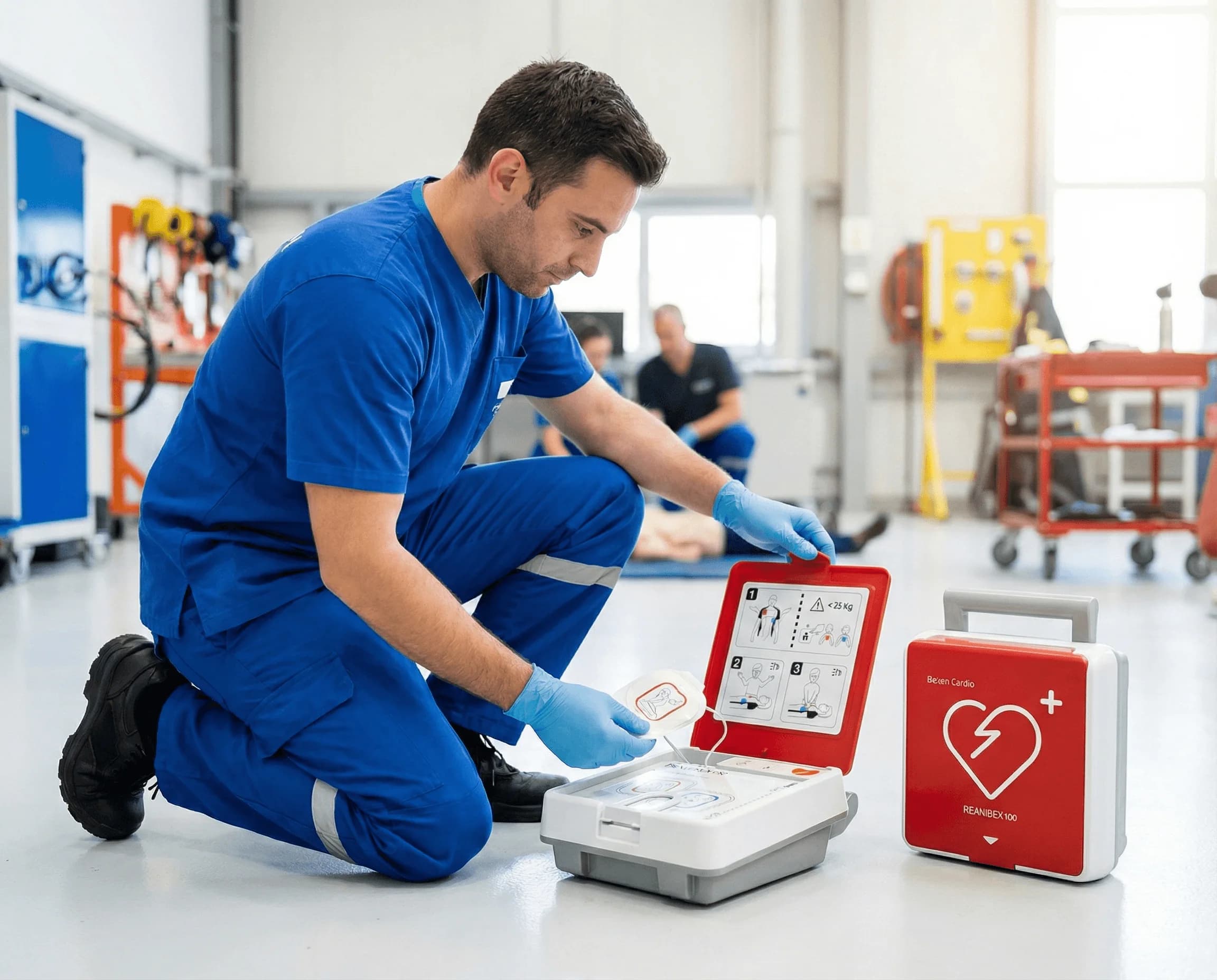
No, the 2007 decree imposes no prior training. The device analyses the heart rhythm itself, decides whether a shock is appropriate and guides the user through voice prompts. A fully automatic model delivers the shock on its own, whereas a semi-automatic model asks the user to press a button. We look at these families of devices in detail in our article on the differences between DAE, DEA and DSA.
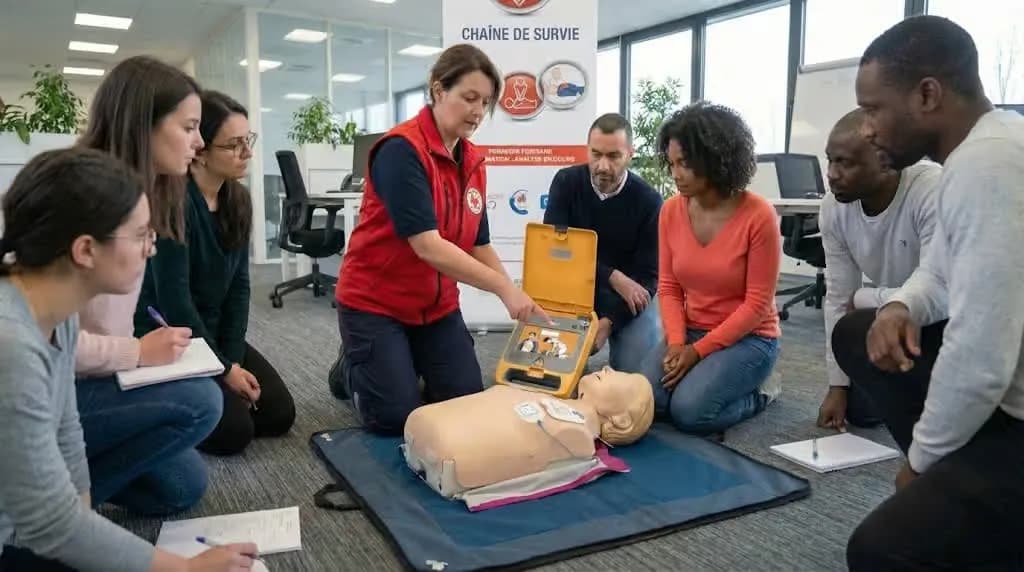
The act of 3 July 2020 nevertheless organises lifelong awareness raising on tackling cardiac arrest: primary and secondary school pupils, employees approaching retirement, sports referees and judges. An employer therefore has a role to play, separate from the obligation to install equipment. Plan a short session when the unit is installed, then an annual refresher.
Training is not there to give you a right you already have. It is there to save time: recognising cardiac arrest within seconds, alternating compressions between two people, placing the pads correctly first time. Out of roughly 50,000 cardiac arrests a year in France, those seconds are what make the difference.
Who can use one, situation by situation
The decree refers to any person, with no further conditions. The table below turns that principle into operating instructions, profile by profile, so that nobody hesitates on the day the alarm goes off.
One point recurs in every line: the person best placed to act is the one standing next to the casualty, not the one named on the organisation chart. Waiting for the first aid coordinator from another building is the costliest reflex there is.
| Bystander profile | Right to use the DAE | To arrange on site |
|---|---|---|
| Untrained employee | Yes, with no conditions (art. R. 6311-15 CSP) | Show them the location on their first day |
| Agency worker, intern, contractor | Yes, same rule as for employees | Include the DAE in the safety induction |
| Customer, visitor, spectator | Yes | Signage visible from the circulation areas |
| Minor witnessing the scene | Yes, the text sets no age condition | Cabinet reachable without a key or step stool |
| Trained workplace first aider | Yes, with no priority over other bystanders | Do not wait for them before opening the cabinet |
| Club or association volunteer | Yes | Raise awareness among referees and sports judges too |
A right to use the device is worth nothing without a working unit
The legal framework opens the door, maintenance does the rest. Expired pads or a flat battery wipe out every benefit the law provides. Allow 2 to 5 years for pads, 3 to 5 years for a battery and 8 to 10 years or more for the device itself: we set out these intervals in our article on the service life of a defibrillator.
There are two ways to keep to that schedule. Either you buy the device, with a 5-year warranty, and track the expiry dates yourself. Or you rent, from 50 euros excl. VAT per month with maintenance included, and consumables are no longer your responsibility to monitor. Our comparison of renting versus buying sets out the criteria to weigh up according to how long the site will be in operation.
Finally, a reminder of the installation timetable for French public-access buildings (ERP): categories 1 to 3 since 1 January 2020, category 4 since 2021 and certain category 5 ERP since 2022. The obligations for each category are detailed in our regulatory guide for businesses and ERP.
Getting your teams ready without turning it into a legal file
Three actions are enough to turn a decorative device into genuinely usable equipment. Display near the bracket a note stating that anyone may use it and that citizen rescuer protection applies. Have people say out loud, in a meeting, the exact location of the cabinets and the number to call. Check twice a year that the route to the device is not blocked by a box or a display stand.
The 2020 act requires the Government to submit an annual report to Parliament with quantified indicators: the number of out-of-hospital cardiac arrest victims, the number of times bystanders performed chest compressions, and the number of times automated external defibrillators were used. Those figures only improve if bystanders feel entitled to act, and that entitlement is settled in your team briefing.
If your site is not yet equipped, a quotation can be sent to you within 24 hours and delivery takes 2 to 5 working days anywhere in France. Our advisers will point you towards the model suited to your visitor numbers, and our buying guide sets out the technical criteria to review before ordering.
Frequently asked questions
Am I allowed to use a defibrillator if I am not a trained first aider?
Yes. Décret n° 2007-705 du 4 mai 2007 (the decree of 4 May 2007) allows any person, including non-doctors, to use an automated external defibrillator meeting the specifications of article R. 6311-14 of the Code de la santé publique (French public health code). No qualification, approval or certificate is required at the moment you assist a cardiac arrest victim.
Am I liable if the casualty does not survive despite my intervention?
Loi n° 2020-840 du 3 juillet 2020 (the act of 3 July 2020) created citizen rescuer status. A bystander who voluntarily assists a person in serious and imminent danger becomes an occasional collaborator of the public service and is exempt from civil liability for harm resulting from that intervention, save in cases of gross or intentional misconduct on their part.
Can a customer or a minor open the cabinet on my premises?
Yes. Article R. 6311-15 of the Code de la santé publique refers to any person, with no condition as to status or age. A visitor, a spectator or a teenager who witnesses the scene may therefore use the device. Your job is to make the cabinet visible and reachable without a key, without a code and without going through anyone.
Do I have to train my staff to use the defibrillator?
Training is not a condition for using the device, which guides the user through voice prompts. The act of 3 July 2020 does, however, organise lifelong awareness raising on tackling cardiac arrest, notably for employees approaching retirement. A short session at installation remains the useful minimum.
What happens if the device had not been maintained when the emergency struck?
Citizen rescuer protection covers the bystander who steps in, not the operator who let the equipment deteriorate. So keep to the intervals: 2 to 5 years for the pads, 3 to 5 years for the battery, 8 to 10 years or more for the device. Renting from 50 euros excl. VAT per month includes this monitoring.
Planning an AED project?
Purchase, rental from 50 EUR excl. VAT per month, installation with GéoDAE registration, servicing and training: our team replies within 24 hours.